A harsh winter forecast weakened when the National Oceanic and Atmospheric Administration took down their La Niña watch in September. Although California superintendents felt let down when El Niño failed to haul in the water needed to normalize operations in 2015-16, those in the North might be relieved to hear that this winter could be milder than previously expected.
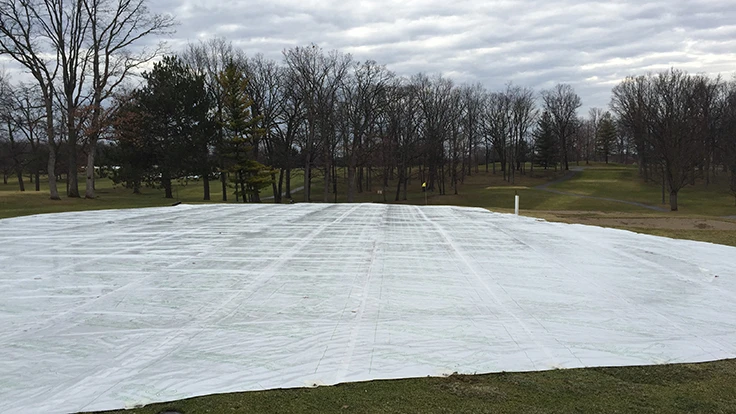
When it comes to winterizing greens, the forecast for a regular winter means the ability to adhere to established practices while taking some new risks. Talk surrounding the benefits of an aggressive fall topdressing program dates back years, but is augmented by continuing research. Meanwhile, industry experts weigh in on the pros and cons of affordable covers and the ever-growing popularity of pigments. Covers
The winter of 2013-14 saw particularly severe winterkill on Poa annua greens across the Midwest and into the Northeast. At the time, Dr. Edward J. Nangle, assistant professor at the Ohio State University Agricultural Technical Institute, was working as director of turfgrass programs for the Chicago District Golf Association. He suspected the issues were brought on by ice encasement as well as direct temperature kill and crown hydration. “I think we saw soil temperatures into the low 40s even in that mid-January time period in Chicago,” he says. “It seemed like the Poa annua started to get active as well. So my perception is that we also had some crown hydration going on, which then caused direct kill of the Poa annua as well.”
A 2014 sampling of turf plugs at Michigan State University’s Hancock Turfgrass Research Center prompted estimates that Poa annua can survive under ice between 45 and 90 days, while creeping bentgrass can survive under ice between 90 and 120 days.
A Chicago District Golf Association survey of superintendents in the district revealed methods they took in the winter of 2013-14 — one of the area’s worst on record — to battle damage, Nangle says. Those who used permeable covers saw mixed results. Many of the superintendents who had negative experiences were unable to prevent eventual snow melt from getting under the covers.
Superintendents who cover during the winter will be best off by waterproofing their greens through processes such as burying the covers around the green edges, Nangle says. Superintendents who use impermeable covers should also pull the covers off as temperatures once again hit 40 to 50 degrees.
Roughly every seven to 10 years, the crew at North Shore Country Club in Glenview, Ill., has to deal with direct winterkill, crown hydration or ice encasement, says superintendent Dan Dinelli. Crew members lay down the woven permeable covers after the course’s Poa annua greens have hardened and soils start to freeze, and remove them when soils begin to thaw. Depending on size, one cover costs roughly $1,200, prior to labor costs. “I like to deep-tine the greens just before covering going into winter with open holes, which is nice to help drain water away from crowns, and the cover prevents the threat of desiccation,” he says.
Permeable covers help reestablish greens in the spring, says Dr. Kevin W. Frank, associate professor and extension turfgrass specialist in Michigan State University’s Department of Plant, Soil and Microbial Sciences. If available, permeable covers should be used to protect greens from low temperatures and desiccation. However, they do not always prevent damage from excessive ice cover.
Impermeable covers, on the other hand, protect greens from ice cover, but need to be applied tightly so water does not get underneath them, Frank says. Applying covers often takes three to four days, but laying down impermeable covers could take longer than permeable covers because it takes time to lay down staples to prevent water from running underneath them. If a superintendent decides to vent, it also takes additional time to lay down tubes. “Covers are certainly not fool-proof, but some clubs are using impermeable covers and venting them throughout the winter to protect their Poa annua greens,” Frank says. “Although I don’t have a large sample size in Michigan, these appear to be successful.” Topdressing
Plant crowns are supposed to lose some moisture in the winter. But wind and dryness in areas such as the Great Plains can push the crown moisture of bentgrass greens below its optimal range, says Dr. Bill Kreuser, assistant professor and extension turfgrass specialist in the University of Nebraska-Lincoln’s Department of Agronomy and Horticulture. “If it’s a hot and sunny winter where it’s just windy and dries out some more, like a desert, then it can get below 50 percent,” he says. “When it starts to get to 40 and 30 percent, then it starts to die off at a lot higher temperature than it would if it was at that ideal peak crown moisture.”
Researchers consistently ward off desiccation with aggressive fall topdressing applications, Kreuser says. In addition to topdressing’s numerous benefits, such as increasing firmness and reducing disease pressure, topdressing in desiccation-prone areas insulates and stabilizes the moisture of turf and prevents moisture from getting lost to the environment. Costs associated with aggressive fall topdressing depend on location and sand type. In Nebraska, sands are relatively inexpensive. Superintendents should match their topdressing sand with the sand in their root zone to avoid layering issues.
Application rates depend on superintendents’ topdressing programs for the rest of the year, Kreuser says. “Topdressing all year-round is the best way to prevent winter desiccation, so you might not think about it in July, but that July topdressing is helping to keep the crown buried,” he says. Superintendents should cut into their green with a knife and look for sand on top of the crown. “You’re talking about hundredths-of-an-inch of sand,” Kreuser says. “It doesn’t have to be a ton, but you just want to keep sure that crown is protected from the changing weather conditions.”
Fall is also a good time for superintendents to topdress because rounds are down and they can put down more sand, Kreuser says. “If you’re going to do it heavy in the season, even just wait until the golf season is really shut down and then go out with an application,” he says. Superintendents can also benefit from applying additional topdressing to greens on top of hills that are exposed and susceptible to desiccation.
Public course managers that stay open on warm winter days could be causing harm to themselves, Kreuser says. Extra tee times are not worth traffic on greens that often exacerbate desiccation pressure and, potentially, entire spring revenues. “A lot of prairie courses out here where carts have to get funneled in or people walk off the same parts of the green — that’s where we see the worst of our damage with the desiccation usually, or one of the areas that can be pretty prone to it,” he says.
Another issue presents itself for those superintendents who apply an eighth-of-an-inch of sand in November. What Kreuser calls such a heavy “cake layer” buries the thatch underneath it, and could either blow off of the turf or damage it.
Pigments Superintendents across the United States use pigments — also known as colorants, paints and dyes —year-round. In the North, pigments can be applied in the late fall to help boost plant health coming out of winter as turf recovers from damage in the spring, says Adam Van Dyke, owner and chief scientist of Professional Turfgrass Solutions. “They warm the canopy by absorbing more light because they’re dark, which may help the plant grow quicker — because coming out of winter dormancy, soils are cold,” he says.
A former superintendent at Mount Ogden Golf Course in Ogden, Utah, and research technician at Utah State University, Van Dyke has conducted numerous field trials with pigments. Where he is located in the Intermountain West — a roughly 5,000- to 7,000-foot elevation – superintendents apply fungicides mixed with pigments to fight snow mold. “In my opinion, and in my work, specifically with snow mold diseases, there has always been a benefit to using a pigment on golf turf,” he says. “Pigments don’t influence disease control, but you generally get better spring green-up and recovery when you use a pigment with a fungicide versus just the fungicide by itself.”
In September, Van Dyke and Nangle instructed a Golf Course Superintendents Association of America (GCSAA) webinar about snow mold sponsored by CIVITAS manufacturer Intelligro. The instructors conducted a small poll of roughly 40 superintendents, which revealed about 70 percent of them use a pigment.
In his field trials in Utah, Van Dyke has never seen label rates of pigments injure turf, and he has found results improve with higher rates. Pigments can range in price from less than $20 to more than $100 per acre, and can be beneficial in a variety of winterizing situations. They will not directly prevent winter desiccation injury to turf, but if the desiccation period is short, and the plant doesn’t die, any pigment remaining on the leaf could have indirect benefits of improved recovery.
Patrick Williams is a Cleveland-based writer and frequent GCI contributor.
Latest from Golf Course Industry
- Tartan Talks 116: Doug Smith
- Audubon International adds 127 golf courses to Monarchs in the Rough
- USGA’s GAP preps for fourth year
- Protect your vehicles from rodent damage
- VIDEO: Fun with fairways
- From the publisher’s pen: Humble giving
- Syngenta adds two to western U.S. team
- The Aquatrols Company introduces soil surfactant for Canada