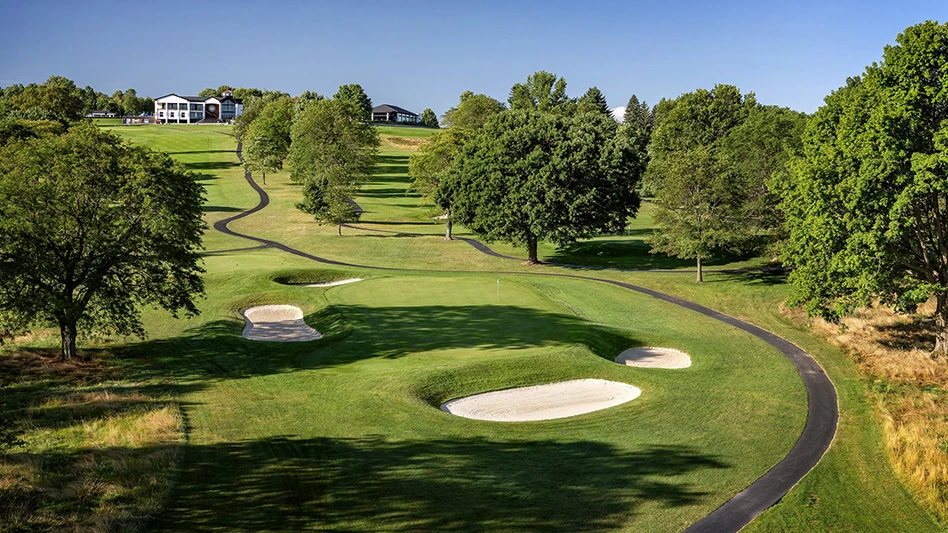
Picture a healthy golf course, a championship-level golf course
such as the TPC at Las Colinas or Colonial Country Club.
It's lush and immaculately groomed. Above all, it's greener than
the Irish countryside.
To keep golf courses St. Patty's Day-green, you need water --
lots and lots of water. After all, the lifeblood of any golf course
is water.
But only up to a point.
"Our main goal from this point is no water," Colonial golf
course superintendent Jeff Elliott said late last week, looking
ahead to the Bank of America Colonial, which begins May 20.
"Basically, we turn the sprinklers off and hand-water if we have
to. Then, we'll pray for dry weather. That's the only thing that'll
make the scores go up."
That's because Colonial is one of the shortest courses on the
PGA Tour. If it's damp and soft, and the wind isn't howling, the
best players on tour will bring the course to its knees. That's not
what club members like to see. But Elliott and his Las Colinas
counterpart, superintendent Scott Miller, have to walk a delicate
line. They want a difficult course for the best golfers in the
world, but they also want the course to be fair and not have the
pros grumbling all week.
At Las Colinas, site of the EDS Byron Nelson Championship that
begins Thursday, Miller is fighting the same
to-water-or-not-to-water fight.
"We want a fast, firm playing surface, but we also want it to
look good," Miller said. "We'll water it as little as possible."
Course preparation for the Byron Nelson and Colonial events
begins months before tournament week. The rough is grown to
frustratingly high levels. For the Nelson and Colonial, it will be
around 3 inches when play begins, about twice what it is the rest
of the year. If the conditions are right, the rough for both
tournaments could reach 5 or 6 inches by the time the leaders tee
off in Sunday's final round.
A few months before tournament week, PGA Tour agronomist Tom
Brown visits and walks the courses with Elliott and Miller, looking
for trouble spots. Not long thereafter, the PGA Tour sends a report
specifying how fast the greens should be and how high the rough
should be.
Elliott and Miller each said the week before his tournament is
his busiest of the year. They add part-time workers every spring to
help work the courses into tip-top shape. Elliott starts adding
staff in early April, and, during tournament week, will have 45 to
50 people to help him keep the course playable. That's more than
double his staff the rest of the year. Miller said he adds about 20
people to his staff.
The greens will be fast and smooth. If they're dry, and the
customary warm Texas winds pick up as expected, low scores will be
tough to come by. But neither the Nelson nor the Colonial is trying
to be the U.S. Open, where the course setup is so difficult that
even par might win the tournament.
"We're in the entertainment business," said Steve Barley, the
Byron Nelson tournament chairman and course superintendent at
Colonial for five years until 1982. "We're a sadistic race. People
go to car races to see wrecks and people like to see train wrecks
on the golf course, too. But, in reality, you don't see people
running over to see guys that are making bogeys. You want to see
guys making birdies."
OK. Make the courses difficult. But not too difficult.
Dow Finsterwald, Colonial's head professional, has played in the
Colonial several times and thinks the course plays three or four
strokes tougher during tournament week than it does the rest of the
year. Of course, he's a player who keeps the ball in the fairway
more often than not.
"You cannot miss a shot," Finsterwald said. "The greens are a
lot harder and faster; the rough is deeper. The course plays hard
to the guy not playing well."
After the final round ends Sunday, and the PGA Tour players move
on to Colonial or head out of town, Miller finally can relax a
little bit. If he gets any feedback from the players, he hopes it's
positive.
"I'd like to hear that they've enjoyed their experience here,
No. 1, and that the greens are fast and firm," Miller said. "I want
to hear that the course is playing fair for everybody."
Source: Fort Worth Star Telegram (Texas)
Latest from Golf Course Industry
- Tartan Talks 116: Doug Smith
- Audubon International adds 127 golf courses to Monarchs in the Rough
- USGA’s GAP preps for fourth year
- Protect your vehicles from rodent damage
- VIDEO: Fun with fairways
- From the publisher’s pen: Humble giving
- Syngenta adds two to western U.S. team
- The Aquatrols Company introduces soil surfactant for Canada