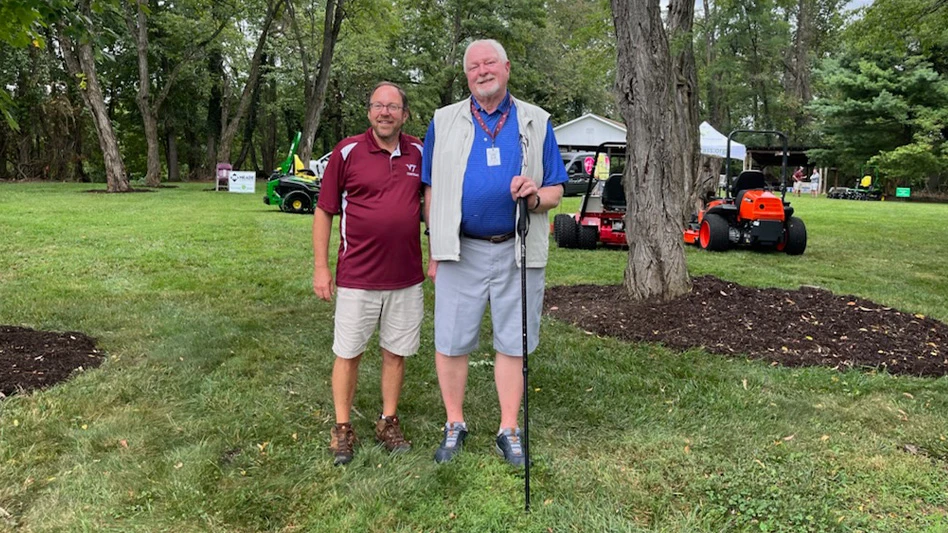
Xunzhong Zhang (top); Lee Carr (4)
We try to surround ourselves with people we care for and who care for us. It’s natural to enjoy conversations with individuals who share common interests, or who inspire us to be better simply by being themselves. Special relationships feel blessed into existence.
The motto for Virginia Tech is “Ut Prosim,” Latin for “That I May Serve.” Admission requires an “Ut Prosim Profile” and the turfgrass team — from students through professors — is serving the industry. At the field day celebrating 50 years of work at the Turfgrass Research Center, opened in 1972, it’s clear that the experiments being conducted are extensive and relevant. It’s applicable academia.
Co-hosted in conjunction with the Virginia Cooperative Extension and the Virginia Turfgrass Foundation, this event started on a Monday afternoon with “Goatley Rules” Golf. Dr. Mike Goatley, professor and extension turfgrass specialist, led the way and the outing was comic and competitive. Photos were taken while people did things like strike a ball from a moving tee. Photos were deleted.
Shifting directions, the good times continued but the tone changed over dinner at Holtzman Alumni Center. Poignant speeches were delivered and the founders and early leaders of the program were recognized. The turfgrass program began in the 1950s when John Shoulders and Dr. Roy Blaser saw a need for a turfgrass research and teaching program at Virginia Tech. They worked with the state highway associations in Virginia and West Virginia, and some professional associations, for support.

Shoulders brought in Dr. Richard “Dick” Schmidt, who worked and taught at Virginia Tech for more than 40 years, attaining professor emeritus status. The Virginia Turfgrass Council was formed in 1960, and the university and industry organizations began to collaborate, including the USGA. Dr. Houston Couch joined the team, studying pathology.
Dr. John “Jack” Hall III joined Virginia Tech in 1976 and later became head of the Department of Crop and Soil Environmental Sciences. He worked with all segments of the industry, curating a special niche with sod producers. Dr. David Chalmers was an extension turfgrass specialist from 1981 to 2002. He shifted to a similar role at Texas A&M, retiring in 2012. At Virginia Tech he directed the NTEP trials, taught turf courses, and advised undergraduate and graduate students.
This year, Schmidt, Hall and Chalmers were present to learn more about the program and be recognized for what they have accomplished. Tuesday morning, field day began with orange juice, doughnuts and a chance to liaise with vendors. Numerous sponsors committed their support, including AQUA-AID Solutions, Syngenta, Revels, Meade Tractor and Bulldog Field Equipment. It felt more like a family reunion than work and people were clearly enjoying catching up.
Greg Caldwell, superintendent for the Pete Dye River Course, was one of the nearly 200 attendees, many of them alumni. As the course is nearby and home of both the men’s and women’s golf teams, Caldwell attends field day whenever possible. “I normally have several trial sites around the golf course for Dr. David McCall, Dr. Shawn Askew and a few others,” Caldwell says. “It's good to see everyone in the same place. I enjoy taking care of the team facility — it’s like a playground for me. Having the turf team on property makes it easy to show them my trouble spots. Any time they’re rating a trial or flying their drones, members notice and tell me how great it is to have them visit.” The relationship is mutually beneficial.

Travis Roberson is a research associate at Virginia Tech, helping operate a remote research facility at Independence Golf Club in Richmond. Companies provide products for him to test and evaluate. “I am working on how drones and other technologies can be used to help superintendents assess and make decisions about issues such as covering greens to prevent winterkill, irrigation efficiency and where it’s best to install soil sensors,” Roberson says. One of his field day responsibilities was helping enforce the rules for Goatley Golf (it’s OK to giggle).
“Ut Prosim was in effect for field day, but it always is. For months, all faculty and students were meeting, planning and deciding what would need to be done to make the 50th field day successful,” Roberson says. “Living out the VT motto is synonymous with a humble heart and that describes the VT turf team, doing what is necessary to benefit the turfgrass industry.”
Having so many prestigious educators in one place was impactful. Seeing the respect the younger students had for the previous generations — and the appreciation and interest the leaders had for the current students — was empowering. Witnessing how considerate team members were was gladsome. They anticipated each other’s needs, graciously holding microphones through demonstrations, guiding attendees, answering questions or adding details. They were in it together.
At one point late in the morning while Goatley was speaking, Chalmers was testing the turf with his walking stick. When it was time for questions, Chalmers asked and Goatley responded. Ideas were exchanged. It was a quick glimpse into the daily, contemplative, problem-solving conversations that have to take place to encourage and elevate understanding. To dig deeper. The answers come more readily, the progress is greater when researchers cooperate, and better yet, when academicians and industry professionals share eyes and ears.

Raised in Michigan, Chalmers went to Virginia Tech to become familiar with warm-season grasses and study under Schmidt to attain his master’s degree. A mentor to many, he has cherished training students and watching them succeed. He has also enjoyed determining best management practices and educating others about respecting environmental issues such as nutrient management or water use.
“I am impressed by how dynamic, collaborative, balanced and productive the program is,” Chalmers says. “The field tours were great.” He appreciated the effort the Virginia Tech turf team made to celebrate the 50th year and the chance to renew relationships. “The turf program has been made possible by the College of Agriculture and Life Sciences supporting faculty and staff positions, as well as the facilities,” Chalmers says. “Industry has been supportive too. The turf industry should not take that for granted. External support through collaboration with state turfgrass associations and industry sponsors is essential to maintain such a dynamic program.
“I would encourage practitioners to be at field day and demonstrate their support. Good things happen when one chooses to show up and learn a few new things along the way. It hit me during field day just how well faculty and staff continue to relate to industry needs.”
From the classrooms to the fields to the course, and from the past to the present, the people involved with the VT turfgrass program are working hard, together. Essential research is being executed and the findings are shared with integrity and honesty. Like golf course maintenance, it’s never easy, but sometimes the people in charge manage to make it look that way. Through the common goal of learning about turf, the Virginia Tech team is serving one another and the industry. Cheers to another 50 years for caring about people, and work.
Lee Carr is a northeast Ohio-based writer and senior Golf Course Industry contributor.
Latest from Golf Course Industry
- Tartan Talks 116: Doug Smith
- Audubon International adds 127 golf courses to Monarchs in the Rough
- USGA’s GAP preps for fourth year
- Protect your vehicles from rodent damage
- VIDEO: Fun with fairways
- From the publisher’s pen: Humble giving
- Syngenta adds two to western U.S. team
- The Aquatrols Company introduces soil surfactant for Canada