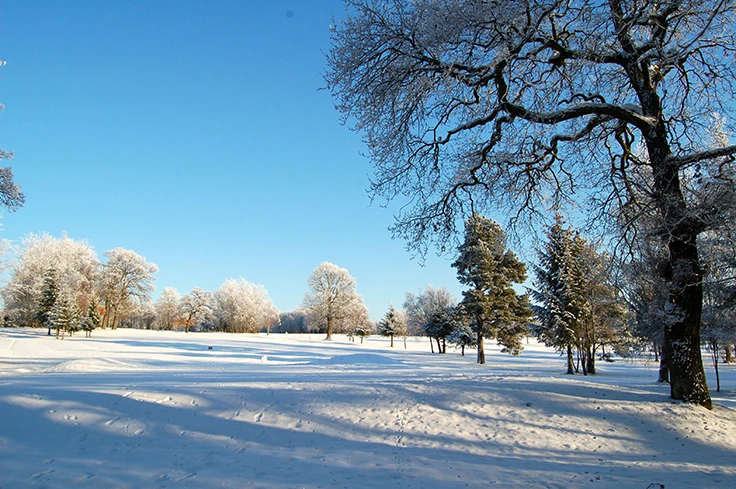
While many golfers in northern climates hibernate for the winter, golf course superintendents must remain ever vigilant. Some have been dealing with wintry conditions for some time but even those in the Northeastern U.S., where El Niño has raised temperatures to record levels, know that sooner or later they will again be confronted by snow, ice and chilly winds.
USGA agronomist Jim Skorulski gave a presentation at the recent New Jersey Turfgrass Association conference in Atlantic City during which he emphasized the importance of preparing in advance for winter weather. Skorulski joined the USGA staff in 1989 and serves the Northeast.
“You’ve got to do whatever you can with what’s available to you to produce a turf that’s going to have the best chance of surviving a winter season, the cold temperatures, the ice encasement, the freeze-frost cycles that we’re ultimately going to experience,” he says.
Skorulski says it’s important for facilities to have turfgrass that is suited to their particular climate. Bentgrass tends to fare better in the cold temperatures found in Northeast and Midwest than Poa annua, which is more sensitive to cold.
“The bentgrass can tolerate up to minus-28 degrees Fahrenheit while Poa might only be able to tolerate 1 degree to minus-6 degrees Fahrenheit,” Skorulski says. “And that’s at its best. As the season goes on and the grass is exposed to field conditions, freeze-frost cycles and things like that, those temperatures will actually (change). The Poa will not be able to tolerate (1 to minus-6 degrees). It will be more like 10-15 degrees Fahrenheit and then you’ll start to see some damage.”
Ice is an issue for superintendents during the winter months, but Skorulski says the first hard freeze or winter storm is not necessarily a time for drastic action. He says the situation must be monitored.
“I’d recommend you get out and check the conditions under the ice,” Skorulski says. “If you have an anaerobic or anoxic condition, you’ll have that sweet, fermentation-type smell; then you know you have an anaerobic condition. And at that point probably the turf is starting to deteriorate. It’s not an immediate problem but it’s something that you have to be aware of.”
Skorulski says bentgrass can usually tolerate 30-40 days of ice cover without major problems but with Poa annua the condition can start at about 20 days. There have been instances where problems have arisen in as few as 14 days.
But removing the ice as soon as it appears carries its own potential problems. “There’s a lot of risk in doing that, because you’re exposing the grass to cold temperatures,” Skorulski says.
In some northern locales, covering greens during the winter months is a popular practice, notably in Canada and the Upper Midwest. But Skorulski says superintendents based in more southern latitudes, including the Mid-Atlantic states, must proceed cautiously if they decide to cover their greens.
“You have to worry about the covers spiking temperatures or maybe getting too hot,” he says. “If you have an open winter and a very exposed green site, the cover temperatures could actually be higher than the air temperature. The grass under the covers could get higher than the air temperature.
“If you are going to use them further south, you need to be aware of that. You’re going to need to vent them, pull them back, and work around the warmer temperatures. And by all means go to white covers because the white reflects the sun and that will give you the best chance of reducing the temperature spike.”
Superintendents have an assortment of tools at their disposal for dealing with winter weather. But the bottom line is there is no method or system that will completely eliminate the risk of cold-weather injury.
“You can take every measure that’s available to you,” Skorulski says, “but then the weather conditions line up and we have a Nor’easter event. The weather conditions change so much from warm to cold and you get a really rapid freeze. That’s when you’re more apt to have damage.”
Rick Woelfel is a Philadelphia-based writer and frequent GCI contributor.





