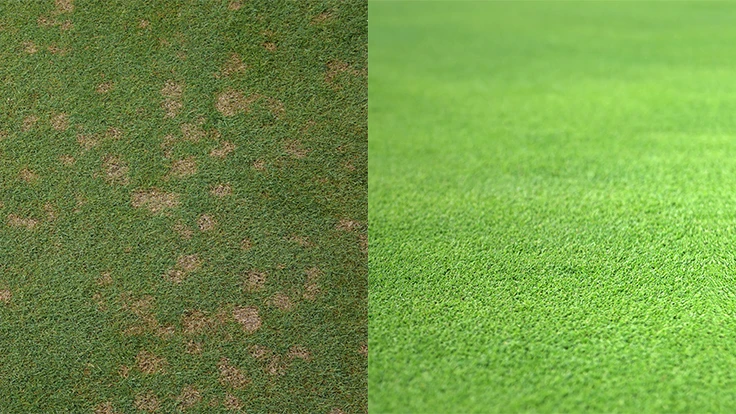
When considering a sound turf disease management program for your golf course there are several factors that must first be considered. Turf managers know there are four components of establishing a turf disease; the host, the pathogen, the environmental conditions, and time. Good cultural turf management programs are extremely important in minimizing major outbreaks, but ultimately it is Mother Nature that holds the disease trump card. While all turf species are susceptible to some diseases, it is turf species found primarily in the transition zone and northward that tend to be most at risk.
Diseases such as dollar spot, brown patch, Pythium, anthracnose, summer patch, gray leaf spot and snow mold tend to be the more major diseases and these disease can occur in tandem, depending on the turf species susceptibilities and the extremities of the environmental conditions. Thus, it is imperative to set up a sound disease management program that includes rotation of several different fungicide chemistries to cover your primary risks.
As every chemical class has its strengths and weaknesses, it is important to know your enemies and understand how to best prevent your threats. In turf disease management, an ounce of prevention is worth a pound of cure. At the foundation of any good disease management program is a good contact fungicide, such as Pegasus® DFX or Pegasus® 6L (chlorothalonil). In the chloronitrile class (FRAC Code M5), chlorothalonil has been the best contact molecule in the turf market for over 50 years. But with EPA restrictions on chlorothalonil and the potential for more pending restrictions, rotating in a different contact, such as Manzate® Max or Manzate® Prostick™ T&O (mancozeb; FRAC Code M3) every other spray can help supplement your disease control and maximize your CLT limitations issues. Manzate® covers a large spectrum of turf diseases and is often used as a cost effective Pythium knockdown product.
The DMI class of chemistries (FRAC Code 3), are acropetal penetrants. This class of products, such as Kestrel® MEX (propiconazole) or Tebuzol® (tebuconazole), while tending to be strongest on dollar spot, are also relatively strong on many of the other turf diseases (brown patch, gray leaf spot, snow molds, etc.) and should, in most cases, be a primary component of your programs. It should be noted that there are some extremely powerful combination products, such as Goliath™ XP, which combine azoxystrobin (QoI: FRAC Code 11) and propiconazole. Goliath™ XP covers over 24 turf diseases, including all the primary soil and foliar diseases, for up to 28 days.
The dicarboxamide class of fungicides has been thinned over the years with vinclozalin recently going away, but a product such as Raven® (iprodione; FRAC Code of 2), functioning as a penetrant, is still a solid dollar spot and brown patch product option.
The benzamidizole class, functioning as acropetal penetrants, are an older class of chemistries (FRAC Code 1), but with products such as T-Bird® 4.5F, still have their niches on diseases like gray leaf spot, summer patch, and snow molds. For those interested in cost-effective combinations, Dovetail® (iprodione + thiophanate methyl) is a combination of a dicarboxamide and a benzimidazole, and will cover a wider base of diseases.
While we’ve not covered all the turf fungicide classes (phenylpyrole, SDHI, and many Pythium fungicide chemistries), the key take home point to sound disease management program is to rotate your chemistry options as best you can to maximize your control and minimize your chance at resistance. For more information on UPI Solutions control products, please visit www.UPI-USA.com.
Diseases such as dollar spot, brown patch, Pythium, anthracnose, summer patch, gray leaf spot and snow mold tend to be the more major diseases and these disease can occur in tandem, depending on the turf species susceptibilities and the extremities of the environmental conditions. Thus, it is imperative to set up a sound disease management program that includes rotation of several different fungicide chemistries to cover your primary risks.
As every chemical class has its strengths and weaknesses, it is important to know your enemies and understand how to best prevent your threats. In turf disease management, an ounce of prevention is worth a pound of cure. At the foundation of any good disease management program is a good contact fungicide, such as Pegasus® DFX or Pegasus® 6L (chlorothalonil). In the chloronitrile class (FRAC Code M5), chlorothalonil has been the best contact molecule in the turf market for over 50 years. But with EPA restrictions on chlorothalonil and the potential for more pending restrictions, rotating in a different contact, such as Manzate® Max or Manzate® Prostick™ T&O (mancozeb; FRAC Code M3) every other spray can help supplement your disease control and maximize your CLT limitations issues. Manzate® covers a large spectrum of turf diseases and is often used as a cost effective Pythium knockdown product.
The DMI class of chemistries (FRAC Code 3), are acropetal penetrants. This class of products, such as Kestrel® MEX (propiconazole) or Tebuzol® (tebuconazole), while tending to be strongest on dollar spot, are also relatively strong on many of the other turf diseases (brown patch, gray leaf spot, snow molds, etc.) and should, in most cases, be a primary component of your programs. It should be noted that there are some extremely powerful combination products, such as Goliath™ XP, which combine azoxystrobin (QoI: FRAC Code 11) and propiconazole. Goliath™ XP covers over 24 turf diseases, including all the primary soil and foliar diseases, for up to 28 days.
The dicarboxamide class of fungicides has been thinned over the years with vinclozalin recently going away, but a product such as Raven® (iprodione; FRAC Code of 2), functioning as a penetrant, is still a solid dollar spot and brown patch product option.
The benzamidizole class, functioning as acropetal penetrants, are an older class of chemistries (FRAC Code 1), but with products such as T-Bird® 4.5F, still have their niches on diseases like gray leaf spot, summer patch, and snow molds. For those interested in cost-effective combinations, Dovetail® (iprodione + thiophanate methyl) is a combination of a dicarboxamide and a benzimidazole, and will cover a wider base of diseases.
While we’ve not covered all the turf fungicide classes (phenylpyrole, SDHI, and many Pythium fungicide chemistries), the key take home point to sound disease management program is to rotate your chemistry options as best you can to maximize your control and minimize your chance at resistance. For more information on UPI Solutions control products, please visit www.UPI-USA.com.
Latest from Golf Course Industry
- Tartan Talks 116: Doug Smith
- Audubon International adds 127 golf courses to Monarchs in the Rough
- USGA’s GAP preps for fourth year
- Protect your vehicles from rodent damage
- VIDEO: Fun with fairways
- From the publisher’s pen: Humble giving
- Syngenta adds two to western U.S. team
- The Aquatrols Company introduces soil surfactant for Canada