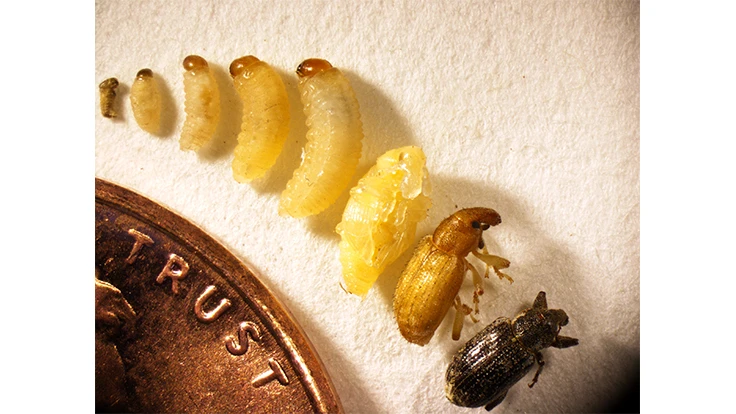
 What have ABW pressures been like this spring?
Dr. Ben McGraw: It’s somewhat difficult to ascertain until larvae are in the ground. Right now, what we can be base it on is adult captures and kind of predict what that would look like for larvae. A lot of my sites are fairly low, so I feeling pretty confident going into the summer with at least the properties that I either do research with or consult with.
Did the insect emerge more or less on time?
From (Southeastern Pennsylvania) to Ohio we do have some research collaborations going on. It really seemed like an odd spring in that we were very stratified across the region. It seemed like south of Pennsylvania, the Maryland, Virginia D.C. populations came out very early, something I think you would somewhat expect but it seems like a huge disconnect across the region. The (D.C. area) stuff seemed really early, (Pennsylvania) is kind of right in the middle, and then everybody to the north of us, like New York, just recently had their adult peak.
So it’s quite a big difference within the region as far as when these things are developing but talking to my colleagues and seeing what I’ve seen, I think, based on weather and plant indicators, it seems to be setting up for a very predictable spring. I don’t foresee too many surprises. And the encouraging part is, it seems like there’s nothing really astronomical in terms of the adult counts that we saw. So hopefully, that translates into everyone getting really good control.
Are superintendents more alert to ABW than they used to be?
It seems like people are really on the ball in terms of where we were five years ago compared to now, I think people are really reducing their sprays which is a positive. I think that’s a good impact for what we’ve been trying to do in the scientific community in terms of getting the information out. I think people are much better educated about the biology of the pest when these things happen and so I’m seeing a whole lot less wasteful application. I think there are still some people out there who a little bit confused by timing or a little bit fearful of having damage but I think the vast majority have really gotten the message and are reducing sprays. That seems somewhat counter intuitive that less spraying equals better control but I think people are getting much, much better about their timing. So maybe in five years we won’t be able to collect enough specimens to do research.
How is the pest moving/advancing this season?
In the DC population you might see damage starting to appear this week (the week of May 15), in (Pennsylvania and Ohio) kind of the middle band of the region you’ll probably see damage starting to appear in two weeks, in New York in about three weeks and add that up as you go north. And that’s really when people start to realize it’s moved into a new region, when you lose turf. Unless you had really, really high adult populations and were seeing it in mower baskets and stuff like that, I don’t know if people recognize that it’s moved into a new region this early in the year. Usually you have to get bit and bit pretty hard to realize that you’ve got a problem for the first time.
Is ABW having an impact in other parts of the country?
It's pretty early in the invasion curve in places like Ohio. We’re still expecting to move further west. I don’t see why it wouldn’t. There are plenty of turf grasses for it to develop in in different areas and as we saw with this insect moving into the Mid-Atlantic (region), I think we’ll continue to see it feed on new turfgrass species too. So there are a lot of mysteries to be solved.
What advice would you have for a superintendent dealing with ABW for the first time?
I think the big thing is not panicking. Try to read up on it as much as you can. Talk to university people, that’s always a good way to go. What I would recommend is getting an idea of what stages you’re dealing with and what’s the extent, what’s the acreage that it’s occurring on. All kinds of basic things that seasoned veterans of this insect have learned over many years.
In terms of controlling ABW, is less more when it comes to spraying?
If you look at a lot of superintendents out there they kind of go through this evolution of dealing with this insect. At first, you might dump the kitchen sink at it. That might work for a little while and then in time that seems to not be either economically or environmentally viable. We know very little about the impact natural enemies have on these populations but you would think if you’re applying a broad-spectrum insecticide to control these populations you’d also be knocking out some of the good guys that are proving some services for you. That’s highly speculative at this point. But it really does seem that people who take their foot off the pedal as far as applying insecticides in either a huge amount of space like wall to wall or frequently throughout the year or a combination of those two; those are the ones who really seem to come through all right by really reducing it to one, well-timed spray. For instance, the adults are basically a moving target. They emerge over several weeks and the people who wait until they’ve all emerged in one area, such as fairways, or any of the short-turf areas, and then decide to spray, those are the people who get the best control. The people who go too early because they’re fearful, or when they first start to see them on a warm day in February or March, they have to follow that up with sequential, adulticide applications. Those are usually the properties where we have the biggest outbreaks. Apart from the environmental disaster that that is, you would think that they would be getting more control.
Why doesn’t more frequent spraying heighten the level of control?
One component is the development of resistance. That wouldn’t necessarily show up with a new property or in an area where the insect has recently invaded but it will. That strategy would lead to not only decreased control with one product, but potentially other, unrelated products. Think of antibiotic-resistant microbes in a hospital. There is an analogy to the insect world too. Creating a sterile environment is really not the best approach.
What have you and your colleagues observed in terms of ABW’s resistance to older chemistries? Are you seeing an increase in resistance?
We’re definitely seeing resistance increasing. The resistance to the pyrethroids is pretty well documented.
We often receive samples or I’ll work with a golf course that has asked us to test for resistance and what we do is a very crude (assessment) to see how well products that they would have available to them in the field perform against their population. Typically, this is done before any sprays have gone out, at the very beginning of the year. It’s very rare for me to find a population these days that is truly susceptible to the pyrethroids. And really, anybody who has ever applied a pyrethroid is moving their population towards the end of the spectrum that is highly resistant. It might be many, many years before that happens and we’ve had a really good run with the pyrethroids; I think they were released in the 1990s. So if you think about it that way, a 25-year history with a product is pretty good in the insect world.
So the people have used pyrethroids repeatedly within a season (since the ABW is multigenerational) they’re going to be moving their populations closer to (the upper end) of the resistance spectrum. You’re moving toward that issue the more you apply of anything. And these insect populations, particularly the ABW since it has multiple generations per year, has the ability to develop resistance to an insecticide much quicker than something that only has one generation per year. So over that time period, and especially if you’re treating the all acreage that you have under your command, wall to wall and tree line to tree line, then you’re really … moving it toward resistance much quicker.
The problem with this insect is we don’t have a lot of adulticides to rotate through. And the adulticides we currently have are broad spectrum, do they’re going to wipe out everything they come in contact with. While pyrethroid resistance is fairly well documented, what’s not really clear is what we believe happens at the very high end of resistances where some have suggested multiple resistances occurring. That chemistries that are not related to the pyrethroids, or have other modes of action also seem to be working less effectively against these insects.
How should a superintendent deal with a highly resistant ABW population?
There are a couple approaches people have taken. Some take it upon themselves to just apply more frequently which isn’t sustainable. It isn’t really a strategy that I would recommend. We do have two products currently that are larvaecides that seem to work effectively against resistant populations. The problem with that is, now you’re letting the population lay eggs. You have larvae out there that could potentially cause turf damage. You’re asking an awful lot of these larvaecides to work and work quickly against a very traumatic pest. So really, it’s a difficult spot to be in if you have a highly resistant population. I think the resistance story is not really fully told at this time. I think there is a lot that’s going on that needs to be look at in greater detail to understand the mechanisms of resistance. That will have big implications about how we manage those populations in the future.
You’ve done some field trials with UPI’s Avatar PLX. What did you learn about its effectiveness against the ABW?
We’ve had one season of trails; we have another going on right now. It’s a little too early to tell. That product is not widely used in the Northeast. We did see some pretty interesting results that make us hopeful. I think there are there going to be several compounds that potentially control adult activity. That would be a big help as far as controlling this insect. Traditionally we have wanted to manage this insect before it lays eggs because wants it’s in the plant it’s pretty difficult to control. That’s kind of been one of the options in the past, we haven’t had a whole lot of options for adult control. The pyrethroids were very effective so people just chose that all the time. We would like to see more data on that. It’s a too early to say but there’s definitely some promise there.
Latest from Golf Course Industry
- Tartan Talks 116: Doug Smith
- Audubon International adds 127 golf courses to Monarchs in the Rough
- USGA’s GAP preps for fourth year
- Protect your vehicles from rodent damage
- VIDEO: Fun with fairways
- From the publisher’s pen: Humble giving
- Syngenta adds two to western U.S. team
- The Aquatrols Company introduces soil surfactant for Canada