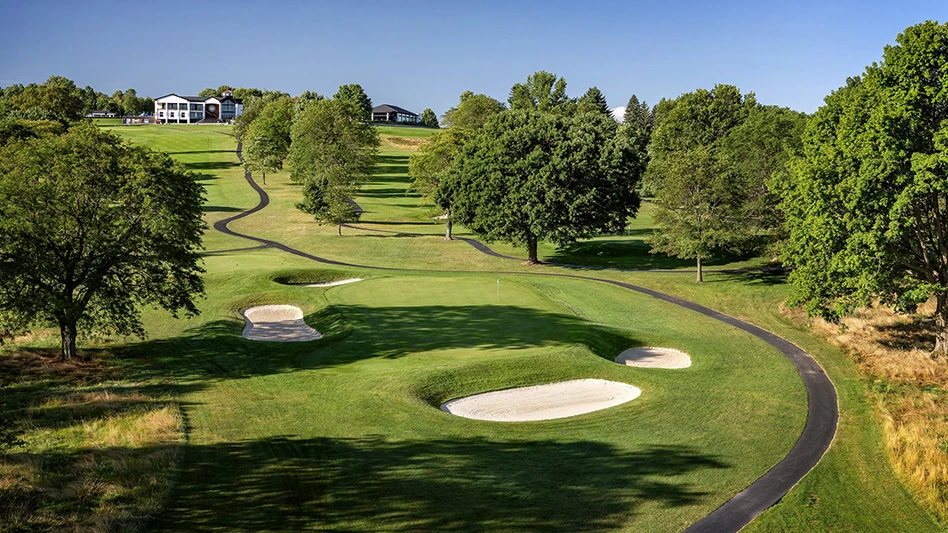
Thanks to a new $32-million clubhouse at TPC Sawgrass, the home of professional golf’s annual The Tournament Players Championship has almost as many sustainable and ecofriendly practices inside as it does outdoor on the course.
The 30-year-old Ponte Vedra Beach, Fla.-based facility is a role model of environmental stewardship and sustainability programs with its Audubon certification, water conservation and energy reduction programs in outside operations. The 77,000-square-foot clubhouse carries on the sustainable tradition with a customized desiccant energy recovery, dedicated outdoor air system that saves the facility tens of thousands of energy dollars annually. The DOAS, which ties into the clubhouse’s overall HVAC water source heat pump loop for additional efficiency, dehumidifies the clubhouse’s 28,000-cfm of Florida’s year-round humid outdoor air that’s necessary for indoor air comfort all while using 140 tons less refrigeration than a conventional HVAC system.
Project consulting engineer, Atlanta-based BAA Mechanical Engineers, had three HVAC challenges arise during the design stage that’s typical of Florida golf clubhouses:
1. Dehumidifying the outdoor air to code compliance and eliminate Florida’s typically high relative humidity thus preventing the likelihood of indoor mold/mildew
2. Finding space for equipment large enough to dehumidify an estimated 974-lbs./hr (117-gal./hr) of humid outdoor air without taking excessive roof or site space
3. Designing the system to meet TPC Sawgrass’s strict ongoing sustainability mission.
John Mayes, P.E., vice president of BAA, specified two 100-percent outdoor air energy recovery units by New Castle, Pa.-based Berner Energy Recovery, which use enthalpy wheels combined with a recuperative loop process via their patented TRICOIL technology. The units come with a factory-piped WSHP option, which eliminates the bulk and expense of exterior conventional condensers and allows heat rejection to the clubhouse’s WSHP loop.
“The units guarantee that no outdoor air is introduced into the space with greater moisture content than a 55°F dew point, according to Bill McClure, president of Atlanta-based Allied Environmental Systems, a manufacturer’s representative that coordinated equipment specifications between BAA and BERI.
On a design 97°F Florida summer day with 114.7 grains of moisture, the DOAS’s 80-percent efficient enthalpy wheel cools the outdoor air to approximately 82°F and 78 grains of moisture. Then the air passes through the TRICOIL’s precooling coil (first coil), where it continues to recover sensible energy from the outdoor air, and lowers it further to 67°F. A driver coil (second coil) connected to the WSHP condensing unit then dehumidifies the air further to the desired 55°F dew point. A thermostatic control on the coil’s leaving air side assures the air temperature doesn’t rise above the 55°F dew point. The air is then freely reheated to 69°F free with a third coil, a sensible reheat coil that accounts for an additional 40 tons of free reheat or equivalent refrigeration tonnage saved versus conventional systems using natural gas or electric heaters for reheat.
“There is nothing else like this - an enthalpy wheel that’s synergistically and compatibly combined with a recuperative loop - in the industry,” McClure says. “Ton for ton, the performance of this dedicated outdoor air system is the most efficient in the world.”
In wintertime operation when the outdoor air is below 55°F, the air is heated by the DOAS’s on-board WSHP that draws heat from the reverse cycle refrigeration loop to heat the air to 75°F.
Since the TPC Sawgrass has a wide swing between everyday occupancy and tournament or special event times when less-used second-floor meeting rooms are filled to capacity, Mayes has designed for maximum efficiency by having one DOAS operating during everyday operation and the second unit operates on demand for the second-floor meeting rooms.
The BERI system design also features the smallest footprint per cfm in the industry, thus allowing the two units to fit the small roof wells designed by project architect, Atlanta-based Chapman Coyle Chapman Architects. This design keeps HVAC equipment off the grounds and out of sight.
“We like the TRICOIL approach from the standpoint that it requires the industry’s least amount of refrigeration tonnage per cfm of outdoor air, plus there isn’t another DOAS brand that would have fit in the tight roof well space the architect wanted to employ,” Mayes says.
Installed by Jacksonville, Fla.-based W.W. Gay Mechanical Contractor, the DOAS supplies outdoor air to the loop’s several dozen horizontal heat pumps recessed in ceilings and vertical units in dedicated closets all manufactured by Ft. Lauderdale, Fla.-based FHP Corp. Heat rejection is handled with a 900-gpm evaporative closed circuit cooling tower by Taneytown, Md.-based Evapco, a methodology choice that saved space as well. The loop’s water/glycol loop is circulated via two 20-hp pumps manufactured by Toccoa, Ga.-based Patterson. Also specified was a boiler by Lebanon, Tenn.-based Lochinvar. Because of the clubhouse’s huge size, the system is controlled and monitored by an Automated Logic building management system.
The TPC Sawgrass HVAC design has been successful on many other BAA golf course clubhouse projects. Alternative systems such as conventional DX split systems typically require 20 percent more energy costs than WSHP loop systems. Additionally, when they’re combined with outdoor air dehumidifiers, they require too much interior mechanical room or rooftop space. Exterior ground level DX unit placements also tend to emit mechanical noise to nearby tees and greens. Chilled water loops are a possible alternative to the WSHP loop, but tend to be 25-percent more costly in equipment, installation and operating costs, Mayes says.
“This is a good middle-of-the-road approach we’ve had great success with that’s both economical to install and operate, especially for golf course clubhouses in the humid Southeast,” he says. “Even if this type of DOAS system wasn’t as efficient as it is, we’d probably still use it for dehumidifying the outdoor air, because it’s providing an incomparable indoor air comfort for the occupants."
Latest from Golf Course Industry
- Tartan Talks 116: Doug Smith
- Audubon International adds 127 golf courses to Monarchs in the Rough
- USGA’s GAP preps for fourth year
- Protect your vehicles from rodent damage
- VIDEO: Fun with fairways
- From the publisher’s pen: Humble giving
- Syngenta adds two to western U.S. team
- The Aquatrols Company introduces soil surfactant for Canada