Brandon Richey made a 90-mile trek through rain-starved Florida last week to serve as the only superintendent in the room.
Richey, the superintendent at Lake Nona Golf & Country Club in Orlando, represented the golf industry in a panel discussion about social media at the 28th annual Turf and Ornamental Communicators Association meeting at Saddlebrook Resort outside Tampa. Orlando City FC head groundskeeper Matt Bruderek, APL Lawn Spraying owner/operator Rick Orr and Cherrylake Tree Farm President Timothee Sallin joined Richey on the panel. Their conversation revealed similarities and differences between how Richey uses social media compared to other turf industry leaders.
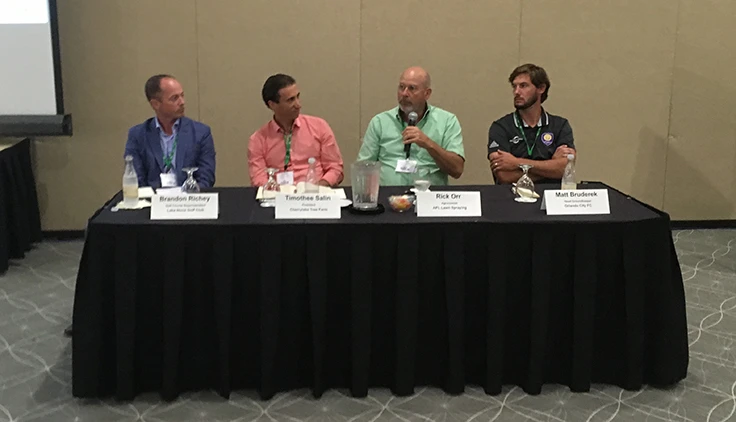
(Pictured from left Lake Nona Golf & Country Club superintendent Brandon Richey, Cherrylake Tree Farm President Timothee Sallin, APL Lawn Spraying owner/operator Rick Orr and Orlando City FC head groundskeeper Matt Bruderek.)
Richey’s professional social media usage revolves around Twitter, where he has more than 1,600 followers. His following quickly increased this past winter when Lake Nona resident and former Ryder Cup hero (or villain depending on your perspective) Ian Poulter praised the course’s conditions. “It was really neat to see the benefit of the outreach for our club and how we can get our club and our profession out there,” Richey says.
Holding the head agronomic position at Lake Nona since 2014, Richey uses Twitter to stay connected with the industry. He started understanding the prominence of social media during the interview process for his current job. A Lake Nona search committee trimmed the list of applicants to eight finalists, and close to five minutes of an ensuing hour-long interview focused on how Richey planned to use social media. “It put a lightbulb in me,” he says. Richey tweets from the account @BKRichey, and he speaks as a unified voice for the Lake Nona golf course maintenance department.
In most cases, sports turf managers use Twitter for similar reasons as golf course superintendents. The opportunity to exchange ideas about products, equipment, weeds and disease attracted Bruderek to the social media platform.
Orlando City FC recently opened a soccer-specific stadium, and Bruderek document the progress to colleagues via Twitter. The stadium is the home venue for Major League Soccer and National Women’s Soccer League franchises. Like a golf course superintendent, Bruderek will host multiple events in short periods of time, so turf stress and recovery are topics he might pursue with colleagues. “Most people in my industry are willing to help you,” he says. “Just like if somebody asked me, I would be willing to help them.”
It’s less congenial in the lawn care segment of the turf business. Orr and his competitors own companies competing for business in Pinellas County, Fla. “Lawn spraying companies hold their cards pretty close to their chest,” he says. “There’s not a lot of communication within our community of lawn spraying guys. It’s a little more cutthroat.”
Orr uses social media, along with his blog www.iloveturf.com, to educate residents about managing St. Augustinegrass, a popular home lawn variety in the region. The information he provides is specific to the county’s soils, regulations and environmental conditions, and social media allows him to target potential customers. “The website made me appear much bigger and much more glorious than some guy driving a truck down the road,” Orr says. Neither Richey nor Bruderek use social media to attract potential members or fans, although their accounts generate indirect interest for Lake Nona and Orlando City FC.
Sallin, who employs a full-time marketing team, strays from using social media to promote Cherrylake, a subsidiary of Florida agribusiness firm IMG Enterprises. “Social media is about communicating ideas,” he says. Sallin views social media conversations as “one-on-one chats,” and he’s experienced success using it to communicate with the company’s Hispanic workforce. He adds that social media will help his company drive future discussions about water conservation and irrigation practices. The majority of Central Florida is in severe or extreme drought, according to the U.S. Drought Monitor released May 2.
Richey also says social media offers opportunities for the golf industry to present similar conservation messages.
“Our biggest fear going forward is that there’s going to be a reduction of resources that you can use,” Richey says. “I really hope that we can continue to use social media to put our service and stewardship out there to government officials and to the general public and make them realize how efficient we are in using resources and things of that nature.”
Guy Cipriano is GCI’s associate editor.
Richey, the superintendent at Lake Nona Golf & Country Club in Orlando, represented the golf industry in a panel discussion about social media at the 28th annual Turf and Ornamental Communicators Association meeting at Saddlebrook Resort outside Tampa. Orlando City FC head groundskeeper Matt Bruderek, APL Lawn Spraying owner/operator Rick Orr and Cherrylake Tree Farm President Timothee Sallin joined Richey on the panel. Their conversation revealed similarities and differences between how Richey uses social media compared to other turf industry leaders.
(Pictured from left Lake Nona Golf & Country Club superintendent Brandon Richey, Cherrylake Tree Farm President Timothee Sallin, APL Lawn Spraying owner/operator Rick Orr and Orlando City FC head groundskeeper Matt Bruderek.)
Richey’s professional social media usage revolves around Twitter, where he has more than 1,600 followers. His following quickly increased this past winter when Lake Nona resident and former Ryder Cup hero (or villain depending on your perspective) Ian Poulter praised the course’s conditions. “It was really neat to see the benefit of the outreach for our club and how we can get our club and our profession out there,” Richey says.
Holding the head agronomic position at Lake Nona since 2014, Richey uses Twitter to stay connected with the industry. He started understanding the prominence of social media during the interview process for his current job. A Lake Nona search committee trimmed the list of applicants to eight finalists, and close to five minutes of an ensuing hour-long interview focused on how Richey planned to use social media. “It put a lightbulb in me,” he says. Richey tweets from the account @BKRichey, and he speaks as a unified voice for the Lake Nona golf course maintenance department.
In most cases, sports turf managers use Twitter for similar reasons as golf course superintendents. The opportunity to exchange ideas about products, equipment, weeds and disease attracted Bruderek to the social media platform.
Orlando City FC recently opened a soccer-specific stadium, and Bruderek document the progress to colleagues via Twitter. The stadium is the home venue for Major League Soccer and National Women’s Soccer League franchises. Like a golf course superintendent, Bruderek will host multiple events in short periods of time, so turf stress and recovery are topics he might pursue with colleagues. “Most people in my industry are willing to help you,” he says. “Just like if somebody asked me, I would be willing to help them.”
It’s less congenial in the lawn care segment of the turf business. Orr and his competitors own companies competing for business in Pinellas County, Fla. “Lawn spraying companies hold their cards pretty close to their chest,” he says. “There’s not a lot of communication within our community of lawn spraying guys. It’s a little more cutthroat.”
Orr uses social media, along with his blog www.iloveturf.com, to educate residents about managing St. Augustinegrass, a popular home lawn variety in the region. The information he provides is specific to the county’s soils, regulations and environmental conditions, and social media allows him to target potential customers. “The website made me appear much bigger and much more glorious than some guy driving a truck down the road,” Orr says. Neither Richey nor Bruderek use social media to attract potential members or fans, although their accounts generate indirect interest for Lake Nona and Orlando City FC.
Sallin, who employs a full-time marketing team, strays from using social media to promote Cherrylake, a subsidiary of Florida agribusiness firm IMG Enterprises. “Social media is about communicating ideas,” he says. Sallin views social media conversations as “one-on-one chats,” and he’s experienced success using it to communicate with the company’s Hispanic workforce. He adds that social media will help his company drive future discussions about water conservation and irrigation practices. The majority of Central Florida is in severe or extreme drought, according to the U.S. Drought Monitor released May 2.
Richey also says social media offers opportunities for the golf industry to present similar conservation messages.
“Our biggest fear going forward is that there’s going to be a reduction of resources that you can use,” Richey says. “I really hope that we can continue to use social media to put our service and stewardship out there to government officials and to the general public and make them realize how efficient we are in using resources and things of that nature.”
Guy Cipriano is GCI’s associate editor.





