Adobe Stock
This would not be the first time I have posed a question about the simplification and/or reduction of maintenance on the golf course. With the recent trend in increased bunker maintenance requirements – a cost now almost equivalent to greens maintenance – this should be a focal point for the industry. Golf has dealt with reduced demand. If there are ways to make our beloved sport more viable, then let us consider them.
Bunker maintenance requires several laborers and significant time, equating to roughly 15 percent of the maintenance budget for many courses. Don’t get me wrong, the maintenance performed by the staff is essential in repairing damage from Wile E. Coyote and preventing player injury by assuring adequate sand over the bunker liner. Staff also spends time redefining highly delineated bunker sand lines in less minimal course design styles.
Jim Pavonetti, CGCS at Fairview Country Club in Greenwich, Connecticut, told during the spring: “We are machine raking bunker once every two weeks to prevent tree seedlings from sprouting, and we are raking footprints once or twice per week, depending on the weather or amount of play we have been receiving.” And that depended upon the staff’s availability given they were at reduced numbers and needed to focus on essential maintenance, which bunkers were not.
So, for clubs in financial difficulties, do they really need to smooth out footmarks and eliminate turf within the bunker? Minimalist design style courses have fescue turf, muddling the delineation between sand and turf. These bunkers then require less maintenance. Do they really need to irrigate the bunker area to firm up the sand? I have seen renovation projects in which the club replaces the sand just a few years after renovating the bunkers. The members were not happy with the sand consistency and, thus, found the bunkers to be, shall I say, unfair. Why do we think golf has to be fair? What happened to the “rub of the green?” It is fine in Scotland, but not in the United States? Golf is one of the best analogies to life. Sometimes it just is not fair.
If the bunker is an actual hazard, then why is a “fried egg” that bad? Yes, a less accomplished player will not be sure where the ball will end up in that situation. This is the same feeling low handicappers get from playing from the rough as there is less ball control. PGA Tour players we see on TV often aim for the sand knowing they’ll have a more consistent lie than out of the rough. The unknown of ball flight and/or control is one of the more subtle design tools an architect has. Why are we eliminating this hazard for the better player with bunker maintenance?
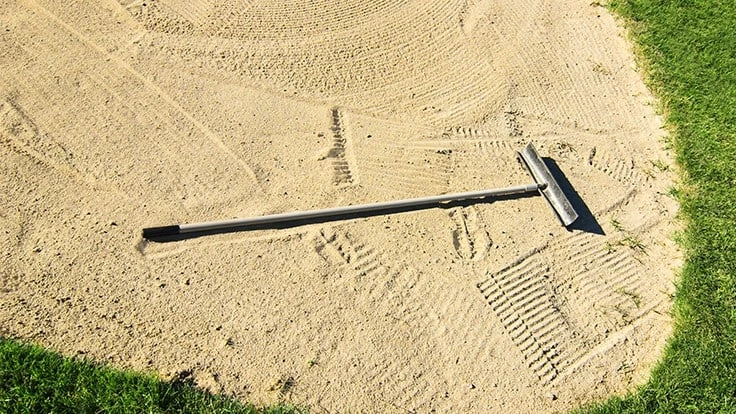
Then there is bunker rake etiquette. Say your ball lands in the bunker from a distance where you can’t see the ball come to rest. Architects like to set the bunker lower in elevation than the rough and fairway surrounds, hoping the feature comes into play even more by collecting rolling balls. Golf is a ground game. Bummed that your 7 iron was a touch short, you first find your ball. Then you look for the rake, the first step in rake etiquette or rake management. You go and retrieve the rake and walk back to a location with the shortest distance from the rough edge to the ball. The shorter the distance, the less raking
Sometimes players utilize the fingers or capes in a bunker form to shorten the distance even more. Your shot is played and then holding the rake you carefully smooth the sand where the ball was played from. No evidence remains. Carefully you walk out of the bunker, no heavy heels please, dragging the rake behind in an attempt to smooth the footprints. Often our route is slightly off, and the rake misses the steps. Down goes the sand wedge, back into the bunker you go to finish the job. If the superintendent is lucky, a player might also rake sand up the side slope, toward the turf edge.
These days we are all dealing with new rules related to COVID-19. Details follow what phase the course’s location is. Some locations are even by county. Rhode Island Phase 2 guidance includes continued one player per cart, but now caddies are allowed. The USGA has their guidance as well. Focusing on bunkers, rakes are still removed.
Now comes the confusion as there is no set rule or guidance on what to do if your ball is in the bunker. Some clubs are playing it as ground under repair so you can REMOVE your ball from the bunker. Others, a private course near Boston and Bethpage, for example, allow a player a drop within the bunker in a spot where the sand is not disturbed. A friend of mine’s daughter plays professionally and is down South this year. The courses she has been playing have the same situation, but no one is complaining. They can roll the ball to an area within the bunker that hasn’t been disturbed.
Where I have played, no one made any recommendation, so I suggested to my playing partners that we play it as it lies (first USGA recommendation). Foot sweeping to smooth the sand is suggested. Of course, this type of player bunker repair has been in existence long before the pandemic. Friar’s Head on Long Island established this upon opening. The venerable Pine Valley in New Jersey does not have rakes.
Before raking by superintendents, bunkers were actually a hazard. Whether it was pressure from professionals for consistent playing conditions or a member complaining golf was not fair, smoothing of bunker sand started in the early 1900s.
Someone soon after that – and my money is on a professional from America – came up with the idea that if we are going to smooth the sand, players could use a rake. Maybe this would reduce the superintendent’s duties a touch? Maybe the real reason is the superintendents were not getting to prepare the bunkers as often as the players wanted. I wonder if we will ever know. But plenty of courses did not rake their bunkers before World War II.
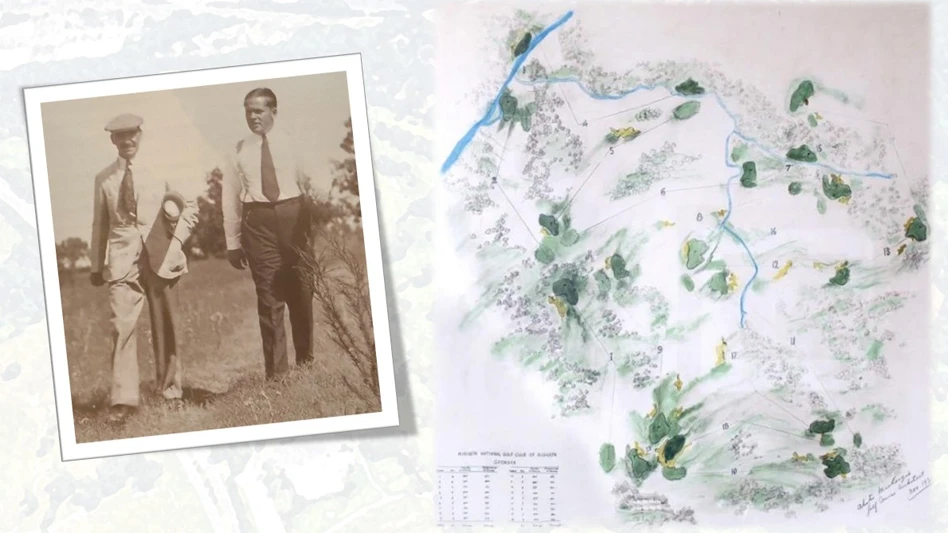
Old-timers and architects were not in favor of bunker prep. A.W. Tillinghast talked about running elephants through bunkers on tournament day. I hear old-timers and architects still complain about Tour players and their bunker demands.
For the vast majority of recreational golfers, bunkers are truly a hazard even in the highly prepared state we usually find them. Maybe these golfers just do not practice sand recovery shots enough? Maybe more courses need short-game practice areas!? As an architect, I know that a good player will doubt a recovery shot from grass while the recreational golfer plays it without a second thought. Precise ball control from the sand is actually easier for the better player.
I played several times this past spring and have found that the bunkers have been maintained by the staff and aren’t any more difficult to extract from than before. Of course, I’m not on Tour. Foot smoothing reduces the bunker “rake management” time immensely. Proper bunker smoothing as shown in this video actually can speed play.
We could even start utilizing waste bunker or area rules for all bunkers. Play it as it lies, remove stones or loose impediments, and play away. Loose impediments that do not require the other members of your foursome to move, right Tiger? What if all bunkers received only a light weekly raking to control weeds and manage sand depths? Would the recreational golfer be more terrified of being in a bunker? Most likely not. Would a low handicapper be tested and possibly lose the hole or a shot in a match? Yes, but isn’t that the point of a hazard? Courses like Shennecossett in Groton, Connecticut, haven’t put the rakes out and don’t plan to according to Eric Morrison, CGCS.
As one greenchair I asked from a private course in Connecticut said: “Honestly, not all that different than we see with divots and ball marks. Some people are just more conscientious than others around proper golf etiquette.”
Then why not eliminate rakes, reduce maintenance expectations so the staff can spend their resources on essential maintenance, and play bunkers as hazards? All it takes is a little etiquette and consideration of your fellow player and how they would like to find their ball in the bunker.
Tim Gerrish is a Rhode Island-based golf course architect and landscape architect with more than 20 years of experience as a project architect. He has taught classes at Stockbridge Winter School of Turfgrass Management at the University of Massachusetts Amherst and the Harvard Graduate School of Design.
Latest from Golf Course Industry
- Tartan Talks 116: Doug Smith
- Audubon International adds 127 golf courses to Monarchs in the Rough
- USGA’s GAP preps for fourth year
- Protect your vehicles from rodent damage
- VIDEO: Fun with fairways
- From the publisher’s pen: Humble giving
- Syngenta adds two to western U.S. team
- The Aquatrols Company introduces soil surfactant for Canada