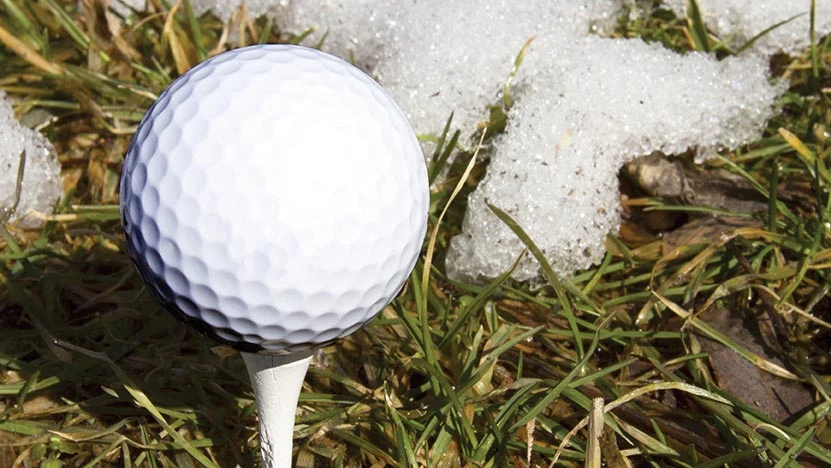
You have survived another winter. How about your greens, tees, fairways and roughs? The sooner you determine that, the faster you can map out your plan for rejuvenation of those areas that need it. Start with the areas that have the highest probability of damage. Did your area experience extended periods with heavy snow cover? Did ice cover certain sections for any of the winter? Did you have an open winter with little moisture that would be conducive to desiccation? If the weather in your area has warmed up enough, you may just be able to scratch the surfaces and visually observe growth starting or lack thereof. One way to get a jumpstart on this important observation is to bring plugs from key areas that might be damaged into the warmth and light of your shop or office.
When you find sections of your course with weakened or no growth the next important determination is how extensive they are. Does an entire green need to be replaced? Can you fill in damaged areas with seed or sprigs? Will limiting cart traffic on fairways allow for enough regrowth and fill-in?
If you have warm-season grasses, sprigging is probably the best option for fill-in. Seeding is preferred for cool-season varieties and some warm-season ones. When seeding, remember that soil temperatures need to be at least in the sixties and preferably in the seventies for warm-season and many cool-season grasses. You can increase the soil temperatures quicker with the use of turf covers. Monitor their use so as not to increase the temperature too much which will create conditions for more diseases.
Kevin Frank, turfgrass specialist at Michigan State, provides the following steps for interseeding greens: “The areas to be seeded on greens should be vertically mowed and if possible aerified, then seeded and lightly top-dressed.” This helps move the seed into the verticut slits for better seed-soil contact. Another option he offers is, “Apply the seed to the greens and then run a spiker over the greens to push the seed into the soil.” Research at MSU indicates regular applications of fertilizer containing phosphorus results in faster establishment than nitrogen applications alone. If covers are used, Frank also recommends the application of Microdochium patch fungicides to prevent the disease from developing.
Do not aerify warm-season grasses in the spring if you are not seeding over them. Aerification increases cooling in the soil and may allow it to freeze more quickly, thus causing further winter injury.
Sodding is going to be the best bet for large dead areas and especially on greens. Dr. John Sorochan, associate professor of Turfgrass Science and Management at University of Tennessee says, “If you need to replace large areas, now might be a good time to consider improving cold tolerance with new varieties.” He says, “If you have old Tifway 419 bermuda on fairways or tees, you might want to go with Latitude 36 or Northbridge.” Consider these and other varieties that have been tested in your area of the country. Frank cautions, “If you purchase sod, make sure your root zone is compatible with the purchased sod root zone.” Sorochan adds, “Check with your sod supplier as early as possible to assure that your preferred grass will be available in the quantities you need, growing in the required root zone.” Sod also can be used on small areas that require quicker ready-to-play conditions.
If winter damage is so severe that most of, or an entire, green needs replacing, do you take that hole completely out of play or do you use a temporary green? Golfers want to play the entire course, but the green needs to become re-established before you can allow play on it. Frank says, “The concern with trafficking newly seeded greens too soon is that the turf will lose density and the greens will essentially go backwards in terms of turf cover. Ultimately this could lead to turf thinning and loss that by July and August may result in golfers playing on a mix of bare soil, algae, and moss.” So, for the sake of the course later in the season, use a temporary green to allow for complete recovery. Be sure to post the information on the use of temporary greens on your website and in plain view on the course and in the clubhouse.
Some parts of the country are facing another form of damage, desiccation from too warm temperatures. Parts of Nebraska and Iowa have had several days in the 70s and have even set records in the 80s. High winds and low humidity exacerbate the situation. In this case it is important to monitor the crown moisture content and visually monitor the crowns. A healthy crown will appear white and plump; when you squeeze the crown, you will have water residue on your fingers. If the crowns decrease in size and start to turn brown, this may be a sign of moisture stress. Light amounts of irrigation can help rehydrate the crowns.
No matter what conditions you find, don’t forget the most important step of keeping people informed. Communicate your findings and plans to the owner and/or the greens committee and let your golfers know what the conditions are and what you are doing to maintain the course for future play, not just for now.
Steve Trusty is a golf writer based in Council Bluffs, Iowa, and a frequent GCI contributor.