It is tough to have a landscape that looks picture-perfect on worldwide television while thousands of spectators trample all over it.
But the Kohler Co. landscaping staff in charge of the Whistling Straits golf course has no fears.
The Haven course is the location of the 2004 PGA Championship from Aug. 9-15 and its beautiful landscape is not only durable, but far from the potted-geranium, country-club setting that typically hosts the popular event.
"The visitors will be exposed to a very natural landscape that is harmonious with the feeling of (the Scottish-style buildings)," said John Geiger, Kohler Co. director of landscape architecture and group maintenance.
Rather than containing colorful, exotic plants, it is a sea of natural grasses, shrubs and perennials.
"Just a very natural, earthy landscape," Geiger said.
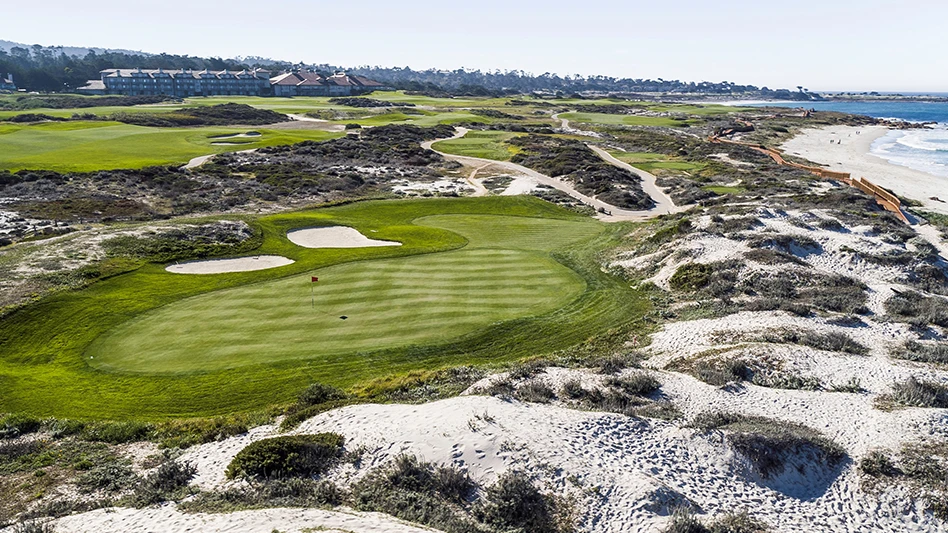
The six-year-old course, which covers a 560-acre parcel of land, was transformed from a relatively flat section of Lake Michigan coastline into a rolling, rugged and windswept terrain that has "a bit of Ireland and a touch of Scotland" in its design, according to the Kohler Web site describing the course.
Its farmland neighbors enhance the excitement to the man-made design as the topography makes a dramatic transition from flat fields to rolling berms in a matter of feet.
"When you drive down that (winding) road into Whistling Straits, you see long grass that doesn't look manicured ... that is what the golf course looks like. We are trying to create the feeling of what you'll experience on the golf course that day," said Dave Longmeyer, manager of landscape services at Kohler Co.
Around 50 plants are incorporated into the Scottish theme, and none of them require a lot of maintenance. The dwarf fountain grass, an upright, open-mound forming plant that gives a fountain-like appearance, is not fussy about soil, is drought tolerant and resists disease.
Little bluestem, a tall grass with fine-textured foliage, also is drought tolerant and has a high palatability to animals. The yellow coneflower, a large daisy-like perennial, just needs sun and a soil that drains well to survive.
"There will not be twenty people scurrying around watering these plants. It's designed to be able to take the heat and rain and drought. It's designed to be low maintenance," said Longmeyer, who added that the plants incorporated around the main buildings are common to Wisconsin.
"If these plants can survive the mass of people that there will be at this event, they'll certainly survive in your home landscape," he added.
The landscape needs minimal water or fertilizer, but that does not mean it is boring or lacks color.
The vegetation comes in all shapes and sizes with various shades of green. Hints of other colors are subtle, but they enhance the beauty of the rolling course and the striking Lake Michigan backdrop.
Perhaps the most impressive aspect of the unique landscape is its ability to show movement. Most all of the plants possess a whimsy, graceful quality, which allows them to flow with the wind current.
The direction and force of wind is known to impact a golf game. Therefore, PGA players may benefit by observing the natural flow of the Whistling Straits landscape. Lake Michigan is known for its gusty air currents so if a player notices a sudden switch in the direction of the grass blades, a given birdie may turn into an eagle.
Source: Herald Times Reporter (Manitowoc, Wis.)
Landscape plants used at Whistling Straits
The following are several of the more common plants surrounding the clubhouse at Whistling Straits. Most all of the plants are available at local nurseries.
Grasses
Little Bluestem -- a tall grass (approximately 2.5 feet to 3 feet) with fine-textured foliage. Turns mahogany-red in August.
Tufted Hair Grass -- an evergreen foliage with a cloud-like quality.
Dwarf Fountain Grass -- an upright, open-mound forming plant that gives a fountain-like appearance.
Perennials
Coreopsis Grandiflora -- a clump of foliage that produces bright golden yellow flowers.
False Sunflower -- an upright clump of stems and foliage that produces yellow or orange daisy-like flowers.
Bee Balm -- a clump-forming, bushy plant that bears lavender or pale pink flowers.
Yellow Coneflower -- a large, daisy-like flower that attract butterflies. Considered an anchor plant because it is known to scatter throughout large areas.
Shrubs
Old Field Common Juniper -- a hearty evergreen shrub with a rough look.
Dwarf Bush Honeysuckle -- a small shrub with tiny yellow flowers that turn maroon in fall.
Gro-low Sumac -- a wood shrub that grows approx. 2 feet high. Leaves turn bright orange before dropping in the fall.
Source: Kohler Co.
Latest from Golf Course Industry
- Tartan Talks 116: Doug Smith
- Audubon International adds 127 golf courses to Monarchs in the Rough
- USGA’s GAP preps for fourth year
- Protect your vehicles from rodent damage
- VIDEO: Fun with fairways
- From the publisher’s pen: Humble giving
- Syngenta adds two to western U.S. team
- The Aquatrols Company introduces soil surfactant for Canada