Kyle Downs / Tripp Davis and Associates
Golf course architect Tripp Davis is currently renovating the course at San Angelo Country Club in West Texas. And he has been pleasantly surprised by what he has found there.
San Angelo was founded in 1920 and expanded from its original nine holes to 18 in 1928-29 by John Bredemus, the first resident golf architect in Texas. Davis has a deep knowledge of someone he refers to as “an interesting character.”
“Bredemus was a Princeton graduate and an excellent athlete — he was declared the Amateur Athletic Union all-around champion in 1912, after the Olympic star Jim Thorpe was ruled ineligible because he had played semi-pro baseball,” Davis said. “After school, he apprenticed for a short time with C.B. Macdonald and Seth Raynor before moving to Texas, where he founded the state PGA. He was the first architect for Colonial in Fort Worth before Perry Maxwell came in and tweaked it for the 1940 U.S. Open, and he designed Memorial Park in Houston, which Tom Doak rebuilt a few years and which hosts the Houston Open.”
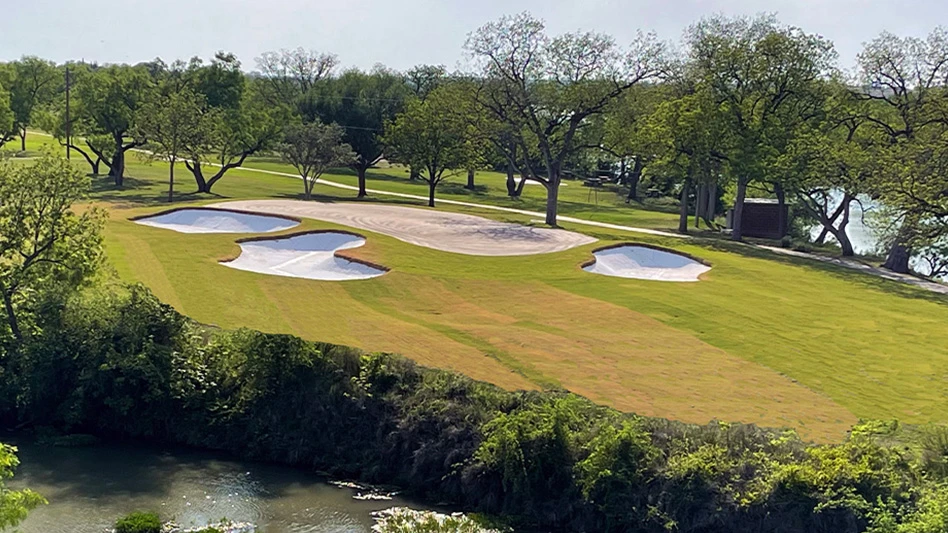
When the club decided it needed to renovate its course, it called Davis. “Fourteen of the greens are original, though they have shrunk quite a bit, and they are very severe by modern standards,” he said. “Sand is hard to find in West Texas, so Bredemus built grass bunkers rather than normal ones, and we debated whether to go back to that, but sand bunkers are now an expected part of the course design landscape. But we have minimized them. We are restoring the design intent on the 14 old greens, and on the four that have been rebuilt, we are using a lot of the same, Macdonald-influenced, design concepts.”
This does not mean that San Angelo will now feature Macdonald/Raynor template holes. “There is no evidence that Bredemus built template holes here, and I think it is a bit of cliché sometimes,” Davis said. “But we will have the greens up on pads, very similar to Raynor’s style, quite rectangular, with the edges falling away rather steeply. They had never converted any of Bredemus’s grass faces along the fairways into sand, so they’re all still there. The only thing is there are trees along them, so we’re taking them out!”
The project is proceeding apace: Davis said about three-quarters of the shaping is finished. “It’s still hard to find sands in West Texas, but we have found a supply for greens mix, so we’re going to start rebuilding greens shortly,” he said. “We should be ready to grass greens in late April or early May, and we are sodding everything else, so we should be done by late June, and hopefully the weather cooperates so we can reopen in September/October.”
Although Davis is being parsimonious with sand bunkers, they will still be a significant part of the course, and the architect has a very definite view of how he wants them to look.
“I like to roll the sod over the edge of the bunker,” he said. “In West Texas, for years they have mowed everything between bunker and green at collar height, similar to what they do in Australia. The toplines are pretty smooth so they can run a machine over the edge. It was really important to roll the sod over and staple it down.”
Texas-based contractor Greenscape Methods is handling the build.
“Any time a club entrusts us to work on its golf course, we understand what that means as most full renovations are a once-in-a-generation type of project,” Greenscape boss Don Mahaffey said. “The project at San Angelo even feels a little more than that as this is the first major renovation since the club was founded in 1927. We’ve been fortunate to work on John Bredemus designs at Memorial Park and Braeburn in Houston, but both of those courses have undergone significant renovations in the past. At San Angelo much of Bredemus’ work is still there, and Tripp has done a masterful job restoring that, especially the Bredemus grassy bunker type features, while also adding interest, especially on and around the greens.”
Davis is installing the ZLine liner system at San Angelo.
“I believe that ZLine is the most effective bunker liner system I have seen in my 30 years in the business,” he said. “Being able to have water move across the top of the liner and run down to our drainage system is key to managing moisture in the sand. … The liner has a grain in it, which helps to hold sand, which is important we’re at 55-60 percent slope in our bunker faces. At that angle, the ball isn’t going to hold, so we only need an inch of sand up there.”
ZLine representative Casey Jones modified the system at San Angelo, removing the edging system.
Latest from Golf Course Industry
- Tartan Talks 116: Doug Smith
- Audubon International adds 127 golf courses to Monarchs in the Rough
- USGA’s GAP preps for fourth year
- Protect your vehicles from rodent damage
- VIDEO: Fun with fairways
- From the publisher’s pen: Humble giving
- Syngenta adds two to western U.S. team
- The Aquatrols Company introduces soil surfactant for Canada