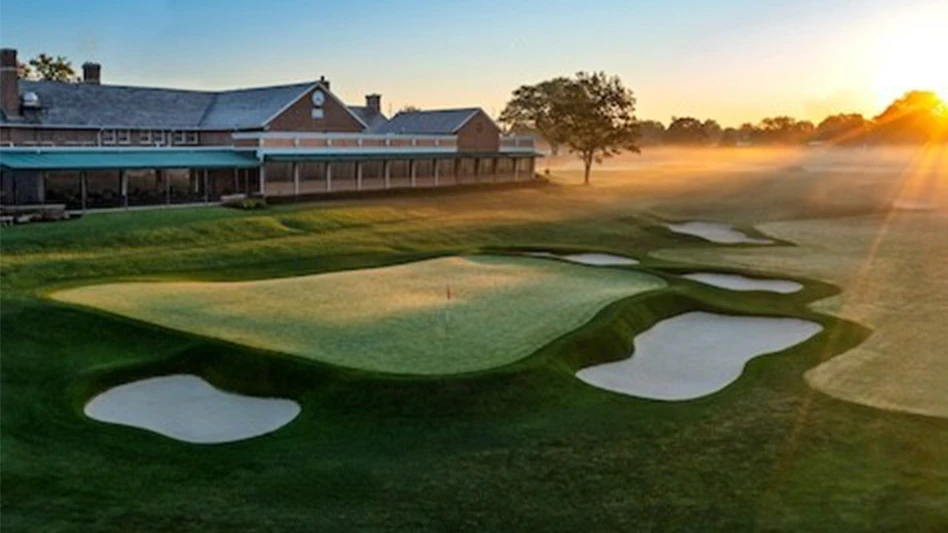
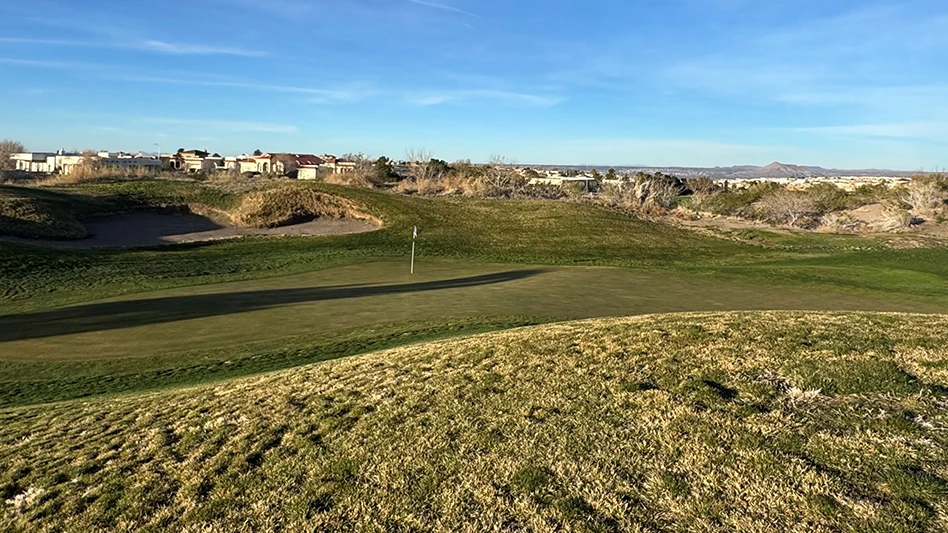
Kingsmill is nearing completion of a renovation that should please both average and professional players.
Legendary golf course architect Pete Dye expects that "John Q. Public" will like the new and more forgiving River Course at Kingsmill-On-The-James. He thinks the "girls" of the LPGA also will embrace the multi-million-dollar tweaking of the course he designed 30 years ago.
"To me, they are girls," Dye, 79, said when gently chided about being politically incorrect. "And the young ones hit the ball so far. They're going 250, 260, 270 yards, and most people can relate to that. They can't relate to how far the PGA guys hit the ball and play the game. I think what we're doing here will be a good challenge for the girls and the John Q. Public player."
Dye was on hand for Wednesday's hard-hat tour of the course, which has been closed since mid-May. Although its length won't change and par will remain 71, every hole is being modified to some extent. Wayne Nooe, the resort's vice-president of golf, expects Landscape Unlimited of Lincoln, Neb., to finish within the month and the course to re-open for limited play in April.
"We'll have everything re-sodded by the end of this month and start seeding the greens within two weeks," he said. "Our goal is to play in April, a few weeks before our (LPGA) tournament. We don't have any concerns about bring ready; we're confident everything will be ready when the LPGA gets here again."
Nooe's original plan two years ago was simply to re-seed the greens with a Penn State-developed A-4 bent grass to withstand heat and disease. But as plans evolved, he and his staff realized a complete renovation was in order. Dye was summoned.
"They let me come back to fix my mistakes, and there was a bunch of 'em," he said with a grin. "I guess I've cost Mr. Busch a lot of money through the years. At the time I designed this course, nobody at Anheuser-Busch knew much about golf, and I wasn't a good enough salesman to get it right the first time. They know a lot more now, which is why they let me come back and fix things."
The work is extensive but not always visible. Upwards of 90 percent of the time and money have gone into the course's labyrinth-like drainage systems.
Trees have been removed or dramatically cut back. Cart paths have been moved and fairway bunkers added or removed. All 18 greens have been reshaped and most landing areas expanded. Several tee boxes have been moved, offering better angles into greens.
"Most of the changes are for members and resort guests," Nooe said. "It's for the 51 weeks that the professionals aren't here. In fact, this was a PGA stop when we began planning to just re-seed the greens. But neither the PGA nor the LPGA has asked for these changes. We're doing it for people who play here throughout the year."
Dye is most excited about the final three holes. A gently sloping landing area has replaced the railroad ties that formed a retaining wall along the right side of the 16th fairway. Trees left after Hurricane Isabel have been removed, offering a panoramic view from the tee box almost to the James River.
No. 17 remains a difficult par-3. Dye has given it a larger putting surface, but added more bunkers. "The last three holes should be the most difficult," he said. "They will be, but there's more ambience and these holes will be more gallery-friendly with these changes."
No. 18 is being toughened, with additional fairway bunkers, a redesigned bank by the water and a renovated green complex to increase playability. "This hole has changed as much as any," Dye said. "The 18th tee certainly isn't for average players, not with that long carry and the new fairway bunkers. It'll be a wonderful finishing hole with the amphitheater effect around the green."
Among the other major changes:
* A new creek has been created and trees have been trimmed at No. 3;
* The fairway has been widened to the left, and new bunkers added along the right side of No. 6;
* Trees have been trimmed, the fairway has been lowered and widened and the fairway has been re-graded at No. 8;
* The fairway has been widened to the left and the wooden wall has been removed from No. 11;
* The tee box has been moved to the right and the grass bank removed from behind No. 13;
* The existing bunkers have been re-graded and new bunkers added to the left wise of the No. 14 fairway;
* The fairway has been widened up the hill to the left and the right to the plateau, and fairway bunkers have been added to No. 15.
Source: Daily Press (Newport News, Va.)