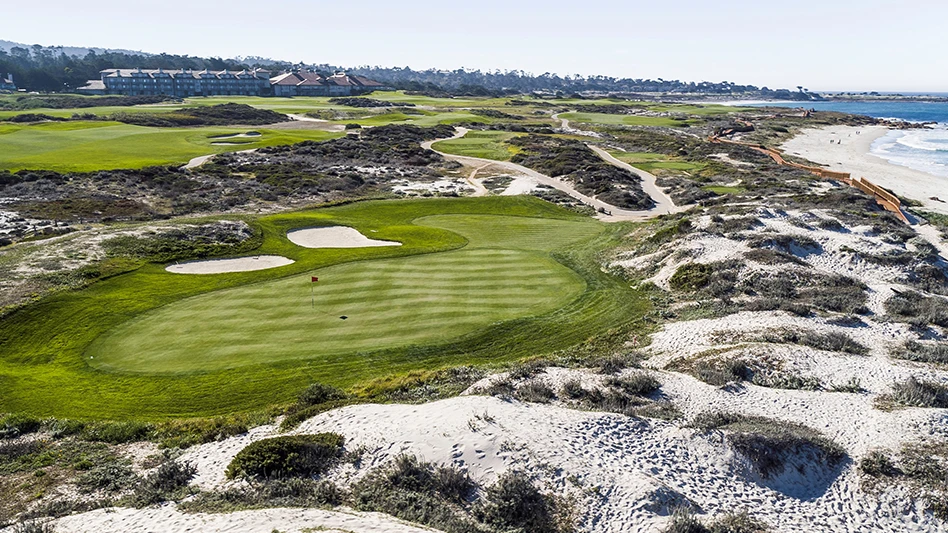
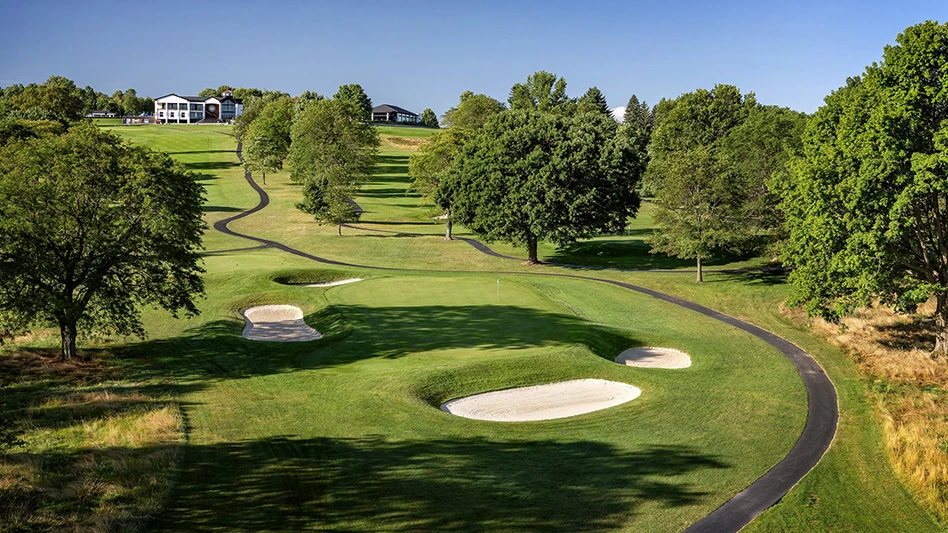
Since May 2006, seven of California’s famous golf courses on the Monterey Peninsula— including Cypress Point and US PGA Tour venues Pebble Beach, Spyglass Hill and Poppy Hills — are being supplied recycled water from the newly-commissioned Forest Lake Reservoir, rehabilitated by the installation of a long-service liner of DuPont Performance Elastomers Hypalon chlorosulfonated polyethylene.
The high-performance liner material, consisting of three layers of Hypalon and two layers of woven fabric scrim, meets stringent leakproofing, soil stabilizing and environmental demands and is expected to have a service life of at least 25 years. It was manufactured by Burke Industries, San Jose, Calif., then prefabricated into panels totaling nearly 1 million square feet (approx 93,000 square meters) by Layfield Plastics Inc., and installed on site by Layfield Environmental Systems Corporation., San Diego, Calif. The general contractor was Anderson Pacific Engineering Construction, and consulting engineers E2 Inc.
Forest Lake Reservoir was originally constructed in 1887, and had operated as an unlined reservoir until the early 1990s. The rehabilitation project was commissioned by the Pebble Beach Community Services District, in line with new operating permit requirements of the California Department of Water Resources Division of Safety of Dams.
Stability concerns
“The DSOD was concerned that if water saturated the reservoir embankments, the stability of the embankments could be affected in an earthquake. Hypalon was used for a similar reservoir rehabilitation project in the Los Angeles area and DSOD approved the 5-ply, 65 mil liner of Hypalon and woven fabric scrim. The new liner and leak detection system is designed to keep any stored water from entering the embankments,” says Mike Niccum, district engineer at PBCSD.
The newly commissioned reservoir covers an area of some 23 acres, and has a permitted water storage capacity of approximately 105 million gallons. It is a key part of the recycled water distribution system that provides irrigation water to seven top golf courses in the area, and several additional recreation areas in the Del Monte Forest.
Why Hypalon?
“Burke Industries has been manufacturing reservoir liners and floating covers of Hypalon since 1967, that’s nearly 40 years of experience with chlorosulfonated polyethylene," says Steve Roades, vice president of Burke Industries. "We believe it’s the most durable pond liner material yet developed, with an expected service life of at least 25 years. As an example, the liner of Hypalon we supplied for the 168 acre reservoir in Perry, Fla. in 1971 is still watertight and in good condition 35 years later.
“Such extended performance is partly due to its excellent tear and puncture strength, and dimensional stability," he adds. "With Hypalon, additional cross-linking develops after installation producing an even tougher and more weatherable liner. It is also much more colorable than materials like high-density polyethylene, polypropylene and thermoplastic olefins. For Forest Lake we produced the liner material in an attractive custom color to blend with the environment. We call it ‘Pebble Beach Tan’.”
Onsite installation
Jon Feenstra, project manager of Layfield Environmental Systems, and the site supervisor responsible for onsite field installation, describes his company’s involvement in the Forest Lake Reservoir project.
“Layfield Plastics Inc., part of the Layfield Group, fabricated the roll stock of Hypalon, supplied by Burke Industries, into about 175 larger panels, the largest being 34 feet wide by 200 feet long, for field installation," Feenstra says. "This is where the Layfield Environmental Systems team took over, installing the panels over the graded and re-excavated site, using a hot wedge welding system and cross-seaming with adhesive patches of Hypalon.”
Meeting regulations with Hypalon
Flexible geomembrane liners and covers for raw and potable water storage, produced from DuPont Performance Elastomers Hypalon, fulfill the latest demands of municipal reservoir engineers, and meet or exceed US federal regulations such as ANSI/NSF Standard 61, and the American Water Works Association standard D 130-96.
“Liners and covers of Hypalon have been weathered outdoors for many years with minimal fading and discoloration," says Paul DiAntonio, business development manager, DuPont Performance Elastomers. "They resist ultraviolet radiation, ozone and water treatment chemicals. The material has a very low thermal expansion coefficient and remains stable yet flexible at high and low temperatures. Repeated freezing and thawing cycles do not cause mechanical damage, and its elasticity allows liners to accommodate limited earth movement.”
Cost-effective alternative to concrete and steel
“On-site seaming with chemical fusion or hot-air welding produces a strong seam and is simple, fast and cost-effective," DiAntonio adds. "Liners and covers of Hypalon also offer an economically attractive alternative to concrete, steel and other rigid construction materials. The flexible option offers low initial capital cost, low maintenance and operating cost, and also reduced chlorine costs through prevention of chlorine depletion.”
Latest from Golf Course Industry
- Tartan Talks 116: Doug Smith
- Audubon International adds 127 golf courses to Monarchs in the Rough
- USGA’s GAP preps for fourth year
- Protect your vehicles from rodent damage
- VIDEO: Fun with fairways
- From the publisher’s pen: Humble giving
- Syngenta adds two to western U.S. team
- The Aquatrols Company introduces soil surfactant for Canada