Source: The Atlanta Journal-Constitution
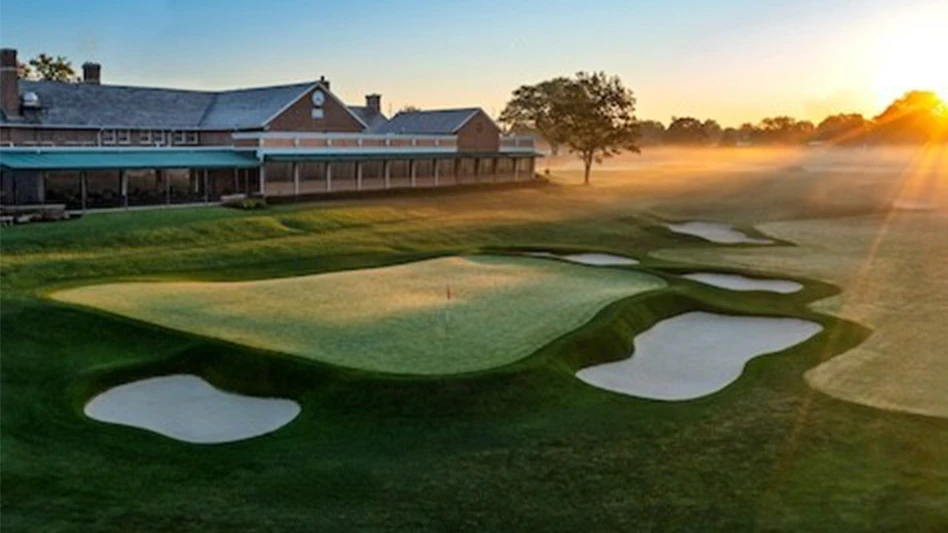
A decade after developer Tom Cousins pulled it from near extinction --- "trading gun shots for golf shots" --- East Lake Golf Club is back, better than even Bobby Jones might have imagined.
This week East Lake starts its run as the "permanent" home of the Tour Championship, the PGA Tour's annual showcase of its top 30 money-winners.
The original Tom Bendelow/Donald Ross course was refurbished by Rees Jones in 1995 and became the focus of a neighborhood revitalization project. The course is playing host to the Tour Championship for the fourth time at a special spot in the club's time line, which previously included the 1963 Ryder Cup, the 1950 Women's National Golf Championship and the 2001 U.S. Amateur.
"This may be the beginning of the second great tournament in Georgia," Rees Jones said. "I know Tom Cousins wants this to be the fall Masters."
While that might be stretching it during a time when football rules, there's no arguing that East Lake offers a historic, fan-friendly stage for the season-ending tournament, which previously visited the Houston's Champions Club, Southern Hills in Tulsa and the Olympic Club in San Francisco --- all courses that have hosted major championships.
"Tom Cousins brought East Lake back to life," said Charlie Harrison, 73, one of the club's most noted amateurs, "and now it will be brought to life on a regular basis."
The opportunity is there for the golf world to gain new familiarity with the storied home course of Bobby Jones, which suffered through more than two decades of disrepair before its renovation.
"I think it's still pretty unknown," tour player Jerry Kelly said, "but it won't be unknown in the next six years [of the contract], that's for sure. It's going to put it on the map in a big way. It's a great course. I hope they keep [the tournament] there forever."
Back among the elite
In Golf Digest's rankings of America's 100 greatest golf courses, East Lake is ranked 74th, not as high as Atlanta's Peachtree Golf Club (51), but ahead of Atlanta Country Club (86th), the longtime home of the BellSouth Classic. East Lake's gains are the impressive part. Off the charts from the late 1960s to early '90s, it immediately jumped into the top 100 when restored in 1995.
"It's right up there, and it's going to continue to climb now," said Rees Jones, who is admittedly partial to the place. "I think the players consider it one of the best courses they play."
The critics seem to agree. There are differing opinions as to whether the present-day East Lake is a Donald Ross restoration or a Rees Jones design, but everyone seems to agree that the course has been, as Tom Lehman said, "a hidden gem."
"It's hard to think of a downside to East Lake," said Ron Whitten, the longtime Golf Digest course critic. "I could make a salient argument that it's better than some of the U.S. Open courses. It's got better topography, a really good set of golf holes. I prefer it to say, Hazeltine National [near Minneapolis]. East Lake is darn strong."
"Obviously, it has a special place in history," architect Tom Doak said, "although I'm not sure how well known that is because it went through such a long period where it was some place where nobody went. It's a hybrid really, but the good part is, it feels like an old course because the walk from green to tee is practically nothing, which you don't find much these days."
Ironically, while a well-chronicled urban revitalization project is what returned East Lake to prominence, it also could put an asterisk on his ranking. But that's not exactly a negative.
"Everyone uses East Lake as the role model," Whitten said. "It's more than just the golf course or the golf club. It's a social revolution. Fifty years from now historians may look at it and say it may be one of the five most significant golf courses of the 21st century. As far as using golf as a vehicle to revitalize the inner city, that's a success story whether they ever held a tournament there or not."
East Lake's pull is highly international, aided by Bobby Jones' strong ties with St. Andrews, Scotland, where he was honored in 1958 as Honorary Burgess.
"There's no doubt in my mind that people particularly from Europe who come to the United States, other than maybe Augusta National, the course they want to play is East Lake because of Bobby Jones," Harrison said. "They want to play the course where Bobby Jones grew up."
Rees Jones met a player at the National Golf Links on Long Island several years ago, Mark Kesnick, who was dying from ALS and wanted to play his Ocean Forest course on Sea Island. When the architect said he gladly would make it happen, Kesnick said, "Can I go to East Lake on the way?"
Jones' legacy
When Bobby Jones won the Grand Slam as an East Lake member 74 years ago, it established the course's reputation around the world, even more prominently than in the United States, where some architects frowned on the course's several parallel fairways.
It wasn't that long ago that East Lake had temporary greens in the winter because of bermuda surfaces that were turned dormant by frost. The club did not switch to bentgrass until George Cobb's re-do for the 1963 Ryder Cup. Tommy Barnes, 89, another of East Lake's great amateur players, used to describe the old bermuda greens as being "like putting on grape vines."
When such drastic changes were suggested for 1963 --- in effect, Cobb de-Rossed the place, flattening the greens and shallowing out the bunkers --- Harrison was a bit uneasy.
"Has Mr. Jones seen these?" he asked while studying the blueprints. "Don't you think out of respect to Bobby Jones we ought to let him look at the plans for this golf course?"
Predictably, Jones said, "Anything y'all do is fine. I'm not involved anymore."
"That's the kind of person Jones was," Harrison said.
During the three previous East Lake Tour Championships, the world's best players have spoken warmly of the course's straight-forwardness.
"One of the comments I've heard a lot is that the course is all kind of right there," Harrison said. "You walk right off the green to the next tee. The course is all packed in there. You don't see that in today's courses. From the fifth tee you can see a whole lot of the back nine. From 14 and 16 you can see a lot of the front nine. It's a picturesque view of the golf course as you're playing it."
Harrison said he was "scared to death at first that it was going to be too easy [for PGA Tour competition].
"Tom Cousins made comments early that it was going to be built exactly like it was when Ross built it," Harrison said. "I didn't want to do that. But I think Rees did a great job. He gave it the Ross feel, but he modernized it."
"It's just a great, old golf course," said Lehman, who played in the 1998 and 2000 tournaments. "It's new, but the topography hasn't changed. And it's a great atmosphere. You look at all those things on the wall in the clubhouse. There's all the Bobby Jones stuff, and then you see a headline, 'Ruth hits another one.' It's pretty cool."
Thinking man's course
With so many modern courses in the TPC mold filling the PGA Tour schedule, East Lake is a refreshing break. The course will play to a par-70 and 7,132 yards for the Tour Championship, once again converting the fifth and 10th holes to par-4s, and has a new drainage system that should prevent the soggy conditions that affected the 2002 tournament.
"It's just a good quality golf course," Australian Stuart Appleby said. "It's not a complicated course, but it offers a lot of do's and don'ts out there. It's position the ball, position the ball. You've got to think your way around the course. It's not boring, by any means."
"It's just pure now," said David Duval, who played the course as a Georgia Tech player during its down period.
"I fell in love with it a long time ago, when I was recruited by Georgia Tech," Charles Howell III said. "There's nothing bad about it. It's just incredible."
Unlike modern courses, East Lake is a caddies-only course in the classic old style of Ross, who was famous for courses "that fit like a comfortable pair of shoes." Indeed, walking from the green to the next tee requires barely enough time to write down a score.
"They're Rees Jones greens and Rees Jones bunkers, so you lose a little of the Ross feel, but everything is still right there," Billy Andrade said. "You don't have to go through back yards and 17 condos to get to the next tee. You see everything."
Davis Love III has told Rees Jones that the greens basically "baffle" the tour players.
"There's a lot of subtle contour in them," the architect said, "and you don't want to go over most of the greens at East Lake because for the most part, they're pitched from back to front. But because there are so many frontal hazards, it's hard to play conservatively."
Nonetheless, the old-timers at East Lake, while marveling at the refurbishment, miss some of the old quirks. Barnes recalled the big oak tree that guarded the 11th green, demanding a big fade to find the flagstick. During the 1963 Ryder Cup, Barnes recalled, Arnold Palmer called it "the only dog-leg par-3 he had ever seen."