Raymond Hearn
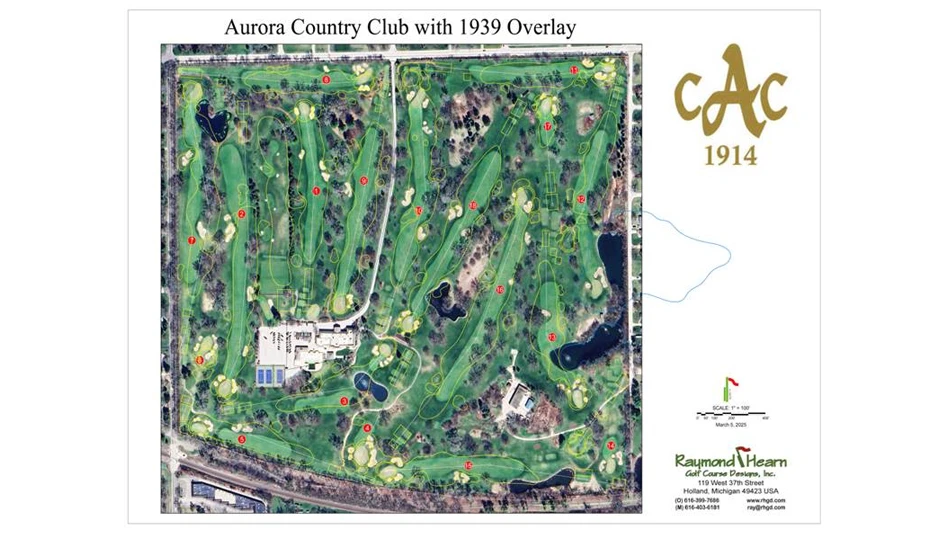
Golf course architect Raymond Hearn, ASGCA, has been selected by Aurora Country Club to lead designs for a renovation and restoration of its classic 1914 golf course.
“What an honor and privilege it is to work with this historic club,” Hearn, founder of Raymond Hearn Golf Course Designs, said. “Our goal is to create a comprehensive Master Plan that involves sympathetic restoration.”
Sympathetic restoration refers to a process where a course is renovated to restore its original design and character, focusing on the course’s history and respecting the architect's original design intent, while also synchronizing with the modern-day game and maintenance practices to improve strategy, shot value, playability and sustainability.
“It's a careful balance between honoring the past and adapting to the present,” Hearn said.
The original 9-hole course was designed by architect Tom Bendelow in 1914. Bendelow expanded the design to 18 holes in 1915 with a possible collaboration from William Langford according to several published sources. In 1935, the club consulted with legendary golf course architect A.W. Tillinghast for some select course improvements.
“We could not be happier to be awarded this prestigious assignment as I know the club had significant interest from a wide array of golf course architects,” Hearn said. “We are walking in the footsteps of golf course architectural legends.
“I will be working closely with the club’s Master Planning Committee, which includes PGA head professional Curtis Malm and veteran golf course superintendent John Gurke, CGCS,” he said. “We will be communicating with them in each phase. After the master planning is approved, my next assignment will be assisting the club in project construction phasing implementation that the club feels comfortable with.”
Hearn said he equates the club’s course to a classic work of art that is ready to reclaim its place among the region’s best. “I want the sympathetic restoration work to increase shot value, strategy, playability and beauty for all levels of golfing ability at the club, not just the single digit handicap golfer,” he said. “I will obviously pay tribute and homage to the legendary architects involved with this design in my sympathetic restoration.”
Tom Cross, Master Plan Committee chairman, said Aurora Country Club has always been committed to providing its members with an exceptional golf experience and that this master planning initiative reflects the ongoing dedication to that tradition of excellence.
“We’re taking a thoughtful, long-term approach to ensure our course continues to be among the finest in the region for generations to come,” he said. “Our partnership with Ray Hearn, whose award-winning restoration work speaks for itself, demonstrates our commitment to investing in world class expertise as we plan for Aurora’s future. This process will be entirely member driven, ensuring that any enhancements align with our club's values and our membership’s vision.”
Gurke said Raymond Hearn Golf Course Designs was a tremendous choice by the club for the master plan and project. “I’m thrilled to be working with Ray on this Master Plan for Aurora Country Club,” he said. “Over my 35 years here I’ve immersed myself in the history and significance of this golf course with architects the likes of Bendelow, Langford and Tillinghast behind its Golden Age design. Ray is a renowned veteran designer who brings great passion, knowledge, and respect for our club’s past, and will tap into those qualities to lead Aurora Country Club and its members into the future.”
Gurke said the master plan committee members did their due diligence and have experienced the work Hearn has completed on other Golden Age golf courses. “He has great passion for what he does, but also for what those before him created at these great courses,” he said. “I love his sympathetic restoration ideas.”
Latest from Golf Course Industry
- Tartan Talks 116: Doug Smith
- Audubon International adds 127 golf courses to Monarchs in the Rough
- USGA’s GAP preps for fourth year
- Protect your vehicles from rodent damage
- VIDEO: Fun with fairways
- From the publisher’s pen: Humble giving
- Syngenta adds two to western U.S. team
- The Aquatrols Company introduces soil surfactant for Canada