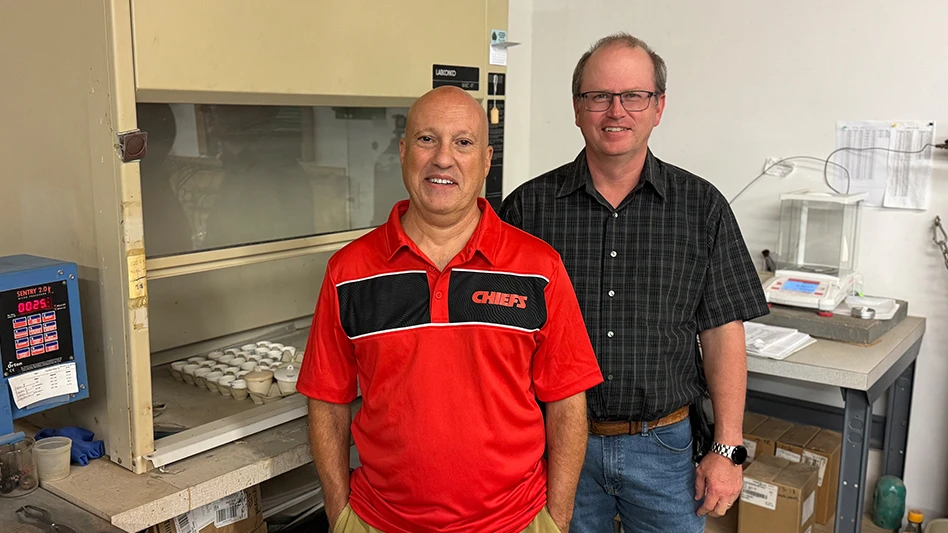
Sam Ferro, left, and Duane Otto.
Depending on the post-2020 Census population estimates one trusts, the population of Linwood, Kansas, hovers between 410 and 450 residents.
Stranger Creek meanders east of where most of those denizens live. Golden tinges of wheat fields lurk north of K-32, the thoroughfare between a compact residential and commercial district and thousands of farmed acres. K-32 connects the Kansas City metropolitan area with the growing college town of Lawrence. Linwood doesn’t have a stoplight because it doesn’t need one.
Linwood also doesn’t have a golf course — Oakwood Country Golf Course in De Soto is eight miles to the east — but a business occupying a non-descript building on East 1st Street offers particle-sized glimpses into the condition of the industry.
“We are a reflection of what’s happening in the golf market,” Sam Ferro says on a nearly 80-degree Monday evening in early October.
Ferro is the vice president of Turf & Soil Diagnostics, a physical soil testing lab and agronomic consulting service. Ferro served as president until transitioning leadership duties to Duane Otto late last year. Otto works out of the company’s lab in Trumansburg, New York. Otto visits Linwood and Ferro a few times each year. Their company formally became Turf & Soil Diagnostics in 2015, when Linwood-based Turf Diagnostics & Design forged a partnership with Trumansburg-based Hummel & Co.
Soil, sand, mix and amendment samples from golf courses executing six-, seven- and eight-figure projects fill counters and shelves inside the Linwood lab. The lone certainty when Ferro, Otto and their team of highly trained scientists arrive for work is that they’ll have samples to test. They follow industry news and have performed testing and consulting for more than 1,000 courses, but the volume, origins and arrival dates of receivables can be tough to predict. “Every day is like Christmas,” Ferro says.
Business is brisk these days, as golf courses furiously invest post-COVID windfalls into addressing infrastructure needs to boost playing experiences. An example of the renovation market’s prowess and the type of course that needs a lab like Turf & Soil Diagnostics sits 37 miles from Linwood. Swope Memorial Golf Course in Kansas City, Missouri, is closed in 2025 for an $8.5 million renovation. Swope Memorial is a municipal facility owned by Kansas City Parks & Recreation.
Loyal clients sustained Turf & Soil Diagnostics during leaner times. Many of those clients are now pursuing bigger and more expensive projects. As renovation costs soar, accredited testing labs become more critical for the industry’s well-being. Substandard materials and mixes can cost owners and operators millions of dollars and damage professional reputations. Testing is a small upfront cost to protect giant investments like the one being made at Swope Memorial and hundreds of other golf courses.
Operating a testing lab requires thorough organization and a detail-driven mindset. Some clients properly label materials inside tightly sealed bags; others send samples without any substantial paperwork. Decades of experience help Ferro, Otto and their colleagues handle whatever enters their buildings.
Listening to the duo describe the testing process can’t be fully processed in a one-hour visit, especially before a Kansas City Chiefs Monday Night Football appearance. Ferro and Otto have devoted their careers to understanding organic matter, moisture, firmness, percolation and dozens of other concepts that determine a golf course’s agronomic and fiscal success. It takes decades to learn what they know. “This is my agriculture,” says Otto, as he explains how somebody from Arizona now runs soil testing labs in rural Kansas and New York.
Companies like Turf & Soil Diagnostics and people like Ferro and Otto make golf a better game.
Their Heartland location proves how humble places help support giant industries like golf.
Guy Cipriano is Golf Course Industry’s publisher + editor-in-chief.
Latest from Golf Course Industry
- Tartan Talks 116: Doug Smith
- Audubon International adds 127 golf courses to Monarchs in the Rough
- USGA’s GAP preps for fourth year
- Protect your vehicles from rodent damage
- VIDEO: Fun with fairways
- From the publisher’s pen: Humble giving
- Syngenta adds two to western U.S. team
- The Aquatrols Company introduces soil surfactant for Canada