Canva Pro
In a lifetime of playing golf, I’ve consistently been an advocate of walking the course. In addition to the health benefits, walking enables one to experience the golf course more completely, enhances pace of play and makes the round “flow” better. Additionally, walkers don’t impart wear and tear on the turf like heavy golf carts do.
I’ve held and still maintain membership in clubs that either encourage or require walking the course, which I appreciate, but I’m tired of carrying my bag and the cost of caddies can be expensive, especially for frequent players. My smart watch tells me that a typical 18-hole stroll takes about 14,000+/- steps, which can’t be a bad thing if I can find an effective way to get my clubs around the course with me.
While I completely support the idea of golf carts for those who are injured or physically unable to walk, or for courses with severe terrain, I’m not so sure that they speed play (in many cases they hinder pace of play). Recognizing the economic benefits carts bring to clubs, I wondered if there weren’t a way to encourage more walking and still enable the club to benefit financially.
There’s no disputing the economic role golf carts play. At a club doing 25,000 rounds per year, cart fees at an average of $25 (many are higher these days) can yield $625,000 in revenues if all players use a cart. If only half use carts, that’s $312,500 in revenues. Neither are insignificant. A typical club might lease 60 to 70 carts for approximately $1,200 per year, per cart, a cost of $78,000 per year (65 carts). Since carts require either gas or electricity and usually a place to store them, along with staff to manage the carts, there might be another $100,000 per year in expenses.
The cart-mandatory course can expect to throw $447,000 (less electricity or gas) to the bottom line, while the 50 percent cart-usage course (with the same number of carts) can yield $134,500 (less electricity or gas) to the bottom line. There might just be a way for walking to make up some or all of that difference.
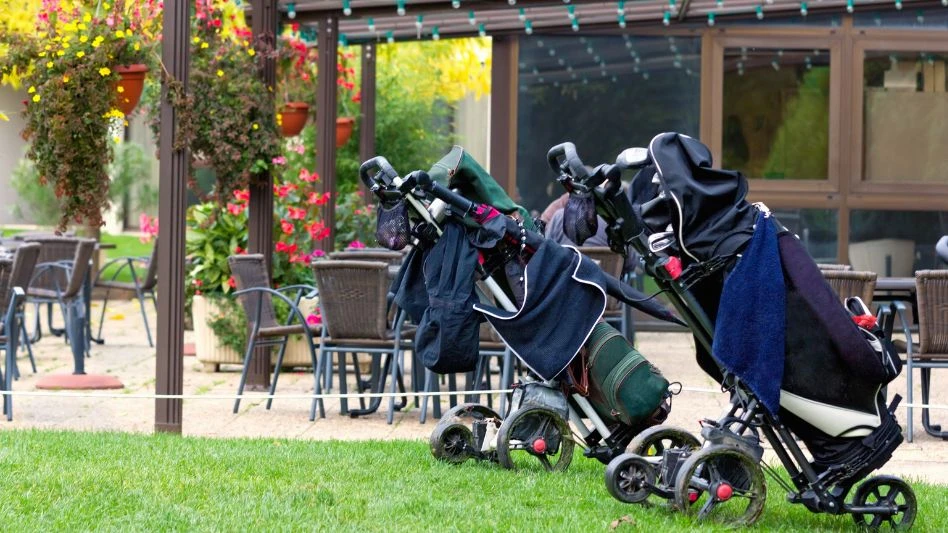
Let’s assume that half the players at most courses (at least) prefer a cart. The other half might prefer to walk, but many would rather not carry their clubs, typically weighing 25 pounds or more around the course. Pushing a cart is an option but also imparts stress on the lower back and doesn’t offer much in the way of revenue. Some clubs offer free push carts while others charge typically around $7 to $12+/-. The answer to closing the gap and encouraging more walking could be electric trolleys.
Frequently found at most courses in Scotland (and elsewhere), power trolleys are a potential option that can generate substantial revenues for the club and satisfy those of us that like to walk. Consider this: purchasing a powered trolley typically costs anywhere from $750 to $1,600, depending on the model and the features. Some have GPS, some have remote control, and others follow the player around the course.
Bill Holbrook of MGI Golf, a leading manufacturer of powered trolleys, told me that clubs can either purchase or lease a fleet of trolleys to rent and that, so far, the typical fleet ranges up to 12 units for an 18-hole course. If clubs were to purchase a fleet of 12 trolleys to rent, the cost might be roughly $15,000 ($1,245+/- per unit for their mid-level “Navigator” model) and they project rental at $17 for each unit five times per week.
Holbrook has seen rental fees up to $35 for an 18-hole round. They suggest that a fleet of 12 would be paid off in 15 weeks with a two-year profit of $91,140 for an ROI of 610 percent. From the perspective of value added to the golf facility, at $45,000 added to the NOI per year, capitalized at a conservative rate of 11 percent, that’s an additional $400,000 in market value to the club. Is the walking golfer willing to pay the $17 to not have to carry or push his/her clubs?
If a club is predominantly a walking club, where players either carry or use push carts, which are sometimes free and sometimes rented for a nominal fee, the positive economic impact of electric trolleys would be even greater assuming that some cart riders might also choose to walk instead. As trolleys become more widely accepted, it wouldn’t be hard to envision larger fleets generating 5,000 to 10,000 rounds or more using trolleys and resulting revenues of $100,000 to $200,000.
Courses can elect to offer both rentals and sell the units to players choosing to use personally owned trolleys. Between offering storage solutions and charging trail fees, these are options that exist for clubs to generate revenues from electric trolleys, even beyond club investment and ownership.
I first used a power trolley around 20 years ago. I then played at a club for 13-plus years that didn’t allow them (despite allowing push carts for free) and now play at clubs that allow them. From my perspective, power trolleys are the “best of both worlds.” I get to walk the course and avoid the physical stress of carrying or pushing. Most models fold nicely into the back of a car and can be easily transported wherever you play, if permitted. With battery, trolleys typically weigh 30 to 35 pounds.
Clubs can benefit either from renting or selling the trolleys, trail fees and from the storage locker systems that are designed for them. Holbrook suggests that for rental fleets, fewer clubs have chosen the remote versions due to the learning curve, but it’s growing in popularity.
MGI warrants their trolleys for personal use for three years and suggests fleet users could realize “at least” two years. The lithium batteries used generally last much longer and are warrantied for three years as well. MGI encourages customers to reach out to them with service issues and they do ask their customers to maintain the trolleys through recommended charging and regular cleaning, which Holbrook says extends the life of the unit.
With many college teams now requiring their players to use push carts to avoid injury and the ever-growing presence of trolleys and power trolleys at courses around the world, including the U.S., the perceived stigma once associated with the “look” of trolleys is disappearing. When considering the benefits to players of walking more frequently, to courses of reduced wear and tear on the turf and the ability to rent/use them even in wet conditions, along with less wear on turf and cart paths the economics may prove to be positive.
Are trolleys the future of golf?
Every club is different because club cultures and physical characteristics vary. Some clubs encourage walking, others don’t. Some courses are designed to be walkable, others not so much. Some clubs seek to preserve caddie programs. The terrain of some courses precludes walking in some cases for most players; other courses are comfortably walkable. The clubs that aren’t walkable will continue to benefit from golf carts.
In my opinion, the electric trolley can help fill a gap both economically and culturally that can cater to more players. That’s good for the growth of the game because it offers the player more options and choices. Each club should analyze their situation, consider the options and learn how they can benefit from this growing trend.
Larry Hirsh is the president of Golf Property Analysts and has executed assignments on more than 3,000 courses in the United States and Canada. He is a certified general appraiser, licensed real estate broker and author.
Latest from Golf Course Industry
- Reel Turf Techs: TJ Vollmar
- Bernhard and Company names G.C. Duke as North American Distributor of the Year
- Course at Sewanee picks KemperSports for management
- WiTricity expands wireless charging technology
- Shining star
- SiteOne Landscape Supply acquires Reinders
- Talking Turf Weeds 17: Waking up your course after winter with Yusif Jaouni and Matt Herrmann
- From the publisher’s pen: Respect the side hustle