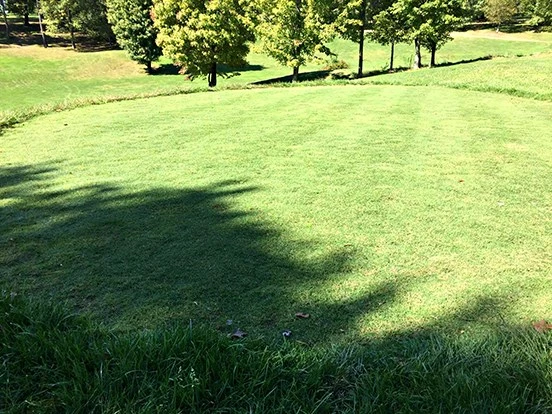
Pittsburgh National Golf Club owner Colin Dunwoody decided in the summer of 2016 to regrass two tee boxes with the newly released Bermudagrass cultivar Latitude 36. The decision was arrived upon after numerous discussions with Latitude 36 licensed growers and Sod Solutions, the agent for Oklahoma State University which had developed the cultivar.
Pittsburgh National is a semi-private facility with bentgrass tees and in the height of the golf season the tees experience high traffic, hot weather and sometimes excessive drought conditions. This makes the regeneration of divots very taxing. Over the past few years, the club has experimented with different cultivars of bentgrass and ryegrass with very limited success. The benefits of Latitude 36 over other traditional Bermudagrass cultivars include a higher cold tolerance, early spring green-up and high traffic tolerance. When weighing these benefits, Pittsburgh National went ahead in July 2016 by sprigging a par-3 tee box on the 12th hole and a par-4 tee box on the first hole, a pair of high-traffic areas. By October 2016, both tees had full turf coverage in preparation for the 2017 season.
Initially, when the decision was made to use Latitude 36 in a trial, the club faced criticism from patrons and area professionals. But struggles with trying to produce quality conditions using other turf varieties convinced Pittsburgh National officials to further experiment with Bermudagrass.
As the height of the 2017 season was ending, Dunwoody and superintendent Michael Dunn made a joint decision to regrass nine more tee boxes, including a section of the teeing area for the driving range, largely due to the success of the two original trial tees which were established in 2016. Pittsburgh National plans on renovating more tee boxes in the ensuing years because of benefits it has noticed with the changes.
Pittsburgh National is a semi-private facility with bentgrass tees and in the height of the golf season the tees experience high traffic, hot weather and sometimes excessive drought conditions. This makes the regeneration of divots very taxing. Over the past few years, the club has experimented with different cultivars of bentgrass and ryegrass with very limited success. The benefits of Latitude 36 over other traditional Bermudagrass cultivars include a higher cold tolerance, early spring green-up and high traffic tolerance. When weighing these benefits, Pittsburgh National went ahead in July 2016 by sprigging a par-3 tee box on the 12th hole and a par-4 tee box on the first hole, a pair of high-traffic areas. By October 2016, both tees had full turf coverage in preparation for the 2017 season.
Initially, when the decision was made to use Latitude 36 in a trial, the club faced criticism from patrons and area professionals. But struggles with trying to produce quality conditions using other turf varieties convinced Pittsburgh National officials to further experiment with Bermudagrass.
As the height of the 2017 season was ending, Dunwoody and superintendent Michael Dunn made a joint decision to regrass nine more tee boxes, including a section of the teeing area for the driving range, largely due to the success of the two original trial tees which were established in 2016. Pittsburgh National plans on renovating more tee boxes in the ensuing years because of benefits it has noticed with the changes.
Latest from Golf Course Industry
- Tartan Talks 116: Doug Smith
- Audubon International adds 127 golf courses to Monarchs in the Rough
- USGA’s GAP preps for fourth year
- Protect your vehicles from rodent damage
- VIDEO: Fun with fairways
- From the publisher’s pen: Humble giving
- Syngenta adds two to western U.S. team
- The Aquatrols Company introduces soil surfactant for Canada