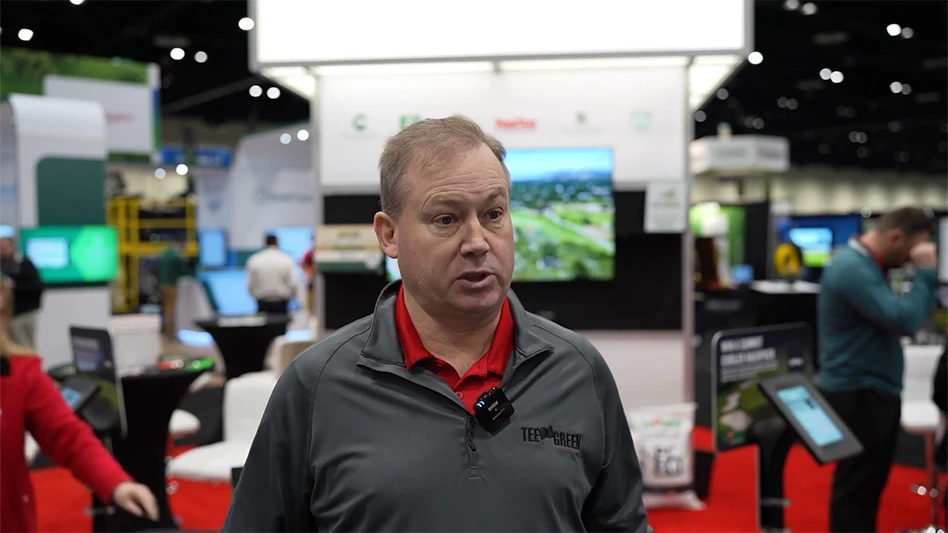
Tim Johansen, superintendent at Palmer Hills Golf Course in Bettendorf, Ia., has been using plant growth regulators for the last 10 to 12 years. While he has never put a price tag on the benefits of the products he employs, he wouldn’t do without them.
“There is no question in our situation that it helps our bottom line in many ways. We used to mow fairways and tees three times a week. Since using PGRs, we mow twice a week during the season,” he says.
Johansen has been at Palmer Hills for 32 years, and he and his crew used to struggle with the quality of their mowing cuts when the turfgrass seed heads were at their peak, as well as with the chores of dealing with replacing bedknives and a having to conduct a grind during the season. “Now, there is no dragging of clippings and virtually no clippings on the short surfaces,” he says. “The clean appearance and green flush is well worth the cost. These benefits, as well as the plant health aspects, make me a believer.”
Johansen uses PGRs for seedhead suppression on fairways, tees and greens, as well as growth suppression during the peak playing season. He also sprays a small band of grass around the collars of the course’s greens when doing fairway applications to help handle growth in a difficult-to-maintain area.
He says by using PGRs to regulate growth of his turf, he saves about eight hours a week on man hours on mowing tees and collars. When combined with fuel savings, that amounts to about $100 per week, not insignificant when it comes to the annual bottom line.
“We eliminate one cutting per week,” he says. “We used to mow three times a week, now we mow only twice per week. The quality of cut is much better and we don’t have excess clippings laying around.”
He uses PGRs from early spring until late September, with a little more caution toward the end of the season.
“I have always been careful late in the year because of potential effects from frost. I have heard that PGRs and frost don't play well together, and because of that I tend to be very careful in late fall,” he says. “As with anything, I would certainly do some testing in different areas of the course to study the various effects achieved with rates and frequencies of application. There are a lot of different products on the market now, and it’s important to find out which one is best for you.”