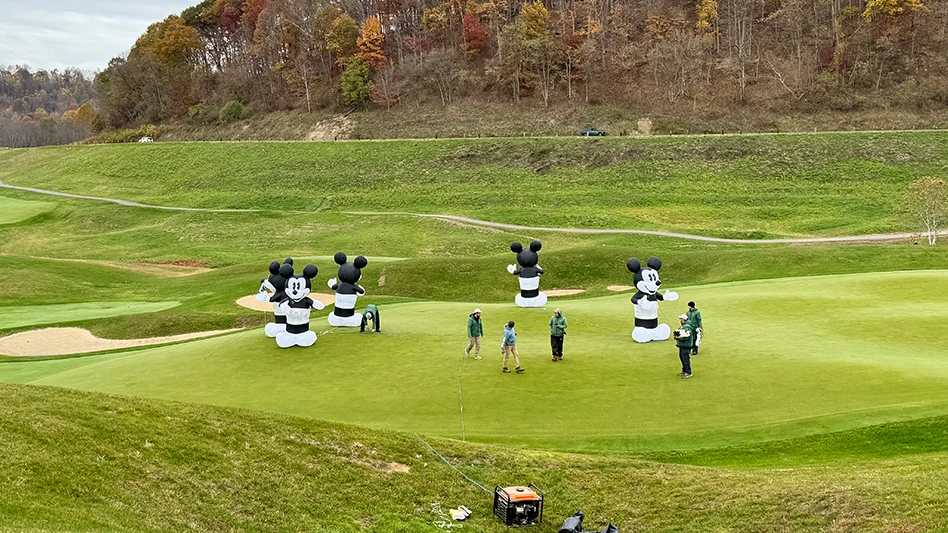
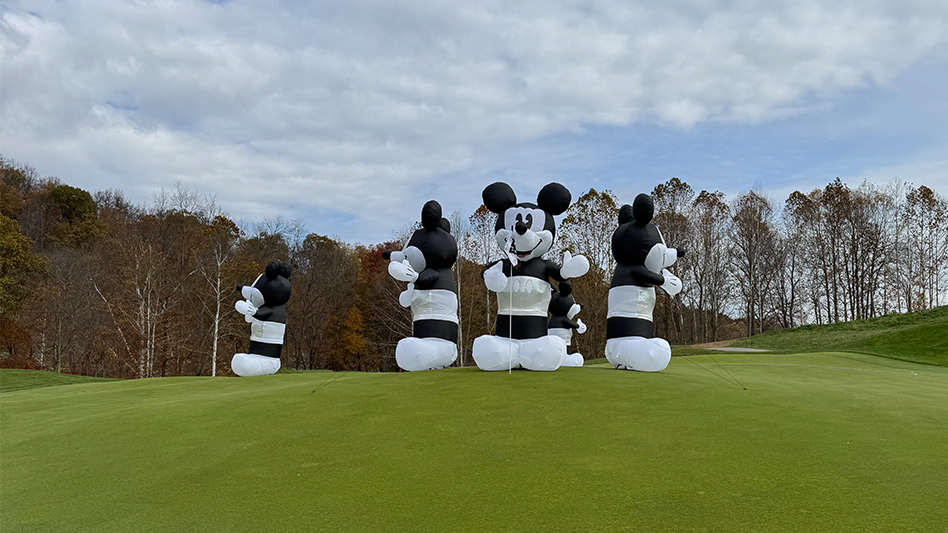
Six members of the Pete Dye Golf Club agronomy team completed their final morning assignment at 10 a.m. on Sunday, Nov. 2. They immediately gathered photos and videos of the finished work. As a team, they appeared stuck in the comical moment as five towering Mickey Mouse inflatables jumbled the17th green.
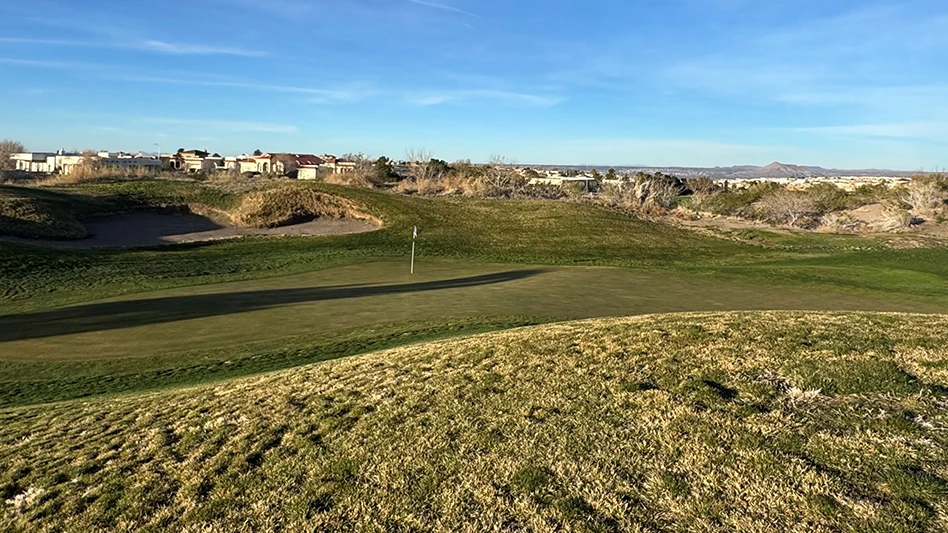
About the Pete Dye Golf Club 17th green: the front could be the cruelest putting surface entry on the Americas side of the Atlantic Ocean. The only truth of landing a shot on the steep false front is that your ball will race off the green at F1 speeds. No spot on the green offers much reprieve, as eight humps resembling Dumbo’s rear induce treachery on approach shots, pitches, chips, bunker blasts and putts.
The hole is the most debated and dissected on the only course named for legendary architect Pete Dye. A windmill borders the green. Playing the hole can be delightful — or drudgery — depending on one’s mindset. Even after making a six on the par 4 during a scramble, this columnist who handles personal golf shots in jest considers Pete Dye Golf Club’s penultimate hole magical and memorable. Regardless of the score, a golfer can’t wait to see what happens the next time he or she lands a shot or strikes a putt on “one of the most polarizing greens on the planet.”
And plenty of putts were attempted on Sunday.
Mickey Mouse met the windmill because Pete Dye Golf Club concluded its 2025 season with a superintendent’s revenge outing. The event attracted 25 foursomes to the imaginative private course atop a former coal mine in Bridgeport, West Virginia.
Score was kept. But totals didn’t matter. The day was about bringing people together to honor the work of superintendent Jason Hollen and his crew.
Exacting revenge on golfers by placing holes in cuss-word places, including the crest of the false front on No. 17, is a Pete Dye Golf Club annual tradition. Sadly, the zaniness isn’t replicated everywhere. This columnist encourages every club to conduct a superintendent’s revenge event. Your golfers and, more important, your superintendent will thank you for thinking outside the inflatable Mickey Mouse box.
A superintendent’s revenge outing also represents a subtle way to flip a digitus medius at Mother Nature. This year exerted a significant toll on superintendents and crews at all points parallel, above and beneath Bridgeport. Maintaining a golf course is a palace-sized challenge, and 2025 will be remembered as unforgiving throughout the industry. Why not celebrate the end of the growing season by placing inflatables on greens, attempting putts while wearing plastic beer googles, and cutting cups and sticking flags in bunkers?
Hollen and his team wisely used the superintendent’s revenge spotlight to inject reminders of unseen or misunderstood aspects of golf course maintenance into the setup.
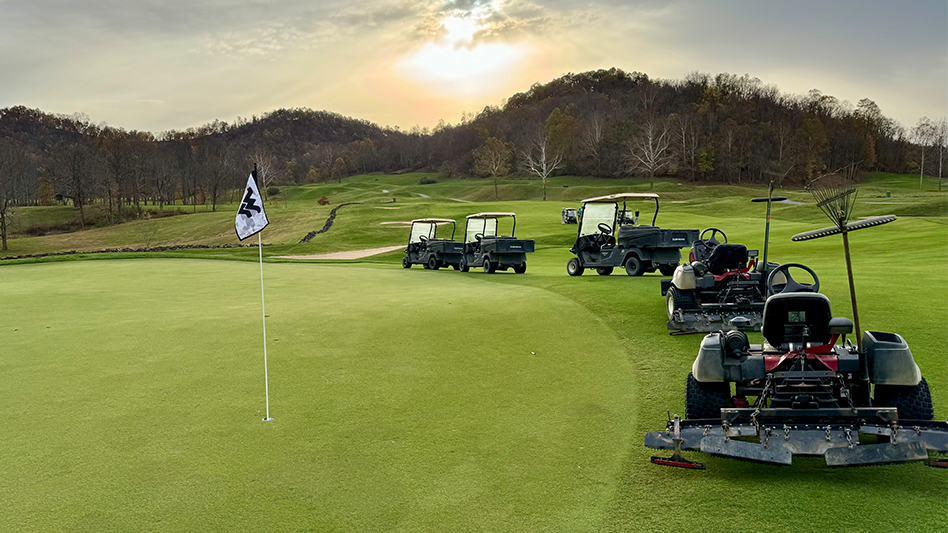
On the 14th hole, a par 4 with three large bunkers extending from the right side of the fairway to the green, three utility vehicles and two mechanical bunker rakes parked in front of the green protected a left-edge hole location. On the 15th hole, a risk-reward par 5 with water right, three fairway mowers lurked in a landing area for drives and two rough mowers rested in a strategic layup zone. Parking equipment on the course demonstrates to stakeholders the capital investments required to maintain a golf course.
Perhaps nothing peeves golfers in limited golf climates more than the disruption caused by aerification, another necessary investment to ensure healthy, high-quality surfaces. Before play started, Hollen’s team aerified the landing zone and left cores scattered on the short par-4 third hole. From the fresh cores, golfers hit second shots to a hanging back-right hole location guarded by severe greenside bunkering and steep slopes.
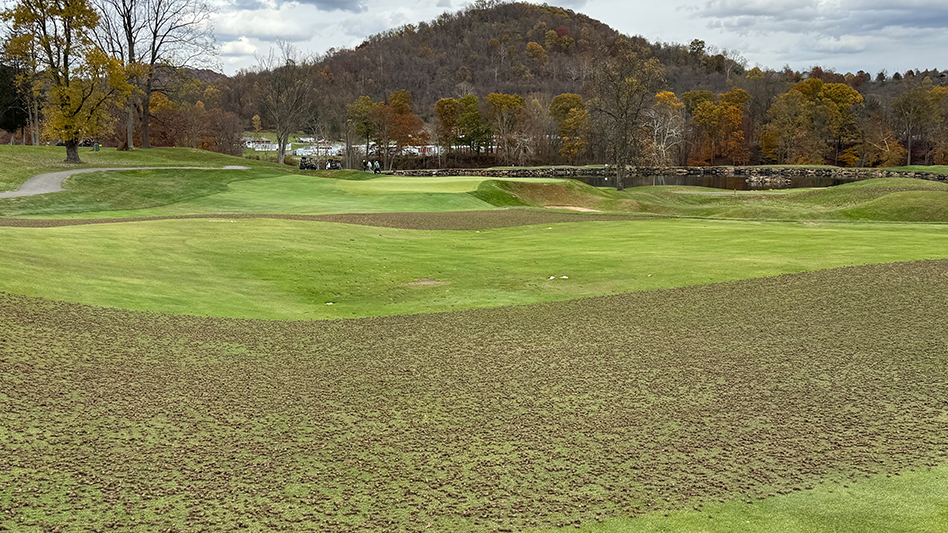
What the #&%&!!!
Every superintendent uttered their preferred version of the above numerous times in 2025, and Hollen tactfully alluded to the conundrums his crew and industry peers faced in a pre-tournament address to golfers.
“It’s been a heck of a season,” he said. “The main thing for today is to have fun. You’ll see some pins in weird locations. Just roll with it.”
No hole location proved weirder than the one on No. 17. Hollen enthusiastically participated in the outing, playing on a team with senior assistant superintendent Kody Frey and two industry friends. The foursome waited for five minutes on the 17th tee as the preceding group completed a hole playing just 280 yards.
“I don’t know what the holdup is,” Frey asked rhetorically. Frey paused and quickly realized they were playing No. 17. “Maybe it’s the hole location,” he deadpanned.
The team proceeded to drive the ball 52 yards from the hole. One flip-wedge approach sailed between the inflatables and skirted left off the green. Another flip-wedge approach missed the right. The other two shots hit the false front and raced off the approach. Twelve missed putts later, the group laughed back to their carts with a double bogey, the highest permitted score on the hole.
It’s been that type of year for many in the industry. It was that type of day at Pete Dye Golf Club.
The Pete Dye Golf Club agronomy team spent Monday, Nov. 3 aerifying greens. Golfers were gone and inflatables were deflated.
They will be left alone, cameras and phones resting snug in pockets or the shop, for nearly five months to continue performing the serious business of preparing a beloved course for whatever variables 2026 brings. More good times and great challenges await.
Guy Cipriano is Golf Course Industry’s publisher + editor-in-chief.