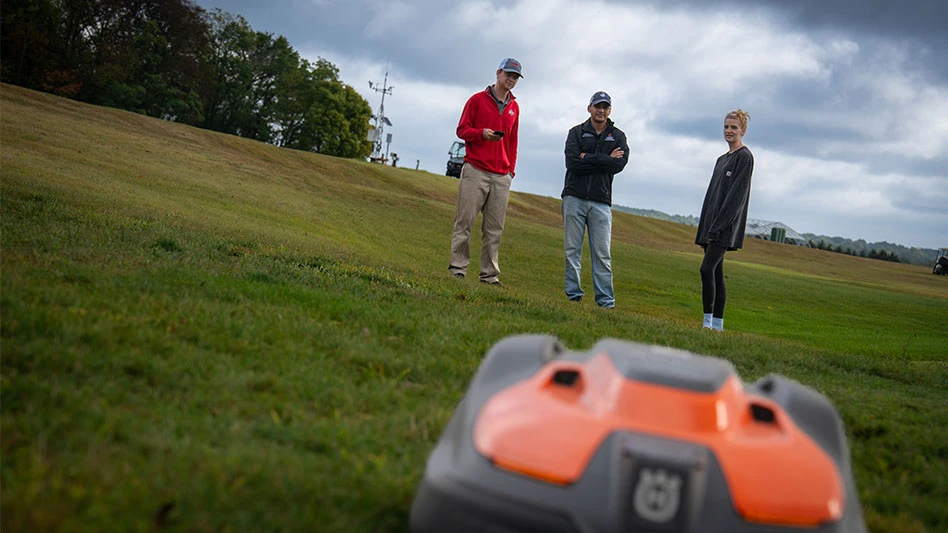
Brian Miller
In the lab of Dr. Tyler Carr, assistant professor of turfgrass science at The Ohio State University, graduate student Brian Miller is conducting research comparing the effects of autonomous mowing versus conventional rotary mowing on weed pressure in cool-season grasses. There were clearly fewer weeds with autonomous mowing, and it’s early in the research, but the entire experiment will be replicated next season to see how the results compare.
Miller grew up on his family’s grain farm in southwest Ohio, and he worked at Snow Hill Country Club in New Vienna during high school. He caddies at Scioto Country Club, outside of Columbus, when he has time. His interests and background provide him with the perfect perspective to be helpful regarding course agronomics.
“We hypothesized that frequent autonomous mowing would enhance the turfgrass density and also reduce the weed populations compared to the conventional rotary mowing practices where we adhered to the rule of thirds,” Miller says. “We also hypothesized that through autonomous mowing, seedhead production would be suppressed because of how frequently we would be mowing compared to conventional rotary mowing.”
As an undergraduate student at Ohio State, Miller majored in agribusiness and applied economics with minors in agronomy and turfgrass management. He worked in the turfgrass research and education facility and then chose to pursue a master’s degree in agriculture with a focus in turfgrass science.
Miller understands advanced agricultural technology from his schooling and being raised in that industry. He sees what golfers want and how the maintenance practices affect play when he caddies. And he understands the academic need for research to parlay ideas and hypotheses into evidence.
Two experiments were actually conducted by Miller, one looking at the summer annual grassy weeds, focusing on crabgrass, and another focused on a broadleaf area where they were looking at white clover and dandelions. “We didn’t see many visual differences on that, where with the crabgrass we saw a pretty good visual difference between the autonomous and rotary areas,” he says.
“We had the autonomous mower mowing every two days and we had two different heights of cut, 2 inches and 3.5 inches,” Miller adds. “The rotary mower was also at 2 inches and 3.5 inches, and I would go out once or twice a week and measure to see if the areas needed to be mowed to satisfy the rule of thirds. With the rotary mower I would mow about once a week.”
For data, they looked at turfgrass density and visually estimated the percentage of crabgrass cover, taking measurements every two weeks. “We saw that the percent of crabgrass cover was significantly affected by the mowing height and the mower type,” Miller says. “Mowing at 2 inches averaged three times more crabgrass than mowing at 3.5 inches. That was expected. What surprised us was that the rotary mower treatments averaged about 1.5 times more crabgrass than those mowed with the autonomous mower. This may be due to the increased mowing frequency from the autonomous mower.”
The higher mowing height had greater density, likely due to how much crabgrass was in areas with the lower height of cut. “When we mowed at 2 inches, the turfgrass density increased when using the autonomous mower compared to the rotary mower,” Miller says. “The rotary areas at 2 inches had quite a bit of crabgrass in them. Those are our early results from this summer and fall.”
Miller is conducting a seedbank analysis over the winter, and then again next summer after the spring research, to see if there is any effect on the seedbank from mowing treatments. For this research, Miller takes soil probe samples from the experimental area, puts them in the greenhouse, waters them to field capacity, and then counts the number of weeds of interest that germinate throughout the test. That test lasts 10 weeks and will determine whether the weed seeds are reduced, creating a higher quality of turf, with frequent autonomous mowing.
Experiments don’t always have definitive results, so to make such an impact is excellent. “It’s pretty exciting,” Miller says. “Early to mid-July is when we started to see the visual differences in the crabgrass. It was pretty neat to see that. To then have significant differences this early on in the program was pretty cool to be a part of. Autonomous mowing is getting more popular every day.”
Miller will defend his thesis in spring or summer 2027 and will likely start working in the industry after that. “Scioto does have a few autonomous mowers, and they are different models from what I am using so it’s cool to see how they work, and how the golf course is using autonomous mowing practices.”
For Miller’s research, they used a Husqvarna 550H EPOS and they will use the same mower in the spring. Half of the project is funded by the PBI-Gordon Turfgrass Pest Management Research Grant Program and the other half is funded by Ohio State, where Miller works closely with Carr.
“He helps me in all aspects, from the research to the coursework to everything in between,” Miller says. “We have a weekly meeting and he answers any questions. In Tyler’s lab we have another graduate student, an undergraduate researcher and a technician, so there is plenty of support. We all help each other.”
Miller participated in the CANVAS conference, held in Utah in November 2025, where he won first place for the Turfgrass Management and Ecology Poster competition. As well as sharing his research, he learned that drone use is expanding. Drones are being used for irrigation audits through thermal imaging, to identify weed pressure and for spraying. In the agricultural world, using drones for precision ag is becoming more and more common, and it is a great place to look for turf applications.
How does Miller’s family feel about his path in turfgrass?
“They have been supportive with anything I have chosen to do,” he says. “My dad is always sending me articles about turfgrass. Whatever my older brother and I have been passionate about, growing up, our parents have taken a liking to it and encouraged us. They taught us to commit to something and go for it and they’re there to support us.”
Sounds pretty perfect.
Lee Carr is a northeast Ohio-based writer and senior Golf Course Industry contributor.