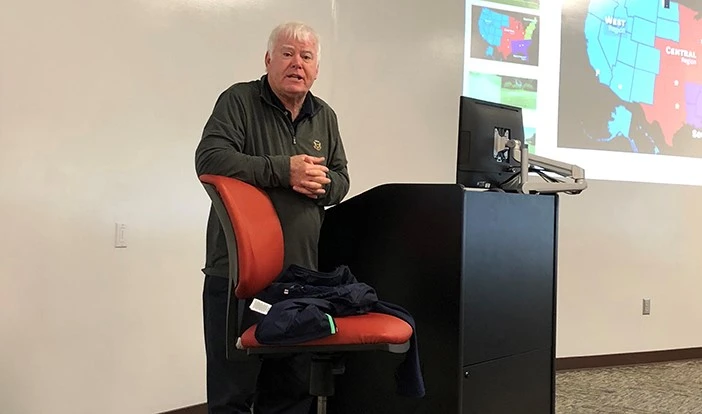
Hats off. Phones away. Notebooks out. USGA Green Section agronomist Pat O’Brien is speaking.
On this morning, the Monday of Carolinas GCSA Conference and Show week, O’Brien stands before three dozen Horry-Georgetown Technical College turf students. He brings slides and stories – and more stories. O’Brien isn’t your typical agronomist. He’s the longest tenured USGA employee.
Ponder that for a moment. The most venerable full-time employee representing an organization formed in 1894 serves superintendents in the Southeast. The region’s superintendents are lucky.
O’Brien is omnipresent in the Carolinas and Georgia, visiting more than 100 golf courses each year. He’s more omnipresent than usual Carolinas GCSA Conference and Show week. After the two-hour discussions with students, O’Brien and longtime friend Dick Schulz, a Georgia-based agronomist, golf course owner and industry entrepreneur, hustle to Prestwick Country Club to participate in the Carolinas GCSA Golf Championships. Prestwick superintendent Paul Kaufman’s backtrack vertical mowing tactics, coincidentally, are mentioned in O’Brien’s presentation.
Prestwick boasts smooth, healthy, slick ultradwarf bermudagrass greens. Ultradwarf bermudagrass greens are subjects of a Tuesday morning seminar O’Brien leads with USGA colleague Dr. Steve Kammerer and Virginia Tech’s Dr. Mike Goatley. The seminar is about winter management of the surfaces. Prolonged low temperatures yielded significant damage to the surfaces in the region, hurting facilities already facing operational tightropes.
Longevity allows O’Brien a little more latitude for boldness than other seminar leaders. He says publicly what other agronomists might only utter privately. When discussing winter damage with the Horry-Georgetown students, he lambasts owners who fail to provide superintendents with the resources to purchase and deploy turf covers. “What a crazy, damn business model some people have?” he says. “It’s just stupidity.” His voice changes tones. His hands forcefully move, further proving his point: cold happens even in the Southeast and it’s best to prepared for it.
The presentation includes other I-told-them-so moments. It also includes doses of humility, with O’Brien describing some of his mistakes to students. Examples of failure further humanize O’Brien – a grandfatherly figure to industry newbies – while soothing students early in their frustrating quests for agronomic perfection. Mistakes are made in the golf business and recovering from them strengthen turf managers.
O’Brien alludes to Schulz, whose course, The Oaks Course, in Covington, Georgia, resides in golf’s middle class, throughout the discussion. Horry-Georgetown’s delightfully dedicated turf leadership tandem of Charles Granger and Ashley Wilkinson ask O’Brien about material they are discussing in class. O’Brien might be the man in front of the room, but he knows the best turf discussions are multi-sided.
Fungicide movement. Hurricanes. Zoysiagrass. Bunker liners. Native areas. Growth regulators. O’Brien has pictures, slides and sometimes opinions on every Southeast-centric turf topic.
Golf is a central part of his life. His job entails visiting courses, leading seminars, writing reports and making recommendations. His zest for the game brings him back to many of the places he visits, allowing him to see the game through the eyes of a member or daily-fee customer.
His biggest complaint as a golf consumer? “Letting the rough get too tall,” he tells the students. To illustrate the conundrum, he shows a picture of a ball buried in thick bermudagrass rough. “Why aren’t we using growth regulators on rough?” he says. “We can prevent this very easily.” Growth regulators are one solution. Another solution, O’Brien says, is using a high-speed, high-productivity mowing system he calls the “Antonio Brown of rough mowers.” Brown is speedy on and the off the field. The star wide receiver on O’Brien’s beloved Pittsburgh Steelers was recently cited for driving more than 100 mph on a Pennsylvania road. Students who follow pro football chuckle at the Brown reference.
O’Brien slips a Steelers reference into nearly every one of his presentations. His next chance to lead a turf talk – and laud the Steelers’ 6-2-1 start – comes during Wednesday’s Carolinas GCSA Conference and Show general education session. He will talk again on the trade show floor.
The rooms will be filled with less impressionable turf managers than the ones O’Brien encountered Monday. Few will agree with his every word. All will be entertained and enlightened in some way.
The Southeast can be an unforgiving agronomic region. O’Brien has endured numerous changes within the industry and his high-profile organization. He continues finding ways to reach every generation of turf manager.
No matter how many times you hear him speak, seeing O’Brien in Myrtle Beach represents one of the great joys of Carolinas GCSA Conference and Show week.
Guy Cipriano is GCI’s senior editor.
Latest from Golf Course Industry
- Tartan Talks 116: Doug Smith
- Audubon International adds 127 golf courses to Monarchs in the Rough
- USGA’s GAP preps for fourth year
- Protect your vehicles from rodent damage
- VIDEO: Fun with fairways
- From the publisher’s pen: Humble giving
- Syngenta adds two to western U.S. team
- The Aquatrols Company introduces soil surfactant for Canada