Every time I leave our Northeast Ohio headquarters, trek down Interstate 71 and enter the city limits of Columbus my blood starts boiling.
And it has nothing to do with state politics.
Our state capital has a gigantic football stadium with an ugly surface. The Ohio State Buckeyes play on the fake stuff. Never mind the school boasts a wonderful turfgrass management program. If Urban Meyer wanted his athletes to run on Muirfield Village-like fairways, there’s plenty of money in the budget. Ohio State’s athletic department generated $145.2 million in 2013-14.
Ohio Stadium isn’t the only high-profile stadium in our state using the fake stuff. The Cincinnati Bengals also play on it. When it comes to turf, the Cleveland Browns, who play on Kentucky bluegrass, are the only winners in the state. Unfortunately, the Browns are losers in every other on-field aspect of professional football.
Once my blood pressure stabilizes, I usually run into some interesting stuff in Columbus.
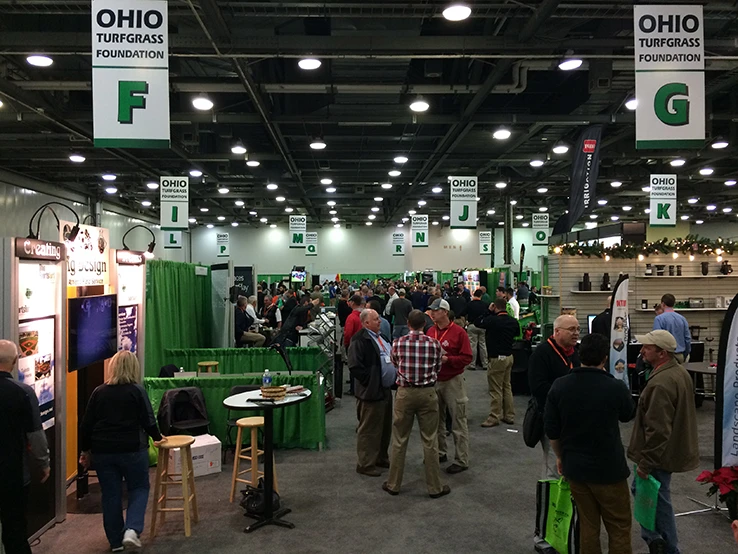
The four-day Ohio Turfgrass Foundation Conference & Show returned to Columbus after a sojourn to Kalahari, a giant indoor waterpark in the northern part of the state. This year’s event included nine hours of activity on the Greater Columbus Convention Center trade show floor and close to 200 hours of education.
Nobody cannonballed into a giant pool in Columbus, but OTF executive director Brian Laurent tells us total participation exceeded 2,300. This total includes attendees, speakers, exhibitors and other guests. The show floor included 20,000 square feet of exhibit space. Both numbers are increases over 2014.
Away from the trade show floor, I spent two days pretending to be an Ohio State student. I didn’t wear a North Face jacket (those are staples on the University of Michigan campus), but I did take 28 pages of notes and bounced from one conference room to the next. Nobody presented a logical reason why Ohio State plays football on the fake stuff.
There was nothing fake about what Keith Kresina experienced. Kresina is the longtime superintendent at The Golf Club, an old-school Pete Dye-designed course 15 miles northeast of Columbus in New Albany. The Golf Club opened in 1967 and helped make Dye, well, an industry legendary. Kresina recently worked with Dye on a renovation and revealed lessons he absorbed from the experience in a presentation he called “The Chance of a Lifetime.” The renovations involved rebuilding greens from the bottom up, installing a new irrigation system, constructing a new set of forward tees, replacing bunker sand, removing trees and re-routing cart paths.
Industry professionals received zero continuing education credit for attending the presentation yet curiosity-seekers filled the room. Kresina emphasized the serious nature of golf course renovations. Receiving a modern irrigation system or new putting surfaces comes with major responsibilities. “Make a wrong decision and you’re stuck with it,” Kresina told his colleagues. “And these are not easy decisions.”
Purchasing decisions also aren’t easy, and Oglebay Resort superintendent Nick Janovich made a bold move when he convinced his bosses to allow him to retrofit two of his existing sprayers with GPS-guided capabilities. Janovich has been spraying with GPS long enough to present his findings at industry events. Oglebay, a 72-hole facility in Wheeling, W.Va., uses the GPS-guided sprayers on its Robert Trent Jones- and Arnold Palmer-designed resort courses. Janovich says converting the two sprayers has trimmed 15 percent from the chemical budgets over the two courses.
Multiple golf industry event regulars also presented at the conference, including the USGA’s Jim Moore, Bob Vavrek and John Daniels, the University of Arkansas’ Dr. Doug Karcher, Penn State’s Dr. Jeff Borger and Ohio State’s Dr. Karl Danneberger.
Leaving the golf room for a presentation or two wasn’t a bad idea. Ohio State’s Dr. Marne Titchenell explained the differences between moles and voles. Moles eat meat and create volcanic-like mounds while voles eat veggies, look like mice and create 1 ½- to 2-inch diameter holes. Titchenell ended her presentation by revealing management strategies for a pest that annoys thousands of golf course superintendents: geese. Here’s a hint: start implementing your harassment techniques early in 2016.
And what’s a turf conference without an across-the-pond visitor? Simon Gumbrill of Stadium Grow Lighting described the renovation and maintenance practices of global soccer giants Real Madrid and Manchester United. The major stadiums in Europe have distinct periods: playing and event seasons. Concerts, tennis matches, truck rallies, etc. are staged on renowned venues, and nobody dares to consider installing a fake surface.
Europe’s best and most passionate turfies would cringe if they visited a city like a Columbus and saw the playing surface at a venue like Ohio Stadium.
Why can’t all of America’s major outdoor sports venues have natural surfaces? That’s the $145.2 million question whenever you attend an event in Columbus.
Guy Cipriano is GCI's assistant editor.