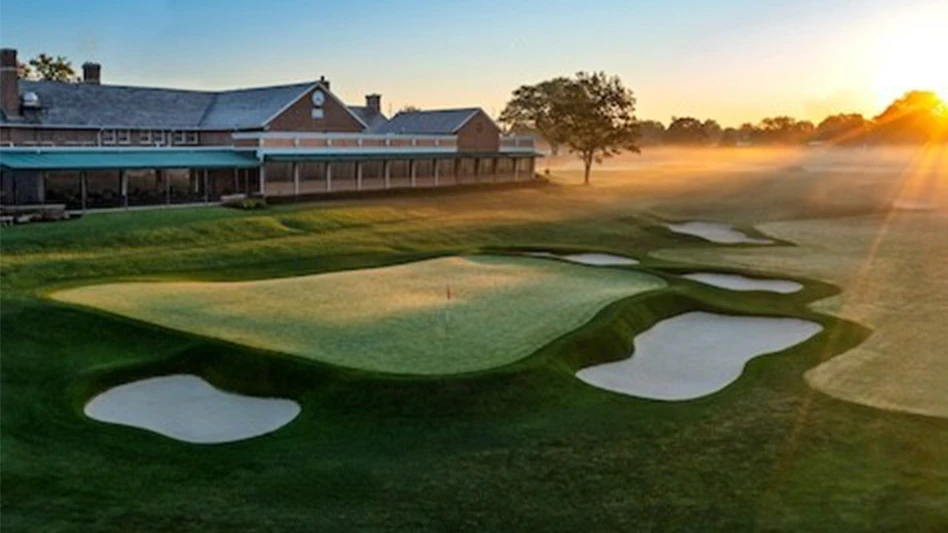
With construction of the Granite Links Golf Club at Quarry Hills, on the Quincy-Milton line, in its final phase, local officials and environmentalists are pressing developers to include public walking trails in the project.
"This is all public land," said Tom Palmer, a board member and spokesman for the Friends of the Blue Hills advocacy group. "It was all built with public money. The public should have access."
Quincy Mayor William Phelan said the partially built 27-hole facility already is a great asset to the city, but he added, "The city continues to hold the developers' feet to the fire on the public benefits, and that includes the walking trails."
Peter O'Connell, one of the principals of the Quarry Hills development team, said walking trails will be part of the completed project, but the layout and design have not been determined.
O'Connell indicated the completed trails might not satisfy Palmer. "Tom Palmer would probably have you traipsing across a green or building a covered bridge across a fairway," he said.
Palmer, a Milton resident and author, has been an outspoken critic of Quarry Hills throughout the project's 13 years of planning and construction.
Built atop former municipal landfills in Quincy and Milton, Granite Links offers spectacular views of the Boston skyline and Boston Harbor, as well as the surrounding Blue Hills Reservation. Historic quarries from Quincy's once-thriving granite indus try have been incorporated into the golf course's design.
Existing walking trails in the Blue Hills Reservation, the state's largest urban parkland, and Milton's Cunningham Park go to the edge of the Quarry Hills site. The Friends of the Blue Hills wants walking trails at the golf course to link Quincy and Milton and connect with existing trails in the reservation and Cunningham Park.
Fill from Boston's Big Dig highway construction project was used to cover the old landfills and shape the golf course. In return for accepting the fill, thereby helping the state get rid of it, developers received approximately $100 million, which was used to finance the construction.
The developers are leasing the property from the municipalities, which receive a percentage of the fees that golfers pay.
The first nine holes opened in Milton last year, and a second nine opened in Quincy in June. The remaining nine holes and clubhouse are scheduled to open next spring.
Last week, delegates from the Democratic National Convention played on the course in an affair hosted by US Representative William D. Delahunt, a Quincy Democrat.
While the golf course is a public facility, its fees are comparable to those of private courses in the area. Annual membership dues for an individual are $4,500, with a $25,000 initiation fee. For nonmembers, daily greens fees for 18 holes, with the cart included, are $90 per person.
Palmer said Quarry Hills officials have indicated they want the walking trails to go around the edge of the golf course on low-lying areas. The only way hikers could get a panoramic view would be by walking up a driveway and into the clubhouse parking lot, according to Palmer.
"I think they are trying to sell a premium golf course, and they think a guy with backpack will hurt them," Palmer said.
O'Connell said the company's land-use planners are still trying to determine the proper location for the walking trails.
The state-approved environmental impact report examining the project indicates that walking trails are to be part of the golf course and that they should link Quincy and Milton, and provide access to scenic and historic areas. The report does not specify a route for the trails.
Milton Selectman Charles McCarthy said he has met with Quarry Hills officials on the trails issue and is hopeful the matter can be resolved.
"I think that this is public land, and while it has been leased, it should not be completely closed off to the public," he said.
Since the Milton section of the course is already built and open, the town has little leverage over the project now. The only town approval the developers need is a permit from the Board of Selectmen to allow alcohol to be consumed by golfers when playing on the nine holes in Milton.
With the construction in Quincy continuing and annual permits required from the city Conservation Commission, Quincy officials are in a stronger position on the trails issue.
After assuming the mayor's job in January 2002, Phelan clashed publicly with the Quarry Hills developers over the terms of the lease and the construction timetable. The issues were resolved in negotiations in late 2002, and Phelan has since praised the project.
The principal Quarry Hills developers are brothers William and Peter O'Connell, who built some of Quincy's best known office and residential projects in the 1970s and 1980s, and Charles M. Geilich, a landfill operator and former Quincy resident who now lives in Florida. Former Quincy mayor Walter J. Hannon is also a Quarry Hills executive.
Source: The Boston Globe