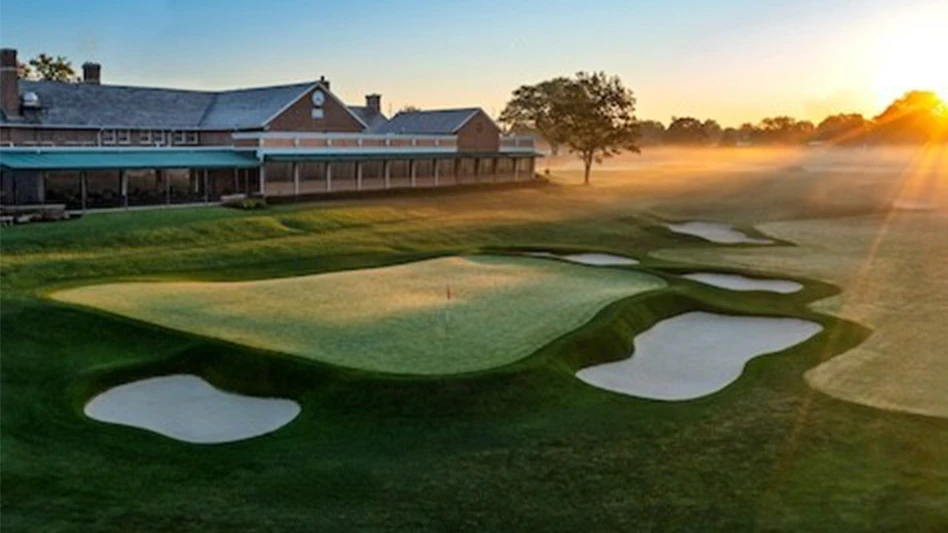
Bloomfield Hills, Mich. - Famed architect Donald Ross designed Oakland Hills Country Club and acknowledged a slightly higher deity upon completion of the course when he said, "The Lord intended this place for a golf links."
Indeed, when the South Course opened in July 1918, with legendary player/partier Walter Hagen as its professional, Oakland Hills was a heaven-sent golf course. But those were the days when hickory shafts were attached to brassies and niblicks, when a good drive traveled 240 yards. The shafts had changed to steel when the club prepared to play host to the U.S. Open in 1951. So Robert Trent Jones, recognized as a legendary architect by some and as a devilish trickster by others, was hired to do a renovation.
Times and golf technology have changed dramatically in the 53 years since the late, great Ben Hogan shot a remarkable 5-under-par 67 during the Open’s final round (the second sub-70 round in the event at the time) to win the title with a 7-over total of 295. He then delivered the most memorable line uttered in a golf victory speech when he said, "I brought this course, this monster, to its knees."
And a nickname for Oakland Hills was born.
"I played the ‘96 U.S. Open there, and I remember it as the hardest course I’d seen at that time," said Stewart Cink, a member of the Ryder Cup team that will attempt to wrestle golf’s most prestigious team prize from Europe when the 35th edition of the matches begin, on the South Course on Friday. "That was before a lot of things changed, the technology and myself. It will be interesting to see the differences. I remember hitting some long irons and having some brutal putts. I don’t know if it will be that long anymore."
The monster has lost a lot of its bite. It will play 7,077 yards; Whistling Straits, the site of the recent PGA Championship, measured 7,514 yards. Two par-5s have been converted to par-4 holes for a total par of 70. And Hal Sutton made it clear by his captain’s selections of Jay Haas and Cink that the course no longer is a test of driving distance.
When Ralph Guldahl won the 1937 U.S. Open at Oakland Hills, he called it a "back-breaker" at 7,037 yards. It’s 40 yards longer now, and today’s game features technology in club-making and ball design that Guldahl and his contemporaries likely could not have imagined.
But "it’s not a 95-pound weakling either," Sutton said.
Oakland Hills remains a formidable test, with fairways narrowed, gnarly rough and hairy collars around its difficult greens. It was built over a pair of dramatic ridges that run across the property and lend surprising slope to any number of holes. Water plays a minimal role. A creek meanders across the 455-yard, par-4 fifth fairway, 300 yards from the tee, and a small pond squeezes the landing area on No. 7, a 411-yard par 4. It also sets up one of the most dramatic shots on the course, the approach to No. 16, a devilish 406-yard par 4.
Two uphill holes that play as par 5s for Oakland Hills’ members, Nos. 8 and 18, will be set up as par 4s measuring 482 yards and 493 yards. The 14th hole is a 473-yard par 4. But even those aren’t monster holes to today’s pros who have the ability to carry the ball 270 yards off the tee.
A new tee and a new twist have been added to the par-4 sixth that typically plays 356 yards. If the new forward tee is in play the uphill hole will measure 310 yards, giving the players the opportunity to take a pop at the green. But here’s the catch: The steeply elevated, two-tiered green narrows in the back and is surrounded by deep bunkers and hellish rough.
"I think the idea is to encourage us to go for it," said David Toms, a Louisiana native who is competing in his second Ryder Cup. "That should make for a lot of excitement, but you have to be cautious. There is a lot of mystery surrounding that green."
Actually, there is mystery in each of them. Oakland Hills, with perhaps the most difficult set of greens outside of Augusta National Golf Club, will require players to manage their games meticulously. It places a premium on accuracy, not length, and anyone who hits loose-approach shots to positions above the hole will be asking for trouble.
"This course certainly has, what I believe, are some of the most challenging and complex greens in major golf," said Kerry Haigh, the senior director of tournaments for the PGA of America and the man who is in charge of course set-up.
That is one area that Sutton, who has been hands-on with every aspect of Ryder Cup planning, will leave to Haigh.
"I told Kerry in the beginning that I didn’t really want anything to do with the setup, because I didn’t want any responsibility with that," he said. "If you doubted what he is capable of, Whistling Straits could have made an idiot out of a genius. He did a great job of setting up that golf course. He has done the same at Oakland Hills.
"It’s going to take management to play this golf course. You’ll have to drive it in the fairway, because the greens are everything I remember them being. And it will take a good iron player. You can’t be a great putter if you putt from the wrong spot of the greens at Oakland Hills. That will be what’s important this week."
Source: Times-Picayune (New Orleans)