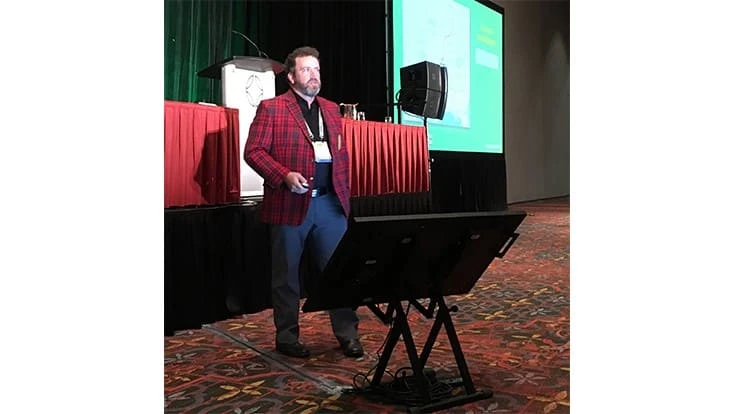
Guy Cipriano
Golf course architect Nathan Crace, ASGCA, has been commissioned by the Recreation and Parks Commission for the Parish of East Baton Rouge (BREC) to begin planning renovations at historic City Park Golf Course in Baton Rouge, Louisiana. The Tom Bendelow-designed nine-hole course will celebrate its official 100th anniversary in 2028. Crace said the goal is to develop a strategy for returning the course to its Golden Age roots while preparing it for the future of the game. But don’t ask Crace about trying to get inside the mind of the original architect from nearly a century ago.
“I’ve never felt comfortable channeling dead architects from the Golden Age and trying to explain what they were thinking at any particular time or on any particular project,” Crace said. He pointed to a column he wrote back in 2007 titled “Resurrecting Donald Ross” that he said applies today more than ever.
“In the early 2000s, we saw an initial surge in ‘restoring’ Golden Age courses back to their early 1900s design,” Crace added. “Old blueprints had been ‘unearthed’ or a notebook was found in an old steamer trunk and suddenly this new cottage industry sprang up Everywhere you turned, people were explaining that ‘Ross would have done this’ or ‘Tillinghast would have done that.’ My argument has always been that if you were to resurrect Ross, Tillinghast or any of the other greats from their time and show them not only the equipment golfers play with, but also how we maintain golf courses in the modern day, they would think you were crazy to try and rebuild what they built a century ago. Why would we assume that they had some unyielding blanket approach to design or that they couldn’t adapt over the course of their careers? They were constantly evolving.”
Instead, what Crace advocates for is a process he calls “Restor-vation.” It’s a phrase he introduced nearly 15 years ago when the craze of Golden Age restoration really began to take hold. He says that “restorvation” is a more balanced approach to preserving the game and its history in the long term, although he admits he knows of at least one project that he lost because the club’s members wanted to rebuild exactly what was built in the early 1900s instead of buying into his philosophy. “I guess restorvation isn’t as sexy as channeling ghosts from the past,” Crace joked. However, he explained that his approach is better for the client and the course in the long run because it has reverence for the past, while keeping an eye on the present and future of the game.
“Ross and other Golden Age architects were at the cutting edge of a new industry a century ago,” Crace said. “Think about that. Think about how differently the game was then: the clubs, the ball, and the way we build and maintain courses. We can’t simply restore what was once there and expect it to thrive, but we also don’t want to ignore it and bulldoze what’s left. That’s why it’s a better balance and that’s why I call it ‘restorvation.’ We restore the original design intent of the Golden Age architect to the absolute best of our abilities with reverence and respect while renovating to the standards of today so that the finished product can withstand the test of time well into the future.”
As examples, Crace added that green surfaces may need to have contours softened to account for faster green speeds resulting from new turf varieties. Fairway bunkers may need to be shifted so that they come into play for the modern player as they did originally. Safety, irrigation upgrades, better drainage, and bunker renovations are also part of his “restorvation” plan. For courses seeing a spike in play – as most have during the pandemic – this may also include expanding tee surfaces to help spread out the wear and tear from additional traffic, upgrades to practice facilities, and adding more back and forward tees to accommodate both low-handicap players as well as beginners, juniors and seniors. Crace believes that a “restorvation” is not just for Golden Age courses. As more and more mid-century courses begin looking for upgrades and a fresh look, the “restorvation” market is ever-expanding.
While Crace said there is no “one size fits all approach” to a proper “restorvation” because each course and client is unique, he explained that part of the City Park project will be to correct some changes made to the course in the 1980s and 1990s they do not fit the style of the original course. In addition to addressing green complexes, bunkers, tree management, safety and better playability, new turf types will be investigated as well as improvements to cart paths and other critical infrastructure such as irrigation and drainage. “We’re very early in the project,” he emphasized. “We are starting the exploratory phase. The last thing we want to do is rush through the process.”
City Park’s original designer Tom Bendelow is known as the “Johnny Appleseed” of golf course architects because he has more than 600 courses to his credit in a 35-year career during the late 19th and early 20th centuries, including major tournament such as Medinah and East Lake. A number of his courses are listed on the National Register of Historic Places and City Park Golf Course in Baton Rouge was the first golf course in history to be awarded the distinction by the National Park Service. Crace said his primary focus for the “restorvation” project will be to bring the course back in line with the historic nature of the site and preserve the heritage of what Bendelow created on the unusually rolling piece of land in the heart of Louisiana’s capital city.
“The goal when we are done is to have the aesthetic and atmosphere of a Golden Age design with the conditions and playability for the modern game,” Crace added. “We want golfers to feel like they’ve walked back in time when they play City Park. As Mr. Bendelow used to say, we want the course to be ‘sporty,’ so we really want to dial up the fun factor for players of all abilities.”
In keeping with his commitment to a reverence for the past and the history of the course, Crace concluded: “It’s important to note that this will always be a Tom Bendelow design. But as a golf course architect, there is no better feeling than golfers walking off the last hole and saying they can’t wait to play the course again. That is the definition of a ‘sporty’ course.”
Latest from Golf Course Industry
- Tartan Talks 116: Doug Smith
- Audubon International adds 127 golf courses to Monarchs in the Rough
- USGA’s GAP preps for fourth year
- Protect your vehicles from rodent damage
- VIDEO: Fun with fairways
- From the publisher’s pen: Humble giving
- Syngenta adds two to western U.S. team
- The Aquatrols Company introduces soil surfactant for Canada