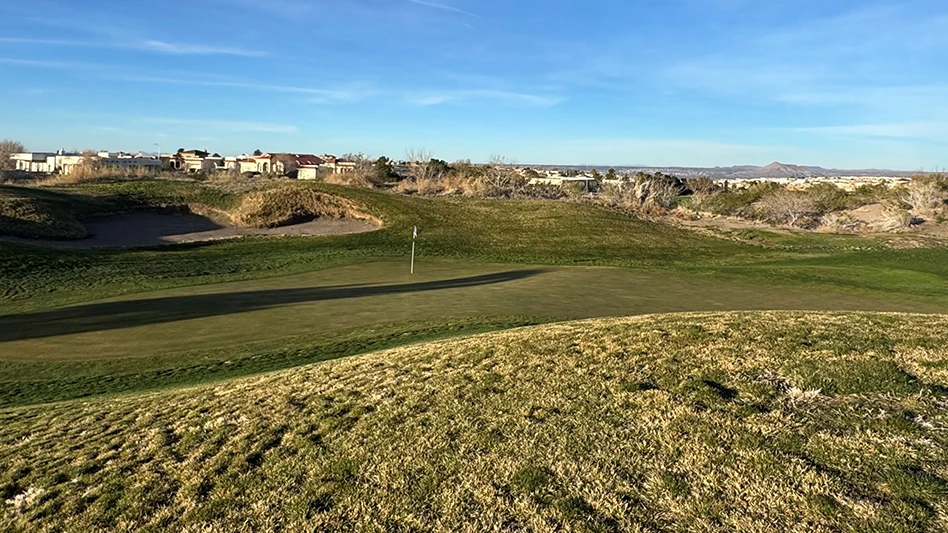
Southern Nevada golf courses are discovering the benefits of replacing thirsty grass with water-efficient landscaping. Since 2001, Las Vegas area courses have converted more than 18.5 million square feet of grass - about 425 acres - to water-smart landscaped, target-style courses, resulting in a 1 billion gallon per year water savings.
Eleven courses in Southern Nevada currently are in the midst of landscape conversions: among them, Red Rock Country Club has converted more than a million square feet this year alone at its Arroyo and Mountain courses.
Spanish Trail Golf and Country Club is undergoing a major overhaul of the entire course, including turf removal, reshaping and improving ponds and moving irrigation lines, said superintendent Jon Valentine. The City of Henderson has launched major landscape conversions at its municipal Wild Horse Golf Course, while the Angel Park Golf Club is in the midst of a 70-acre conversion scheduled for completion in 2008, said superintendent Bill Rohret. So far, he said, players are giving the changes "rave reviews."
"We don't hear any more complaints about balls being lost in the rough," Rohret said.
Along with landscape conversions, golf courses take other measures to save the community's most precious natural resource. All local golf courses have on-site weather stations linked to their irrigations systems by computers that enable each course to base their irrigation schedules on daily weather conditions. These systems also monitor evapotranspiration, or the amount of moisture given off by grasses and plants, so water is applied only as needed.
Most golf courses use valve-in-head technology in their irrigation systems. While typical residential and commercial systems have one valve for every five to 10 sprinkler heads, golf course systems are equipped with one valve for each sprinkler head. This provides them with greater control over watering run times and coverage.
Current drought restrictions subject local golf courses to water budgets, restricting them to 6.3 acre-feet of water per acre. (An acre-foot equals about 326,000 gallons.) Significant financial penalties are applied to any water used over budgeted amounts.
Golf course water budgets are based upon acre-feet of water (including potable, raw, reclaimed and recycled water) for each acre irrigated, including lakes and ponds that exist within a golf course and those serving as golf course irrigation reservoirs. Once measured, the irrigated acreage remains fixed, creating an incentive for golf courses to convert unneeded turf to other styles of water-efficient landscaping. If a golf course expands its course by increasing the number of playing holes, a new irrigated acreage is determined.
To further extend their water savings, golf courses in Southern Nevada primarily use warm season grasses. Some municipal courses don't overseed, so the grass gets almost no water during the winter months and only about two-thirds as much as a cool-season grass, such as fescue, would require in the summer.
Through these many efforts, Southern Nevada golf courses are doing their share in the community's ongoing efforts to conserve water and use it more efficiently.
"Golf courses are the most judicious business about the way they use water," Valentine said. "We don't just set a timer and walk away. Water conservation is one of the biggest parts of what we do every day."