Rob Collins
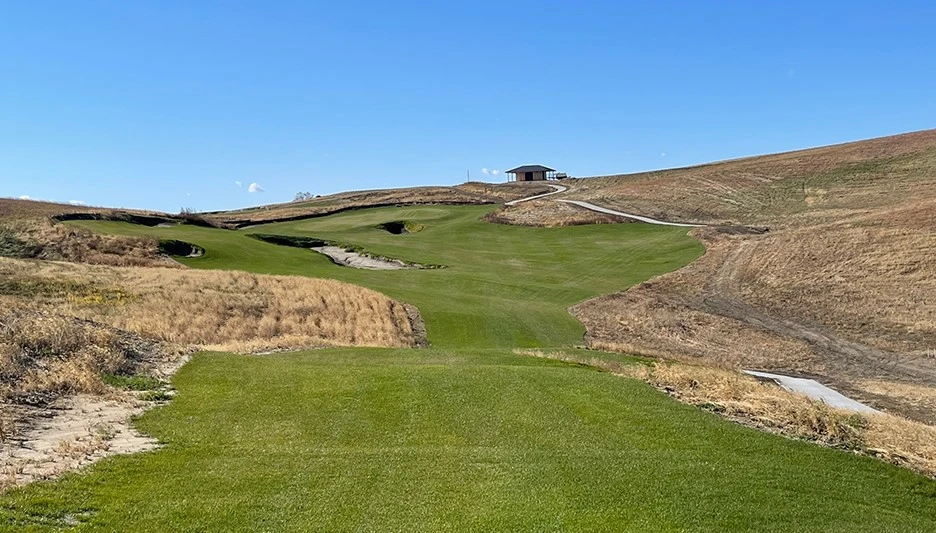
The new Landmand golf course in Homer, Nebraska, will open for public play on Sept. 3, 2022. The course is the first 18-hole effort by the firm of King-Collins Golf Course Design, which created the popular nine-hole Sweetens Cove in Tennessee.
Developed by the Andersen family, which has farmed the surrounding land for four generations, Landmand (the closing ‘d’ is silent) is named after the word for farmer in Danish, reflecting the family’s Scandinavian origins.
The Andersen family already owns the nearby nine-hole Old Dane course, which it built in 2012. The initial contact with Rob Collins and Tad King came about with thoughts to renovate Old Dane, but the project became more ambitious after King and Collins visited Nebraska and viewed several parcels of land. They were captivated by a site in the Loess Hill, above the surrounding farmland, cleared of trees in the 1970s but essentially left fallow for more than 20 years. The 580-acre parcel has become the Landmand course.
“My goals have not changed,” Will Andersen said. “From the beginning until now, all I have wanted is a fun, playable golf course for the community. Anything on top of that is a bonus.”
Everything about Landmand is big. The 7,200-yard course has almost 84 acres of maintained turf through the green, with close to four acres of bunkers and nearly 277,000 square feet of green surface. Four greens are over 25,000 square feet, including the 17th, a tribute to Alister MacKenzie’s legendary Sitwell Park green, which measures a whopping 30,340 square feet. For comparison, the enormous double green for the fifth and 13th holes on the Old course at St Andrews measures 37,000 square feet. “It’s taking our crew about three hours to mow the greens with three triplex mowers,” Andersen said.
“Tad and I knew immediately when we saw the site and met Will that Landmand was the big opportunity for us,” Collins said. “But it came with a catch. The site was and is extraordinarily beautiful, but it was clear straight away that delivering a course worthy of the property would take a mountain of work.”
King-Collins is a design and build practice – Collins is the firm’s principal golf architect and King takes control of managing construction. Landmand was built on loess soil, a mixture of clay, sand and silt, formed by the wind.
“We believe that the total amount of earthmoving to build the course was in the region of two million cubic yards,” Collins said. “That is an enormous volume, but it was necessary to create a walkable, playable course on terrain of this severity, traversing as it does the towering Loess Hills of eastern Nebraska. Thanks to a team filled with outrageously talented golf construction professionals, we are immensely proud of the final product. I believe it will be something that golfers have never seen the likes of before.”
Grassing of Landmand finished in September 2021. Greens are 007 creeping bentgrass, while the through-the-green areas are a drought-tolerant mix of Kentucky bluegrass and ryegrass.
“We considered fescue fairways, but given the nature of the soil, decided that this mix was a better choice,” Collins said. “It can get extremely firm and fast, while also tolerating very dry conditions. Obviously, Nebraska has a pretty extreme climate – very cold in the winter and both hot and dry in the summer, so that was a key factor in our decision making.”
The course will operate via 15-minute tee time intervals and closes Sept. 30 for the 2022 season.
Latest from Golf Course Industry
- Tartan Talks 116: Doug Smith
- Audubon International adds 127 golf courses to Monarchs in the Rough
- USGA’s GAP preps for fourth year
- Protect your vehicles from rodent damage
- VIDEO: Fun with fairways
- From the publisher’s pen: Humble giving
- Syngenta adds two to western U.S. team
- The Aquatrols Company introduces soil surfactant for Canada