Frantic might be too methodical of a word to describe agronomic life at Quail Hollow Club since last May.
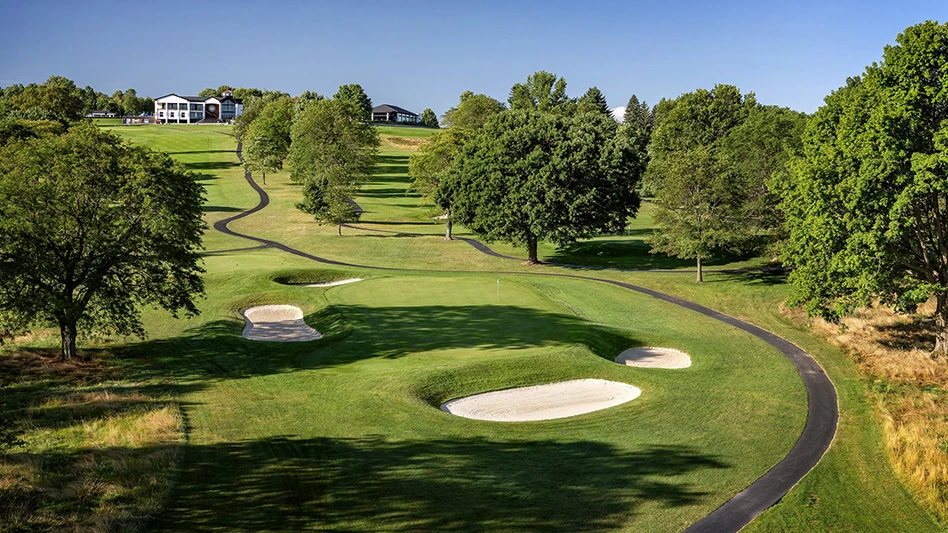
Even before play ended at the 2016 Wells Fargo Championship, the PGA Tour’s annual stop in Charlotte, N.C., surveyors started inspecting the celebrated course for a renovation that commenced hours after the final putt. Twelve weeks and thousands of carefully executed labor hours later, the course reopened last August.  Tweaking, advancing and progressing are part of the Quail Hollow ethos, which suits superintendent Keith Wood’s turfgrass management style. Wood arrived at Quail Hollow on the eve of the 2015 Wells Fargo Championship.
He immediately implemented a fertility program to help turf alleviate the stress produced by water with high bicarbonate levels. Bicarbonates stunt proper root growth and can damage turf quickly. Using experience from previous golf course management stops in the Carolinas, Wood made compost and carbon staples of Quail Hollow’s fertility program. “I wanted to do everything I could to mitigate the effects of the bicarbonates,” he says.
Wood’s curiosity in soil biology stems from a class he took at Rutgers University taught by EarthWorks President and founder Joel Simmons. More than 20 years of managing turf in the Carolinas has proved to Wood the concepts are relatable to heavy clay soils such as the ones he manages at Quail Hollow. Renovate Plus, an amendment that boosts oxygen movement and promotes an active microbial generated nitrogen cycle, helps “buffer the ups and downs,” of water with high bicarbonate levels, Wood says.
“The rock phosphate, the green sand, the zeolite that’s in it … all those things help improve CECs, help improve soil structure, increase microbial activity so that way you are not building thatch as much as you are,” he adds. “You’re just building healthy soil to create a healthy plant.”
Healthy soil allowed the Quail Hollow team to handle a major renovation on an accelerated timetable. The changes included installing Champion Bermudagrass greens, adding three new holes and enhancing bunkers in preparation for the 2017 PGA Championship Aug. 10-13. The club is also hosting 2021 Presidents Cup.
“We wanted the grass to mature as quickly as possible,” Wood said. “We didn’t have a lot of time to build up the necessary nutrient reserves in the soil. We felt as though we needed to amend on the front end to go ahead and do what we can to help the soil mature, allowing the grass to root in quickly and be able to tolerate the stress of having a lot of play. We also tried to limit the possibility of winter injury common in the Carolinas. Young turf that isn’t properly rooted in is very susceptible to cold injury here in the Carolinas so we wanted to do everything we can to make sure it is rooted in and tightly knitted.”
The renovations meant Quail Hollow didn’t overseed with winter rye for the first time in 12 years, and Wood is aiming for quick vigor following dormancy. GPS soil testing and an application of Replenish 10-2-5, an organic fertilizer which includes ammonium sulfate, are among Wood’s early spring plans. “It will get us up and going pretty quickly,” he says. “When the golf course wakes up in late April and early May, it will have everything it needs to succeed.”
Check out EarthWorks Website -- www.earthworksturf.com -- for more information.
Guy Cipriano is GCI’s associate editor.
Latest from Golf Course Industry
- Tartan Talks 116: Doug Smith
- Audubon International adds 127 golf courses to Monarchs in the Rough
- USGA’s GAP preps for fourth year
- Protect your vehicles from rodent damage
- VIDEO: Fun with fairways
- From the publisher’s pen: Humble giving
- Syngenta adds two to western U.S. team
- The Aquatrols Company introduces soil surfactant for Canada