Nick Wall / Airswing (2)
Kauri Cliffs will regrass its fairway corridors with a less thirsty Bermudagrass starting October 6, under the direction of golf course manager Andy Wood. The course will reopen for play on December 10, in time for the high summer season down under.
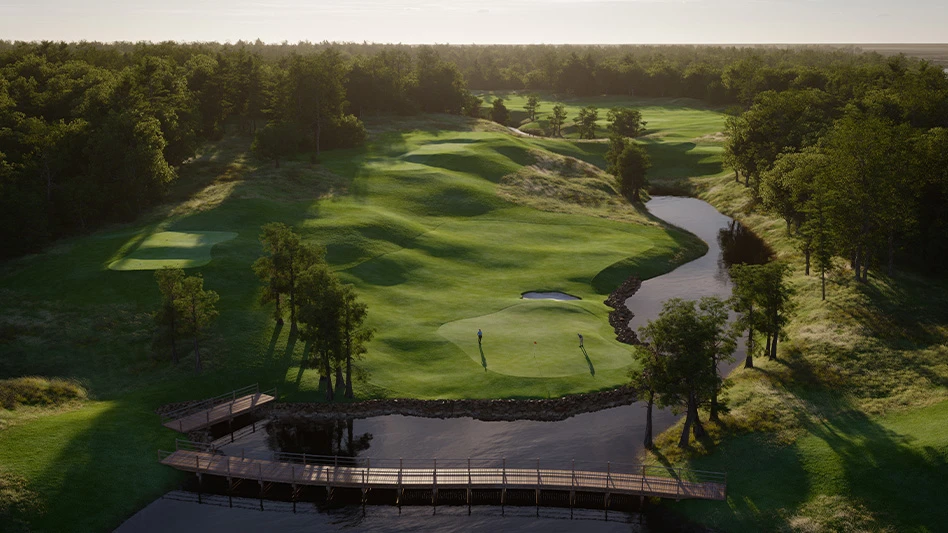
Kauri Cliffs was designed by Nicklaus protégé David Harman and opened in 1999. The clifftop 18 and the adjoining lodge, Rosewood Kauri Cliffs, are widely acknowledged to have created the luxury stay-and-play model that has transformed New Zealand into a popular golf destination.
But the course has not undergone renovation or comprehensive regrassing during the last quarter of a century. What’s more, shifting climatic conditions in New Zealand’s sub-tropical “winterless” north have made wall-to-wall bentgrass less and less practical from environmental and agronomic standpoints. The choice of Transcontinental Bermudagrass on the fairways will conserve water while providing golfers a lusher and hardier playing environment.
“Truth is, while Kauri is among the most beautiful courses on Earth, our bentgrass fairways never looked or played their best in high season — our summer months of November, December, January, February and March,” Wood explains. “With those months getting warmer and warmer, the move to Bermudagrass is something of a no-brainer, especially with the introduction of modern, drought-tolerant, high-performing strains like Transcontinental.
“We take our environmental stewardship very seriously here. Switching over to Bermuda will require far less water. It’s the responsible choice — and the truth is, Kauri will look and play better during those months when everyone’s flying halfway across the world to play it.”
Wood oversaw the COVID-19-era regrassing of Kauri Cliffs’ tees and greens. The latter undertaking replaced 25-year-old bentgrass putting surfaces with state-of-the-art, drought-tolerant Pure Distinction bentgrass. “Our regular guests tell us Kauri, today, has the best greens in the country,” Wood says. “Of course, our sister course at Cape Kidnappers might be a close second.”
Cape Kidnappers, also located on New Zealand's North Island, occupies a completely different climate and ecosystem. The Hawkes Bay region lies a little more than 300 miles to the south of Kauri Cliffs. It's drier and cooler there — perfect for all strains of bentgrass, old and new.
Still, course manager Brad Sim oversaw a comprehensive regrassing of his fairways and greens back in 2022. He worked with original architect Tom Doak and shaper Angela Moser on the project, which included a complete greens reconstruction.
“We rebuilt the putting surfaces from 10 inches down and Angela put the contours back exactly as they’d been before,” Sim says. “Regrassing the greens at Cape addressed our thatch problem, but it also restored the bounce and roll that Doak had in mind when he first built this place 20 years ago.”
The natural setting at Cape Kidnappers is unique. The entire peninsula extends about six miles into the South Pacific. The golf course and adjacent lodge, Rosewood Cape Kidnappers, share a 6,000-acre property that also accommodates the world’s most populous gannet colony. Cape Sanctuary is the largest privately owned and funded wildlife restoration project in New Zealand.
“During the regrassing,” Sim says, “we also embarked on some strategic tree clearing and we’re determined to keep that going. This is an incredibly diverse and lush eco-system. Between Cape and Kauri, I doubt there are two resorts on earth that take environmental protections more seriously than we do. Yet we’re also determined to protect our vistas and the original course designs here.
“It’s a balance. The vision behind that balance is what makes both properties so unique — and so attractive to traveling golfers.”
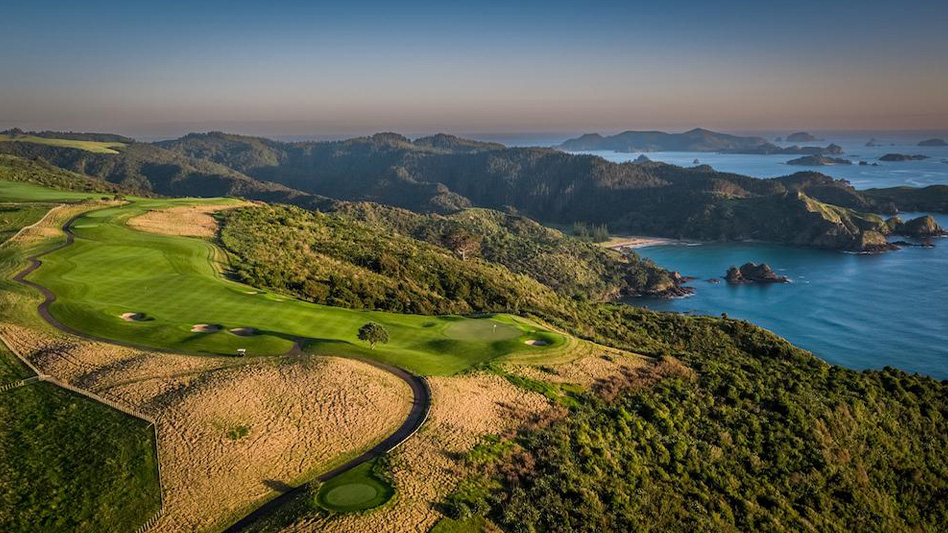
American financier Julian Robertson and his wife, Josie, were the originators and longtime keepers of that vision. They possessed the perspective to identify the coastline at Kauri Cliffs — with its long views over the Cavalli Islands to the South Pacific beyond — as the future home for a world-class golf course.
Yet the Robertons also understood how this ‘sense of place’ can elevate the resort golf experience. Kauri Cliffs, for example, continues to operate as a working cattle and sheep farm over most of its 5,000 acres. According to Kauri Cliffs head professional Mitch McMurtry, there are so many inviting hikes and beaches and picnic spots accessible from the golf course, it’s not uncommon for couples and foursomes to go off the first tee, get distracted, and not return for seven or eight hours.
“Sometimes they go off the first tee like any other group — only, we never see them again!” he says. “We typically check on their whereabouts and well-being before we close the shop. So long as I’ve been here, everyone is accounted for. Eventually.”
While Julian Robertson passed away in 2022, his family maintains ownership of all three of its New Zealand properties. Starting Dec. 1, 2023, Rosewood Hotels & Resorts was entrusted with the hospitality operations at the Rosewood Kauri Cliffs, the Rosewood Cape Kidnappers, and the Rosewood Matakauri in Queenstown, on the South Island.
“We do feel as though Rosewood is the ideal partner to best preserve and protect the hospitality experience that our parents built, and the regrassing projects at both golf courses — alongside water conservation — are part of that commitment to excellence,” CEO Jay Robertson says. “But we also recognize it is the sense of place, the specific geography of New Zealand, that draws traveling golfers here. Southeast Asians come to New Zealand to escape the heat, or maybe the congestion of urban life. For North Americans, it’s a bit different: They have a tradition of traveling from colder, northern climates to warmer ones in winter.”
“Here again,” McMurtry says, “the sense of place in New Zealand is a game-changer: Of course, it’s warm here when it’s wintry in New York City or Chicago. But down here it’s not just warm; it’s summer and the days are long.”Latest from Golf Course Industry
- Course at Sewanee picks KemperSports for management
- WiTricity expands wireless charging technology
- Shining star
- SiteOne Landscape Supply acquires Reinders
- Talking Turf Weeds 17: Waking up your course after winter with Yusif Jaouni and Matt Herrmann
- From the publisher’s pen: Respect the side hustle
- Super-Scratch events to expand nationally
- Beyond the Page 78: Labor solutions, AI talk and mayhem