Years before she turned to turf maintenance, Jennifer Torres worked in the crafts and fabrics department at her local Walmart.
Torres is a mother and a grandmother, a U.S. Army Veteran, a Rutgers University alumna, a superintendent at Westlake Golf and Country Club in Jackson Township, New Jersey. She is also a heck of a seamstress, a handy and applicable skill in this time of social distancing and face masks.
“I grew up in the era when we had home economics and kids learned how to cook and sew and everything,” she says. “That has helped.”
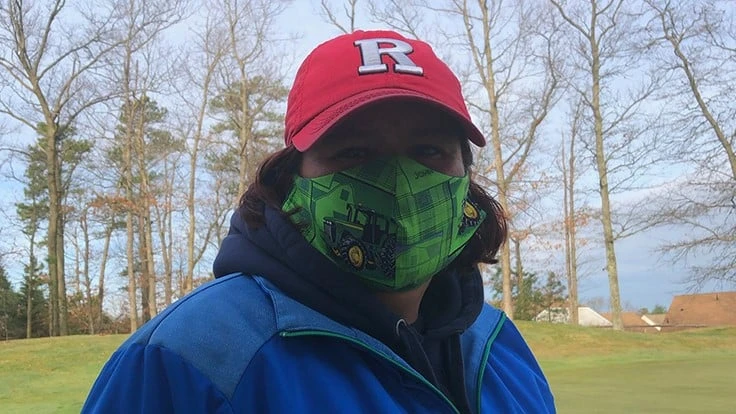
New Jersey was among the first states to require face masks in public spaces like grocery stores thanks to an executive order from Gov. Phil Murphy announced on April 8 and enforced two days later. Torres edged him by almost a week after she downloaded a face mask pattern from Pinterest and started stitching them for her family and her crew. She has finished nearly 60 — the first adorned with John Deere fabric — and requests are still filtering in. She even shipped a couple to the United Kingdom.

“The first few, I had my granddaughter help me cut them out and put them together,” Torres says. “We made it a family affair. We took a video of it and it actually fulfilled her art and math and a few other things for her schooling.” Measure twice, cut once. Good skills for an 8-year-old second-grader to learn.
“I’m getting a little quicker,” Torres says, noting that she has the process down to about 15 minutes. “The hardest part is putting the rubber bands in for the ears, because I do that by hand. The rest I do by machine.”
Masks are more prevalent on golf courses than in many other workplaces — at least among spray techs and other chemical jobs — but more superintendents have said they are wearing them along with their crews on the course and in the maintenance facility. During a webinar Monday, Traverse City Golf & Country Club superintendent Steve Hammon said he has started wearing a mask during everyday life and, looking back at March and April adjustments, he would have implemented the practice earlier both personally and professionally.
New Jersey is still more of a COVID-19 hotspot than northern Michigan right now, but face masks will likely pop up anywhere and everywhere this spring and summer. Torres recommends stitching with 100 percent cotton fabric — preferred patterns might be hard to find where fabric stores have been deemed nonessential and are still closed — and washing them regularly with soap and water.

“I guess there were a couple posts out there that said you could put them in your microwave, and that’s not a good idea,” she says with a laugh. “It actually makes organisms grow rather than kill them.”
If you have no clue how to use a sewing machine — or even just a needle and thread — Torres is still fielding requests from around the industry. Word of mouth, though, is building up a bit of a backlog for folks to cover their mouths. A bandanna or T-shirt will work in a pinch, but neither is as eye-catching as, say, the logo of an equipment manufacturer or your own club.
Matt LaWell is Golf Course Industry’s managing editor.