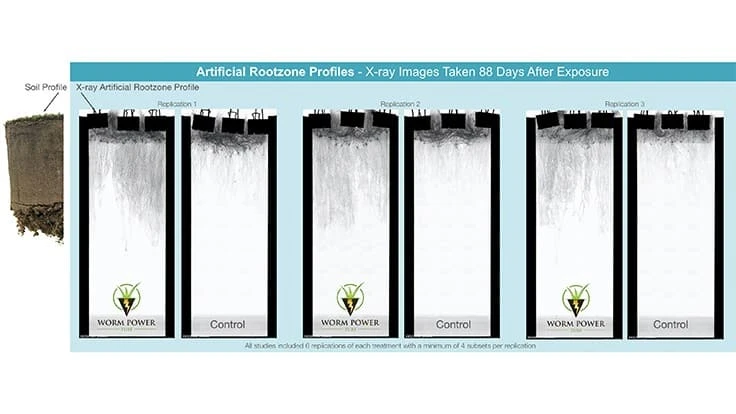
His chest puffed forward and what he considered thoroughly cored and cleansed cool- and warm-season turf root samples in his possession, Dr. Jim Brosnan sauntered from one Tennessee research space to another only to make a humbling discovery.
“When you put samples in an X-ray situation,” Brosnan says, “you see how dirty they really are.”
Because he’s one of the most highly regarded weed scientists in the turf industry, Brosnan’s initial foray into analyzing the root-studying process executed by Phenotype Screening Corporation left him neither undeterred nor frustrated. Above all else, successful researchers are curiosity-seekers. Brosnan wanted to collaborate on a root study with Phenotype Screening, a Knoxville neighbor of his employer, the University of Tennessee. “When I left, I said, ‘If I’m ever doing a root project again, I’m doing it this way.”
Not familiar with Phenotype Screening? Didn’t realize turf roots could be studied via X-ray? Hey, we all learn something new in this business.
First, let’s start with Phenotype Screening, which Brosnan never knew existed until industry acquaintance Mike Prorock mentioned something about the nearby lab. According to its co-founder and president Dan McDonald, the 16-year-old company has spent the bulk of its existence growing and imaging row crops for root analysis. Phenotype Screening agriculture clients use the company’s patented imaging technology to evaluate treatment performance. The entire process occurs indoors. “In our laboratory, we grow crops and measure what’s going on above ground and we measure what’s going on below ground so we can give the whole picture,” McDonald says.
From corn to soybeans to cotton, McDonald has observed the evolution of crop treatments inside the Tennessee lab. The company sought opportunities for a turf-focused collaboration.
The missing link between Brosnan and Phenotype Screening combining on a turf root study was an industry partner. That changed when AQUA-AID Solutions approached Brosnan and Phenotype Screening about conducting a study via imaging technology to determine how applications of Worm Power Turf affect the area, length and distribution of Poa annua roots. The study contrasted traditional methods of studying turf roots involving cup cutters to obtain core samples that are washed, dried and weighed.
Traditional studies present limitations, because a core only provides a snapshot into a “tiny fraction” of a green’s area, Brosnan says. Time and funding are other barriers to executing far-reaching root studies.
Extremely fine root systems supporting turfgrass plants are tricky to capture on X-ray, forcing McDonald’s team to develop a “noise-free environment” for the Worm Power Turf study. Half of the plants were treated with Worm Power Turf while the other half went untreated. Plants were cultivated using artificial soil and cleansed to a micron level low enough to ensure roots could be analyzed via X-ray. Roots were also studied under stressful situations such as canopy closures and reduced water.
“It was very different for us and we had to develop a whole new tool set, because canopy closures are not that big of a deal when you’re just doing something like a soybean plant,” McDonald says. “We usually work on the plant level. We’ll have many of them, but our emphasis is just on one plant. With grasses, of course, it’s a community of plants and you’re trying to optimize the entire community. It’s a different way of thinking and different tools to see if the product is helping or not.”
The project represented Brosnan’s first chance to study Worm Power Turf, a vermicompost extract with a loyal customer base of superintendents who have observed strengthened roots following applications. The results of the study can be found HERE.
“It was rewarding to feel like we did a really good study that had really solid methods,” Brosnan says. “I know the team at AQUA-AID Solutions wanted to do a root project to support observations they’ve had, not only from themselves, but other superintendents. We were able to do this with some improved methods. And I learned there are probably some root studies out there that probably haven’t used optimal methods, and I’m as guilty of that as anybody. Our challenge as scientists is to evolve our methods as technology evolves. This was an example where our team has been able to do that.”
Following the project, Brosnan and McDonald immediately started brainstorming ideas for future collaborations. Curiosity, after all, never ceases.
“They have welcomed turf with open arms,” Brosnan says. “It’s fun as a scientist to work with another team of scientists that’s really open-minded. They could have really easily said to me, ‘We do corn and soybeans here. We don’t have time for this.’ But they were welcoming. It’s led to a nice project and hopefully more nice projects will come from that.”