Lee Carr (2)
Driving home after volunteering at Pinehurst for the first U.S. Adaptive Open Championship in 2022, Northern Ohio Golf Association CEO Robb Schulze was speaking with his colleagues and fellow rules officials. They felt inspired. They knew that they were well-positioned to host an adaptive open locally.
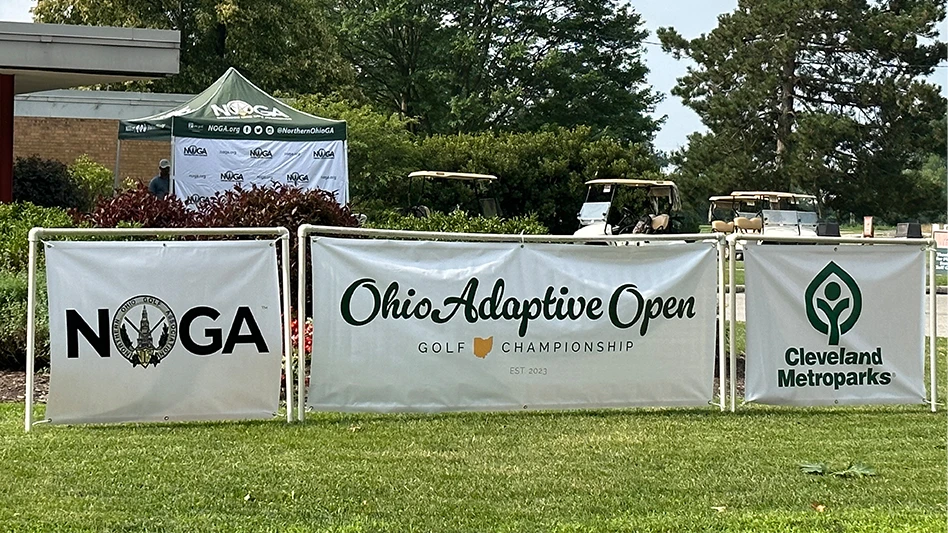
They did more than talk. They planned and worked. A critical component in hosting this event was finding the right venue. Seneca Golf Course, in Broadview Heights, Ohio, is one of eight Cleveland Metroparks golf courses. Recently renovated, it is known as “a course for every golfer” and this guiding philosophy made it an ideal choice to host the inaugural Ohio Adaptive Open Championship. Though initially the event was imagined for 2024, everyone involved realized it could feasibly happen sooner, and together they focused on launching the event in 2023.
Sponsored by the USGA, the second U.S. Adaptive Open Championship was contested at Pinehurst No. 6 in July, across 54 holes. The Ohio event was contested across two days, Aug. 5 and 6, across 36 holes. Both events hosted golfers categorized by their challenges. The tournaments boasted a plethora of helpful volunteers and featured a palpable competitive intensity.

 Seneca Golf Course in Broadview Heights, Ohio.
Schulze is also the CEO of The Turn, an organization serving children and adults through adaptive fitness and recreation programs. His experience helped him position the event for success. “This is a golf tournament and we are good at running golf tournaments, but there are a lot of nuances to an adaptive open,” he says.
There are numerous playing categories, from intellectual disabilities, to seated golfers, to stature and amputee challenges and more. Golfers are eligible through categories qualified as long as their GHIN handicap was 36.4 or lower. Nine players in the field of 23 have a handicap in the single digits.
Challenges and skill levels helped determine every player’s appropriate tee. To be the correct length, forward tees were used, or tees were established in fairways. Players were sent out in pairs, but not necessarily with a golfer from the same classification.
Dave Donner, still serving as superintendent at Seneca, but also newly appointed director of golf operations for the Cleveland Metroparks, says the event had been discussed and planned for during the past few months. The course is in great shape and due to over 7 inches of rain in July, it’s looking particularly green with some striking contrast provided by complementary native areas.
Seneca has renovated 27 holes in the past few years, split into three nines – Furnace Run, Chippewa and Baldwin. For the Ohio Adaptive Open Championship, Furnace Run and Chippewa combined for each round, “This is the first time we have held an adaptive golf tournament and we’re excited about it,” Donner says.
Helping with the event were volunteers from NOGA, The Turn and Cleveland Metroparks. A rules official went out with each group and Donner says the tournament setup wasn’t too different. Bunkers were raked and prepared as usual. Aside from tee discussions and placements, accessible restrooms were placed throughout the course, in addition to tents and cooling stations.
“We cleared some space in the maintenance facility to make sure we can store and charge some of the participant’s carts overnight,” Donner says. “Honestly, it’s not too different, it really isn’t. It’s more about having volunteers here. A few players have caddies and some have an adaptive cart.”
“Penalty areas can be accommodated for,” Schulze says. “Rule 25 covers modifications to the rules for certain categories of players for adaptive golf. It specifies how to take relief and how to do certain things when you are in a seated vehicle or facing different challenges.”
Golf for everyone is about much more than ability, fresh air and physical activity. There are emotional, psychological and social components. “There’s a lot of balance, hand-eye coordination and posture in a golf swing, but the social aspect is greater than what we are doing than on the physical side,” Schulze says. “I like the word community. People are coming together as a group and they are able to talk about their challenges and focus on a common activity.”
The event was a positive experience for all involved.
“There are several organizations across the country that we can contact to continue to learn more.,” Schulze adds. “We will make sure that our event is one that people are going to want to participate in and we are off to a good start. We can build from year to year and it’s going to get bigger as we go. We’re looking forward to it.”
Lee Carr is a Northeast Ohio-based writer and senior Golf Course Industry contributor.