As key figures of the Horry-Georgetown Technical College turf faculty, Ashley Wilkinson and Charles Granger monitor the development of 50 students trying to earn two-year degrees. The golf turf experience at Horry-Georgetown involves juggling school with work on Grand Strand golf courses, leaving the area for internships and volunteering at multiple professional tournaments.
The experience also includes participating in what awaits Tuesday and Wednesday. Horry-Georgetown students interested in golf industry careers will make the 10-mile trip from their Conway, S.C., campus to the Myrtle Beach Convention Center for the Carolinas GCSA Conference and Show.
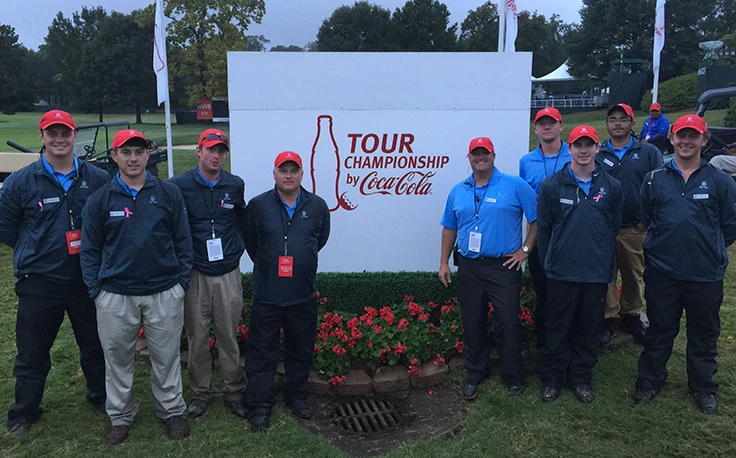
(Pictured: Horry-Georgetown students volunteering at the Tour Championship at East Lake Golf Club)
“It’s a great time to show our students the industry,” says Wilkinson, who held multiple industry positions before pursuing a teaching career. “We don’t have to go anywhere. The industry comes to us.”
The industry is visiting Myrtle Beach during an era that contrasts what Wilkinson and Granger experienced as students in the early 1990s. Course closures far outpace openings, yet dwindling enrollments in turf programs has produced a talent shortage, allowing students and recent graduates more control over the early portions of their career, Granger says.
“You think golf courses and you think just how many stakeholders are involved for you to put that product out,” Granger adds. “There are a lot of people involved. It creates a lot of jobs. I recently did a webinar about attracting young people in our business. I’m 25 years into this and when I got into this as a student, there were probably 80 in my class We now have a class of 30. You see turf programs close and struggling. We are now seeing a ton of opportunity for students – the most since we were building 300 golf courses a year. It’s supply and demand.”
To help its members struggling to fill assistant superintendent, and spray, irrigation and equipment technician positions with qualified candidates, the Carolinas GCSA has added a career minicamp to the conference and show. The event follows the annual turf bowl and begins at 4 p.m. Tuesday, Nov. 15 in the luncheon area of the exhibit. The minicamp is designed to spark dialogue between superintendents and students from six colleges in the Carolinas and Georgia. Wilkinson and Granger envision the minicamp becoming an annual event like the turf bowl.
“We’re trying to get all of these students to meet the superintendents so they can have a better understanding of what they are both looking for,” Wilkinson says. “What the superintendent is looking for might not be what this upcoming generation of graduates wants and vice versa. Every day I can go into websites and there are at least 100 assistant jobs open. It’s crazy. All of my students are hired before they graduate. That’s not just us. That’s every school that has good students. Some of these superintendents need to learn why they aren’t getting interns or how they can solicit help for assistant positions. There’s just not enough talented young people. Hopefully the career minicamp will get even bigger next year.”
Wilkinson and Granger spend part of their summers visiting Horry-Georgetown students interning at golf courses throughout the country. Wilkinson jokingly refers to their travels as the “Griswold Turf Vacation.” The theme uncovered during conversations with superintendents during the most recent tour revealed dire labor situations facing many facilities. Conversations about the talent shortage are sure to fill the conference rooms, trade show floor and hallways in Myrtle Beach. And perhaps some Carolinas GCSA members return home later this week with a lead on a future co-worker.
“You are seeing superintendents starting to hedge their bets a year down the road or 18 months down the road because they might have a first assistant or second assistant that plans on moving up,” Granger says. “They are trying to hedge their bets now to try to get somebody. Some guys are holding jobs nine months to a year for the right candidate.”
Guy Cipriano is GCI’s associate editor.