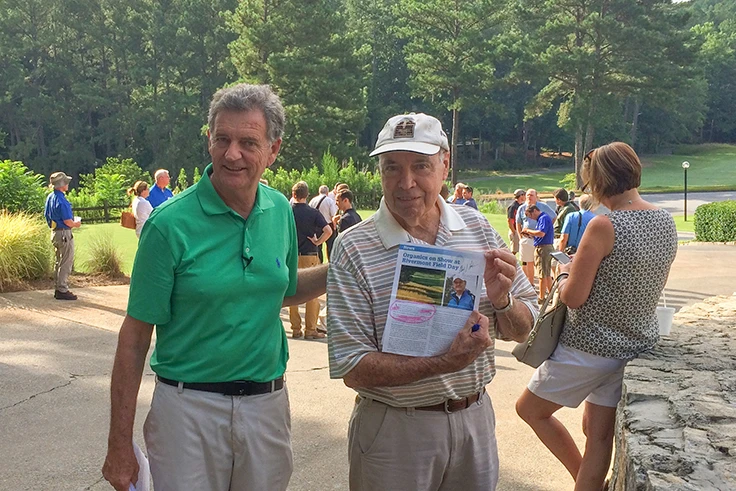
More than 70 people turned out for Mark Hoban’s first organics and native grasses field day at Rivermont Country Club in Johns Creek, Ga., this summer. But for a while, Hoban wasn’t sure if anyone was going to turn up. Anyone, that is, except his mentor and a legend of the superintendent profession, Palmer Maples Jr.
Maples was the first and, for some time, only person to sign up for the event promoting interest in a more organic approach to golf course maintenance. At the least it was a wonderful gesture by Maples, who at 84 is long retired and not likely to be putting any new turf tricks into practice.
But the fact that he did turn up, traveling from his home in Missouri, underlined two of the great truths about the profession that will be as important 50 years from now as they were 50 years ago – curiosity and relationships matter.
Maples made the trip because he is fascinated by the work Hoban and a scattered, but growing, band of others are doing. He also wanted to support Hoban, who was just starting in golf course maintenance when he worked for Maples at The Standard Club back in the ’70s. “Mark was one of my golf course sons,” Maples says.
Maples, of course, remains a giant in golf course maintenance circles. A member of the Georgia GCSA Hall of Fame and Georgia Golf Hall of Fame, he was president of the Carolinas GCSA (1967-69) and GCSAA (1975). In February, he plans to don his white jacket and escort another of his “golf course sons” Bill Maynard, CGCS, to the front of the room when Maynard becomes GCSAA president.
“It was quite an outing,” Maples says of the field day at Rivermont. “It was very interesting, well-attended and I thought it was interesting that a lot of people came from quite a ways away. Clearly, they wanted to at least form an idea of what could be done with organics and I know that’s what Mark wanted to achieve.”
An inveterate experimenter throughout his career, Maples praised Hoban’s willingness to push boundaries in his attempt to reduce reliance on chemicals. “It has always been true that if you’re not killing some grass, you’re not learning anything,” he says. “It is so important not just to know what you can do, but also to learn what you cannot do. That’s how you know what your parameters are.”
Hoban agrees. “You don’t know how low you can go until you go too low,” he told attendees in reference to his use of conventional inputs. “This year we went too low.” Hoban was supported at the field day, as he has been throughout the past few years of his organic approach, by owner Chris Cupit. “We’ve made some mistakes but I think there are great possibilities,” Cupit told the group before heading out onto the golf course. “We need more data. We need more courses to try things.”
That is why Hoban was so keen to share what he’s doing through the organics and native grasses field day. He hopes others will be encouraged enough to delve into a similar approach on their own course and share what they learn.
There was a healthy mix of superintendents, vendors, managers, owners and even some Rivermont members walking the fairways at the field day. One of those members, Neal Thelen, says the early stages of Hoban’s approach weren’t altogether popular. Thelen spent a career in advertising with Procter & Gamble so understands “the power of the visual.” So simply educating members about the new approach was not enough. “You’ve got to sell not just tell,” he says. “It took a couple or three years to catch on once people could see the results.”
Some elements of Hoban program include compost teas, carbon, fish hydrolysate, molasses and worm castings, which he sometimes combines with his aerification sand. He promotes beneficial microbial populations beneath the surface, even shipping in trichoderma, a fungi that attacks plant pathogens. He harvests seed from broomsedge plantings on the course. The goal is to achieve a golf course maintenance program that is more sustainable both economically and environmentally.
The idea for a field day came after a number of vendors of organics asked if they could bring superintendents by to see the results Hoban was achieving. The field day began with a formal presentation in the clubhouse followed by a tour of biological trials on greens, compost trials on fairways, University of Georgia fertilizer trials on fairways, native grasses, wildflowers, worm farm, and compost tea brewers and extractors.
Among others, including University of Georgia’s Dr. Clint Waltz, attendees also heard from Emily Dobbs about Operation Pollinator, supported by Syngenta, which promotes golf courses encouraging habitat for bees and butterflies to gather pollen and nectar. They also heard from Maples at one point when he stepped forward to help hand out data sheets for test plots on a fairway. “Anyone missing the second page,” he cried out waving a stack of papers above his head.
Later, Maples and Hoban came together and the mentor was clearly proud of what his apprentice had become. Hoban shrugged off the praise. “You know what Einstein used to say: ‘It wasn’t that he was that smart. He just stayed with the problem long enough,’”
That’s clearly an approach Hoban is committed to with his organics program.
Trent Bouts is a golf writer and editor based in Greer, S.C., and is a frequent GCI contributor.
Maples was the first and, for some time, only person to sign up for the event promoting interest in a more organic approach to golf course maintenance. At the least it was a wonderful gesture by Maples, who at 84 is long retired and not likely to be putting any new turf tricks into practice.
But the fact that he did turn up, traveling from his home in Missouri, underlined two of the great truths about the profession that will be as important 50 years from now as they were 50 years ago – curiosity and relationships matter.
Maples made the trip because he is fascinated by the work Hoban and a scattered, but growing, band of others are doing. He also wanted to support Hoban, who was just starting in golf course maintenance when he worked for Maples at The Standard Club back in the ’70s. “Mark was one of my golf course sons,” Maples says.
Maples, of course, remains a giant in golf course maintenance circles. A member of the Georgia GCSA Hall of Fame and Georgia Golf Hall of Fame, he was president of the Carolinas GCSA (1967-69) and GCSAA (1975). In February, he plans to don his white jacket and escort another of his “golf course sons” Bill Maynard, CGCS, to the front of the room when Maynard becomes GCSAA president.
“It was quite an outing,” Maples says of the field day at Rivermont. “It was very interesting, well-attended and I thought it was interesting that a lot of people came from quite a ways away. Clearly, they wanted to at least form an idea of what could be done with organics and I know that’s what Mark wanted to achieve.”
An inveterate experimenter throughout his career, Maples praised Hoban’s willingness to push boundaries in his attempt to reduce reliance on chemicals. “It has always been true that if you’re not killing some grass, you’re not learning anything,” he says. “It is so important not just to know what you can do, but also to learn what you cannot do. That’s how you know what your parameters are.”
Hoban agrees. “You don’t know how low you can go until you go too low,” he told attendees in reference to his use of conventional inputs. “This year we went too low.” Hoban was supported at the field day, as he has been throughout the past few years of his organic approach, by owner Chris Cupit. “We’ve made some mistakes but I think there are great possibilities,” Cupit told the group before heading out onto the golf course. “We need more data. We need more courses to try things.”
That is why Hoban was so keen to share what he’s doing through the organics and native grasses field day. He hopes others will be encouraged enough to delve into a similar approach on their own course and share what they learn.
There was a healthy mix of superintendents, vendors, managers, owners and even some Rivermont members walking the fairways at the field day. One of those members, Neal Thelen, says the early stages of Hoban’s approach weren’t altogether popular. Thelen spent a career in advertising with Procter & Gamble so understands “the power of the visual.” So simply educating members about the new approach was not enough. “You’ve got to sell not just tell,” he says. “It took a couple or three years to catch on once people could see the results.”
Some elements of Hoban program include compost teas, carbon, fish hydrolysate, molasses and worm castings, which he sometimes combines with his aerification sand. He promotes beneficial microbial populations beneath the surface, even shipping in trichoderma, a fungi that attacks plant pathogens. He harvests seed from broomsedge plantings on the course. The goal is to achieve a golf course maintenance program that is more sustainable both economically and environmentally.
The idea for a field day came after a number of vendors of organics asked if they could bring superintendents by to see the results Hoban was achieving. The field day began with a formal presentation in the clubhouse followed by a tour of biological trials on greens, compost trials on fairways, University of Georgia fertilizer trials on fairways, native grasses, wildflowers, worm farm, and compost tea brewers and extractors.
Among others, including University of Georgia’s Dr. Clint Waltz, attendees also heard from Emily Dobbs about Operation Pollinator, supported by Syngenta, which promotes golf courses encouraging habitat for bees and butterflies to gather pollen and nectar. They also heard from Maples at one point when he stepped forward to help hand out data sheets for test plots on a fairway. “Anyone missing the second page,” he cried out waving a stack of papers above his head.
Later, Maples and Hoban came together and the mentor was clearly proud of what his apprentice had become. Hoban shrugged off the praise. “You know what Einstein used to say: ‘It wasn’t that he was that smart. He just stayed with the problem long enough,’”
That’s clearly an approach Hoban is committed to with his organics program.
Trent Bouts is a golf writer and editor based in Greer, S.C., and is a frequent GCI contributor.