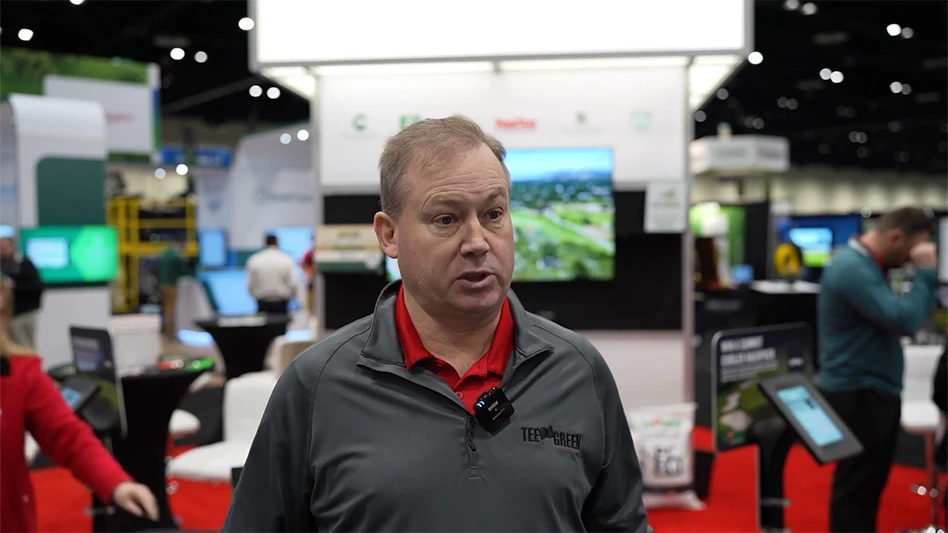
TEQUESTA, Fla.--At Jupiter Hills Golf Club, a high-end 36-hole private course in Tequesta, Fla., Superintendent Steve Ehrbar faced a tough challenge. His membership was accustomed to extremely fast greens, with Stimpmeter readings around 13. "I think it's the biggest challenge I've had at Jupiter Hills. When you have to meet those demands, you've got to keep the plant healthy," he says. "We're putting stress on it, we're mowing at low heights, we're rolling the greens frequently."
But granular nutrient programs weren't giving him the steady growth he needed for his Tifeagle and ultradwarf Bermudagrass greens, with occasional flushes of heavy growth when the Florida weather didn't line up right. He started experimenting with foliars to provide a greater amount of control, beginning with Gary's Green from Grigg Brothers, working it into his standard program during the season.
"As time went on, I saw the benefits of the foliar spray program on the green," Ehrbar says. "It was just a whole lot more predictable than even some of the best granulars."
Over time, Ehrbar filled out his nutrition program with more GRIGG™ Proven Foliar™ products, including its GRIGG P-K Plus®, GRIGG Nutra Green™, GRIGG Manganese Combo, GRIGG Ultraplex® and GRIGG Tuff Turf®. Though he started only using them in rotation during the season, he's currently applying them nearly all year round, he says.
"What I liked about the program was that it's going out weekly," he says. "The weather always changes here. Two weeks from now, it might be in the 80s or in the 60s. I didn't want to put a product out that's going to last 4-6 weeks and just live with the results. If it got warm, we'd have too much of a flush of growth and we'd lose all our speed on our greens."
Ehrbar runs an alternating two-week program. GRIGG Gary’s Green® runs in both weeks depending on the turf needs, anywhere from two quarts per acre to 2.5 gallons per acre, he says.
"It just ranges to what we're trying to achieve," he says. "If we're trying to grow a little grass, I use the Gary's Green really as my nitrogen source."
GRIGG Nutra Green™ also goes out weekly at 176 ounces per acre, except when it's paired with
GRIGG P-K Plus®, when it goes out at a gallon per acre. GRIGG Ultraplex® goes out every week at one gallon per acre. To finish out Week A, he runs GRIGG P-K Plus® at two gallons per acre. During Week B, he swaps out the GRIGG P-K Plus® for GRIGG Manganese Combo at one gallon per acre.
About once per year, he'll use a low rate of GRIGG Tuff Turf®, which gives the turf some rigidity and stands it upright, he says.
"It's good for tournament if you're trying to achieve a little more speed and get a truer ball roll," Ehrbar says.
Ehrbar used regular tissue testing even in early days to make certain the turf was picking up the nutrients he applied, at first testing every 4-6 weeks.
"That led me to see how much I needed of these products. I look at it like a blood test," he says. "You really see if there are any deficiencies. Soil tests are great, but they don't really don't tell you what's going on inside the plant."
Using the foliars with his regular spoonfeeding program, Ehrbar was able to get firm control of the nutrient levels in his turf, and eventually slowed to testing about three times each year.
"It just got to be that the results were the same once I got the program built with different rates," he says. "That's one of the reasons I love the product, just from the fact I know that if I change the rates up a little bit, I know what the turf's response is going to be."
That kind of nutrient progam requires some room on his budget, but he knows that the demands of his membership require high-level results, and he's able to justify it through the quality of the greens.
"I've got years of experience, and there are products that are less expensive, but you get what you pay for," Ehrbar says. "I get very predictable results."
With the nutrient program, he and his crew roll the greens every day, topdress them weekly and mow at about one tenth of an inch to achieve their green speeds on a daily basis.
To test the products, he recommends taking them out to the course's nursery or range to find the correct application rates, even if a colleague up the road has a program that works for them.
"Do not take it out to the greens until you're comfortable with it. There's just too many variables," he says. "And one application isn't going to be noticeable. It's challenging to wait two months, four months, six months. But that's where you see results, if you stick with it."
But time and familiarity with the products will provide the experience to put together the right program to get steady, healthy growth, he says.
"I've just built such a trust in these products, where the turf can handle the abuse we put on it," he says. "It's enhanced control, knowing just how the greens are going to respond."
Kurt Kleinham is a contributing editor based in Akron, Ohio.