Each part here is inspired by hot button topics furiously debated here in the shop.
There are a lot of things that don’t work and a few things that do work. When I find the ones that work, I will let you know. As golf courses, we are less in competition with each other than we are in competition with every other way a person could spend their leisure time.
Basic transportation
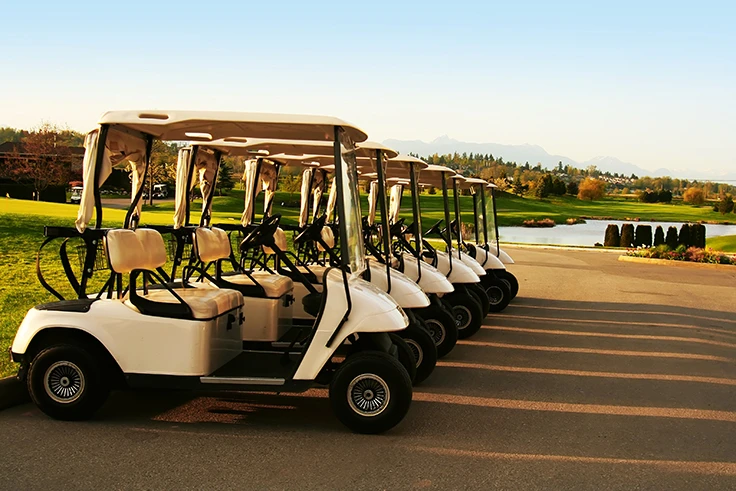
While specialized utility vehicles are nice, it is hard to beat the deal a course can get buying a few of their guest golf car fleet when it goes off lease. Off lease golf cars from your own or another golf course can be had for about $2,000 each, which is less than half the price they are when new. Former fleet vehicles have several advantages: they look like the current lease fleet, parts are available and possibly still interchangeable with the current leased fleet, and are easily modified. One place I worked I maintained 54 of them to be used by the 150 seasonal workers to scurry about the property doing the necessary tasks. I numbered them, built the pickup truck like wood box out of pressure treated exterior grade wood, painted it to give it a finished look and drilled holes in the corners to let the water out. Steel braces in the back to the bumper supported the overhanging box. I also added a trailer pin hitch so they could pull mow trailers. The conversion was quick to build and install after removing the bag rack. These boxes and extra seats are available as accessories that you can buy from the cart customizing places if you would rather buy than build and simply bolt on.
The workers had a habit of smashing the nose cowlings, so I built light weight steel pipe brush guards for them and that put an end to having to buy new nose cowlings. The course kept these modified golf cars (already aged five years as fleet vehicles) for another eight years. After I moved to a different golf course, I saw them go by on trailers as individuals bought them one by one to use at their deer camps.
Beverage cart factoid #27
The beverage cart attendant who gets out of the beverage cart at each stop makes more sales and gets better tips. If you are golf course management, you might want the more sales part. If you are a beverage cart attendant, you might want the better tips part. If you are the customer, you may enjoy the better service part. It looks like a win-win-win to me.
Cutting head adjustment – as a religion
When I asked a visiting factory tech when his company would switch to self-sharpening reels, I apparently touched a nerve. Turns out he is rabid follower of the competing philosophy and would not even consider self-sharpening reels because the bedknife touches the reel.
This could be used as a test of whether or not you truly embrace diversity in the world around you. Can you accept anyone who adjusts mower cutting heads differently than you do?
There are two schools of thought, almost religious in the zeal of their supporter’s belief about bedknife to reel contact – light touch or no touch. Even though Toro wrote the book on mower cutting heads used in the turf equipment certification exam, the Toro salesman will not even get near the subject because he has to sell equipment to both sides of this divide.
For the no-touch group, they set the reels so that they touch and then backlap until they get the gap they want between the bedknife and the reel. It is fast and easy if you do it this way.
The light-touch people backlap to get a sharp edge on the reel and then each time the mower comes in adjust the bed knife so that it touches the reel to cut the test paper. It is fast and easy if you do it this way.
Personally I do both. I have mowers that I set for no touch and others I set for light touch. In order to use the Toro self-sharpening feature, it requires me to set the EdgeMax bedknives to light touch. That is what continuously sharpens them. The trick to being successful with self-sharpening blades is that they need to be adjusted a small amount every day. If you do not, the blades get dull like any other reel.
For the no-touch reels, I set them by ear. I adjust them just to the point I don’t hear them rubbing and using two strips of test paper, ideally the first is cut and the second one is folded by the blades. It is a tricky, tiny adjustment to achieve this.
Which is better? When done right, both cut the grass equally well, so like religion, it is a matter of personal choice. Which wears the reel out faster? It looks about the same to me. To get back to a keen edge, you have to take some metal off to get past where the blade is rounded and that is what eventually wears the reel out.
Paul F. Grayson is the Equipment Manager for the Crown Golf Club in Traverse City, Mich., a position he’s held for the past decade. Previously, he spent 8½ years as the equipment manager at Grand Traverse Resort & Spa. Prior to that, he worked as a licensed ships engine officer sailing the Great Lakes and the oceans of the world.
There are a lot of things that don’t work and a few things that do work. When I find the ones that work, I will let you know. As golf courses, we are less in competition with each other than we are in competition with every other way a person could spend their leisure time.
Basic transportation
While specialized utility vehicles are nice, it is hard to beat the deal a course can get buying a few of their guest golf car fleet when it goes off lease. Off lease golf cars from your own or another golf course can be had for about $2,000 each, which is less than half the price they are when new. Former fleet vehicles have several advantages: they look like the current lease fleet, parts are available and possibly still interchangeable with the current leased fleet, and are easily modified. One place I worked I maintained 54 of them to be used by the 150 seasonal workers to scurry about the property doing the necessary tasks. I numbered them, built the pickup truck like wood box out of pressure treated exterior grade wood, painted it to give it a finished look and drilled holes in the corners to let the water out. Steel braces in the back to the bumper supported the overhanging box. I also added a trailer pin hitch so they could pull mow trailers. The conversion was quick to build and install after removing the bag rack. These boxes and extra seats are available as accessories that you can buy from the cart customizing places if you would rather buy than build and simply bolt on.
The workers had a habit of smashing the nose cowlings, so I built light weight steel pipe brush guards for them and that put an end to having to buy new nose cowlings. The course kept these modified golf cars (already aged five years as fleet vehicles) for another eight years. After I moved to a different golf course, I saw them go by on trailers as individuals bought them one by one to use at their deer camps.
Beverage cart factoid #27
The beverage cart attendant who gets out of the beverage cart at each stop makes more sales and gets better tips. If you are golf course management, you might want the more sales part. If you are a beverage cart attendant, you might want the better tips part. If you are the customer, you may enjoy the better service part. It looks like a win-win-win to me.
Cutting head adjustment – as a religion
When I asked a visiting factory tech when his company would switch to self-sharpening reels, I apparently touched a nerve. Turns out he is rabid follower of the competing philosophy and would not even consider self-sharpening reels because the bedknife touches the reel.
This could be used as a test of whether or not you truly embrace diversity in the world around you. Can you accept anyone who adjusts mower cutting heads differently than you do?
There are two schools of thought, almost religious in the zeal of their supporter’s belief about bedknife to reel contact – light touch or no touch. Even though Toro wrote the book on mower cutting heads used in the turf equipment certification exam, the Toro salesman will not even get near the subject because he has to sell equipment to both sides of this divide.
For the no-touch group, they set the reels so that they touch and then backlap until they get the gap they want between the bedknife and the reel. It is fast and easy if you do it this way.
The light-touch people backlap to get a sharp edge on the reel and then each time the mower comes in adjust the bed knife so that it touches the reel to cut the test paper. It is fast and easy if you do it this way.
Personally I do both. I have mowers that I set for no touch and others I set for light touch. In order to use the Toro self-sharpening feature, it requires me to set the EdgeMax bedknives to light touch. That is what continuously sharpens them. The trick to being successful with self-sharpening blades is that they need to be adjusted a small amount every day. If you do not, the blades get dull like any other reel.
For the no-touch reels, I set them by ear. I adjust them just to the point I don’t hear them rubbing and using two strips of test paper, ideally the first is cut and the second one is folded by the blades. It is a tricky, tiny adjustment to achieve this.
Which is better? When done right, both cut the grass equally well, so like religion, it is a matter of personal choice. Which wears the reel out faster? It looks about the same to me. To get back to a keen edge, you have to take some metal off to get past where the blade is rounded and that is what eventually wears the reel out.
Paul F. Grayson is the Equipment Manager for the Crown Golf Club in Traverse City, Mich., a position he’s held for the past decade. Previously, he spent 8½ years as the equipment manager at Grand Traverse Resort & Spa. Prior to that, he worked as a licensed ships engine officer sailing the Great Lakes and the oceans of the world.