Each year crabgrass and goosegrass seem to make their weedy way north as the golf season progresses. This gives those in the middle of the country a little more time than their southern counterparts to await the arrival of these two annoying comrades. However, this extra time doesn’t make their eventual arrival any less bothersome.
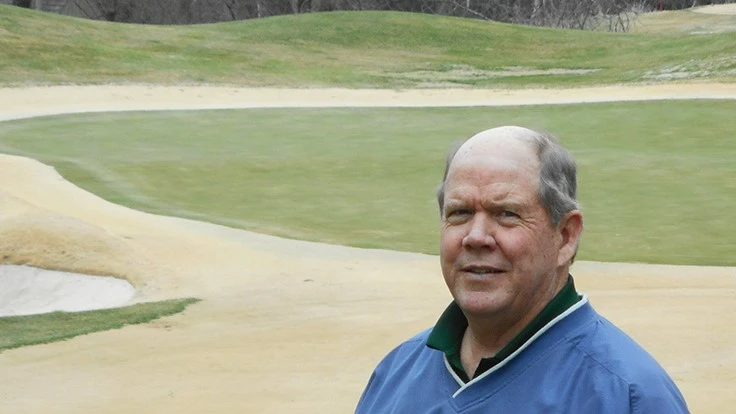
But, some superintendents, like Scott Johnson, CGCS, of Shadow Glen Golf Club outside of Kansas City, hope each year to eliminate that arrival altogether, if at all possible. This can be done with a well-planned and thoughtful preemergent program.
Scott has enough things to worry about each season at the high-end private club, which opened in 1989 and was designed in part by Tom Watson (Kansas City native), Tom Weiskopf and Jay Moorish. He doesn’t need to spend time trying to combat a weed infestation as well. The best way to not worry about goosegrass and crabgrass is to prevent them (as best you can) from settling in at all.
“Superintendents in this area like to wait for a window in February or March to apply,” Johnson says. “A window of warming temps.” This is done with the knowledge that the weeds won’t become a problem for a few more months.
“Goosegrass hits late summer in the Midwest,” Johnson says. “Very late June, through July and into August.” But applying the preemergent early on seems to work best for superintendents in this part of the country.
“It’s good to get it down in the off-time,” he says, “before the course gets busy. It will sit there patiently and wait.”
Scott doesn’t have a weed problem on the surface of his A1/A4 bentgrass greens. His problem, when he’s had a goosegrass problem, is on the edges. “The collars, mainly,” Scott said. “And the zoysia aprons around the greens, just outside of the collars.”
In the past he’s noticed the biggest problem is usually in and around the practice green, which gets more traffic and more compaction than any other green on the course. “The goosegrass gets tracked onto the green from the surrounding bluegrass area.”
These weeds love weak, compacted turf. So much so, in fact, that Scott has a nickname for them.
“I call them ‘Opportunistic Invaders’,” he says. “They love hardpan areas. Especially goosegrass. It’s always waiting for the right conditions.”
The key to fighting these weeds is using the right product, as well as the timing of that use. As mentioned earlier, in this part of the Midwest that timing is often very late winter or early spring.
Perhaps the most commonly used product by superintendents in this fight versus weeds is The Andersons Goosegrass and Crabgrass Control. This preemergent combines oxadiazon (known to many as Ronstar) with bensulide. Bensulide is one of the few organophosphates used as a herbicide. Most of the others in this family are used as insecticides.
“I apply The Andersons Goosegrass and Crabgrass Control three times a year,” Johnson says. “Early spring, late spring and then again mid-September. I apply the normal rate listed on the bag, which delivers 1.5 lbs. of active ingredient oxadiazon and 6.0 lbs. of bensulide per acre.”
Johnson also enjoys the Poa suppression that comes with The Andersons' product. Another preemptive tool he uses is a fertilizer and dithiopyr (Dimension) combo.
“I put out two applications in the early spring and then again later spring, at half rates for each application.”
Despite these extensive measures, every year a few of these obnoxious weedy visitors inevitably beat the odds (and the preemergent) and find their way onto the very edge of Shadow Glen’s collars. But, because of their low numbers (and the effectiveness of the preemergents) they are quickly disposed of.
“The little amount we do get on the edge of the greens each year we cut out with a knife,” Johnson says. “We’re talking about less than 100 plants total, and that’s in a bad year.”
This no doubt speaks volumes about the effectiveness of Scott’s (and other superintendents in the region) preemergent programs.
Johnson says his first assistant, Heath Fisher, has taken the goosegrass battle rather personally. “He’s taken it as his mission in life to kill goosegrass,” Johnson says, only somewhat jokingly.
No doubt Heath is the one wielding the knife when it comes to cutting these guys out of the collars…