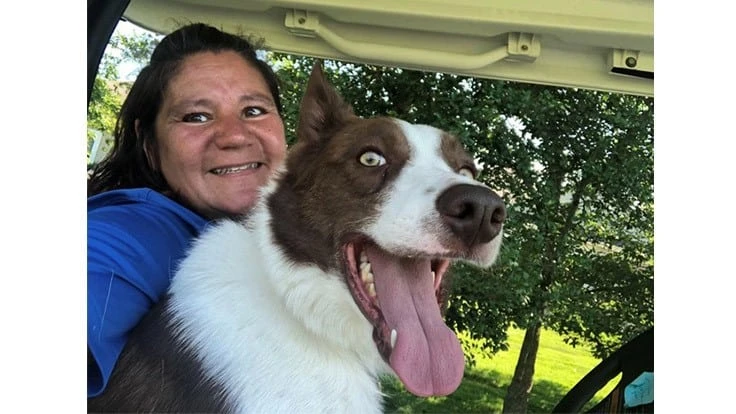
Courtesy of Jennifer Torres
It was a bitterly cold January afternoon. The temperature was 19 degrees; the wind chill was approaching single digits. But Jennifer Torres didn’t care. Rusty was in trouble.
Torres is the superintendent at Westlake Country Club in Jackson Township, New Jersey. Rusty is her working partner, a 4-year-old Border Collie.
Late on the afternoon of Jan. 11 the two were touring their course. Torres was checking to see that some tree removal had been completed. Rusty was running free and doing his job, chasing geese.
The pair soon reached the par-3 sixth hole, which features a pond and on this occasion was occupied by what Torres calls “Two little pesky geese residents,” who were reluctant to leave the frozen pond despite Rusty’s efforts.
Torres describes what happened next:
“He would not give up trying to get them to leave,” she says. “There was actually an area that hadn’t frozen over because the bubblers were in that pond. He made his way into there and the geese finally flew away.”
But Rusty found himself unable to get out of the icy water. Standing near the back tee, perhaps 100 yards from the pond, Torres realized her friend was in trouble. Like the high-school athlete she once was, she took off in a sprint toward the pond.
“I started screaming,” she says, “trying to get somebody from one of the houses (the club is part of a residential community) to hear me at least so somebody would know that I needed help. Not that I thought one of those people were going to jump in the water with me, but at least somebody would know that I was in trouble.
“I grabbed at a stake that was alongside the pond and it wouldn’t budge. At that point, I said, ‘He doesn’t have much time left. He’s starting to struggle and starting to go under,’ so I jumped on the ice with my feet and started breaking the ice and making my way out in the water to him.”

In moments, Torres found herself waist-deep in water and mud. Fortunately, Rusty was only about 10 feet from the bank.
“I was able to grab his collar and kind of lift him up and he came right with me,” Torres says, “and he made it out of the water before I did. By the time we made it to shore, he was OK. I was kind of in slow-mo trying to get out of the water.”
By this time, a resident had emerged from their home to see if the pair were all right.
Both wet and cold, they made the short drive to Torres’s shop where she wrapped Rusty in blankets and put in a call to Flyaway Geese in Charlotte, North Carolina, the company that paired Torres with Rusty two years ago, to ask about signs of hypothermia.
Physically, Rusty was fine. But since the accident, he doesn’t venture far from his friend’s side. “He still clings to Mommy a little bit more than normal,” Torres says. “It wasn’t his fault. He was focused on the geese. He was doing his job.”
Torres posted an account of the accident on her Facebook page and received numerous responses from her professional peers who didn’t have to be told why she risked her safety and possibly her life to rescue her dog.
“Every one of them said they would do the same thing,” she says.
Torres offered these suggestions for working with a dog in cold/icy conditions:
- Take the time to check your course If the ice around the edges of a pond is at the point where you don’t think your dog can get themselves back out. Don’t take them out or make sure to keep them on a leash
- Invest in a very good safety jacket for them. There are some that are very good for the working dog. It gives them an added sense of protection. If they get into a pond or creek and can’t get out, it gives you a little more time to get to them.
Rick Woelfel is a Philadelphia-based writer and frequent Golf Course Industry contributor.





