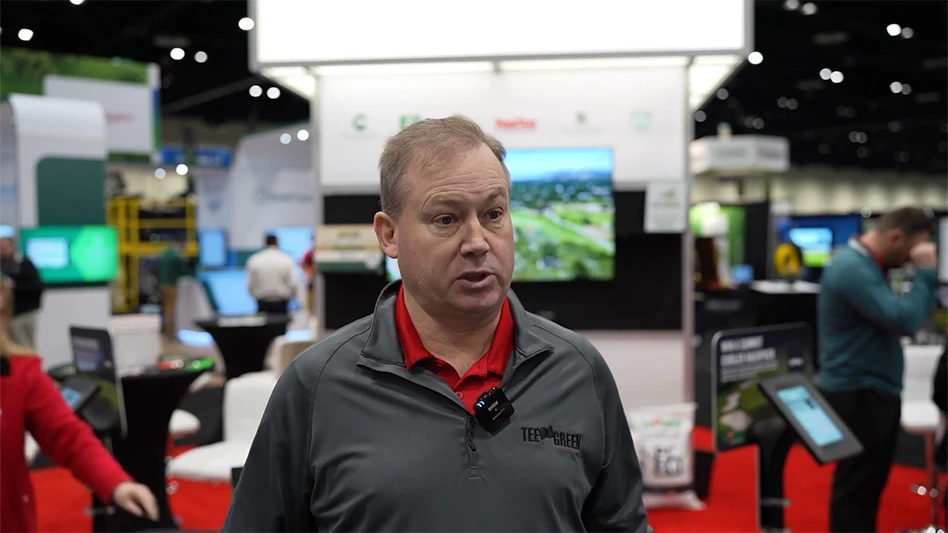
Scott Robinson and Jim Baird discussed the issues of shaded greens and tees at the inaugural Golf Industry Show in Orlando, Fla.
Baird, who works with the United States Golf Association Green Section, opened the session stating the obvious need of light in a plant’s physiology.
“Plants need light to make their own food,” Baird said of photosynthesis.
When it came to maintaining greens, Baird said cool-season grasses are much more equipped to deal with less sun. Annual bentgrass and fine fescue performed the best, while Kentucky bluegrass was the worst of the cool-season grasses.
Of the warm-season grasses, Baird said St. Augustine was the best at thriving in a shaded setting, while Burmudagrass was the worst. He noted that while St. Augustine was the best warm-season grass, it still is less tolerant than even the “worst” cool-season grass.
A number of solutions dealing with shaded greens included the use of fans to reduce the relative humidity, watering less often than in high-light areas and increasing the mower height. With the demand for faster greens, Baird admits a higher cut might result in golfer complaints, but a higher cut is directly proportionate to the turf health.
Changing hole locations more frequently is another option to reduce wear on the greens.
Robinson, an arborist, looked at options ranging from pruning to complete removal of trees. With many courses forced to seek approval of green committees before removing a tree, Robinson suggests using time-lapse photography to show the negative effect of a tree (or trees) on the health of a green. Pictures taken every hour of a location can show where shadows exist and sun appears.
Robinson said this method is cheap, easy and graphic, but only shows the problem and doesn’t suggest a solution. This also requires time, and the sun must be shining throughout the day.
Pruning is a process that meets with far less resistance than removal. Thinning, lifting or reducing the crown can have some positive results.
When crown thinning, 30 percent of the tree is removed, but this doesn’t mean there will be an increase of 30 percent more sunlight. Multiple layers of leaves and branches will still block the sun.
Lifting, a process of removing the lower layers of the tree, and reduction, chopping off the top of the tree, are other options but not aesthetically pleasing or entirely effective.
In many cases, a tree should be removed. Robinson said he’s been brought to a course to consult on just one tree.
In cases where a green committee resists, outside consultants with ample evidence and firepower can be useful. A computer program also is available to map the course, each tree and show its effect on the green at different times of the day and year. This allows a superintendent to virtually remove or prune a tree prior to making the first cut.