.jpg) |
Golf courses know that finding ways to reduce operational costs of their golf car fleet can result in a big savings at the end of the fiscal year. Because the biggest expense for any golf car fleet is the purchase of new batteries, it makes sense that extending the service life of the existing batteries can yield the biggest savings.
While golf car fleet managers regularly charge and add water to golf car batteries, they often neglect some key maintenance procedures that can take extra time to do, but will greatly help extend the battery's service life. By adding these tips to your routine battery maintenance, you're guaranteed that your golf car fleet's batteries will last longer.
Perform an equalization charge
The first is to routinely perform an equalization charge to the batteries about once every month. This reduces the possibility of electrolyte stratification, a condition that occurs when the acid in the electrolyte fails to mix completely with the water and settles to the bottom of the battery case. Over time, the concentrated acid at the bottom of the cell can damage the battery plates and significantly reduce the service life of the battery.
The method used to properly equalize batteries is as easy as using a high-quality battery charger that features an automatic equalizing mode, or has the capability to extend or restart the charging process as needed. If your charger does not have an equalization mode, simply perform a full charge, then unplug the charger so it can re-set. Plug the charger back in and go through another charge cycle, extending the charge by one to three hours. You'll know that the equalization process is effective when you hear the electrolyte bubbling and mixing the electrolyte. Make sure you perform this in a well ventilated area, and wear personal protective equipment including safety glasses and gloves.
Properly water batteries and consider a watering system
After charging, and especially after an equalization charge, the electrolyte in the battery cells can lose water. It's essential to fill each cell with distilled water to the point that the cell plates are covered prior to charging and that the electrolyte is still below the vent tubes. Because it takes lots of time to pop open the cell covers on each and every battery, and fill with water, a watering kit can not only cut the watering time significantly, but also prevent over or under-filling. The cost of a watering kit will often pay for itself over time and many systems typically last five years or more. In addition, many watering kits have a water level indicator that is easy to spot and shows if the cell needs water. Over the course of a year, the time saved in using a watering kit can reduce watering time by 20-40 hours annually, depending on the size of the fleet. Multiply that times the hourly pay rate and you can add up the savings.
Measure the battery's state-of-charge
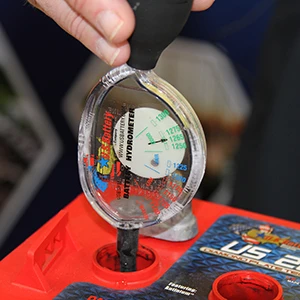
Ninety percent of the problems with golf cars not having enough power or short operating times, are usually due to an undercharged battery. A battery may only need to be fully-charged instead of replacement. By checking the battery's state-of-charge (SOC) with a simple hydrometer, you can quickly determine if the battery is fully charged and diagnose other problems.
Each battery manufacturer has specifications for what the correct specific gravity readings are for their products. Specific gravity readings are usually found on the manufacturer's website and are indicated by specific gravity vs state of charge. If the specific gravity readings are increasing during the charge process, then the battery is still charging and is not yet fully charged. At full charge the specific gravity will stop increasing over several successive hourly readings. At that point, you'll know the battery is fully charged. If all of the battery cells are reading below the manufacturer's specifications for fully charged specific gravity , the battery is discharged or not fully charged. The battery should be fully charged including an equalization charge.
If batteries have been inactive and not charged for long periods, or have been subjected to long periods of undercharging, they may become sulfated. Sulfated batteries typically have many cells with low specific gravity readings even after a full charge. They can usually be recovered by implementing an equalization charge after every full charge/discharge cycle for five to 10 cycles. Recovery will be indicated by gradually increasing specific gravity and runtime after each equalization charge. The batteries may consume more water during this recovery so be sure to check water levels more frequently.
If you perform these three basic maintenance procedures, along with other routine tasks like checking the tightness of terminal connections and cleaning battery posts with water/baking soda solution, you will see a dramatic difference in the overall service-life of your fleet's batteries.
After you begin to see some real savings occur, it will definitely change the way you think about battery maintenance procedures and the importance of taking the time to perform them.
About the author
Fred Wehmeyer is the senior vice president/engineering at U.S. Battery Manufacturing. For additional resources on battery maintenance and videos demonstrating the techniques mentioned here, visit www.usbattery.com.





