.jpg) |
Editor's Note: Images courtesy of Gordon Moir
THINGS YOU MAY NOT KNOW
Over the years, I have had the good fortune to visit St. Andrews a number of times. Whether it was visiting Walter Woods, Eddie Adams or Gordon Moir, it was always a pleasure to visit the birthplace of golf. There is so much history in the town of St. Andrews it is surely a pilgrimage I would recommend to anybody.
My first visit to the UK was in 1982 when a group of U.S. superintendents went over to share ideas and information at a conference held at Cambridge University. The dormitory I stayed in was built in 1452, a mere 40 years before Columbus discovered America. The people of England and Scotland are quite warm and happy to share their culture and history. When you visit, be sure to visit as many venues as you can throughout the United Kingdom.
So how many people maintain The Old Course at St. Andrews? Gordon Moir shared that there are 14 full-time staff, including Gordon McKie. They take on eight more staff from late-April until October, but four of those people only work half-a-day. During The Open, staffing ramps up to 64 people and that includes the staff from The Old Course and from the other six courses within The Links Trust. Only eight of the 64 are volunteers and are either staff who have worked for The Links Trust previously or they are from clubs in the immediate area. There are no rookies in this group and all are experienced greenkeepers.
 |
Many golf tournaments require additional support in terms of equipment. However, when you have six other golf courses, it is easier to fill your needs. Toro is the official supplier of turf care equipment and they supplement the fleet with seven new 3400 mowers to mow the fairways and a few extra Workmans.
When Gordon Moir was asked who the actual owner of St. Andrews is, he responded… ”Technically, the golf courses are owned by Fife Council which is the Local Authority. As government has evolved, it has been passed to them from originally the Town Council of St. Andrews. This was in 1974 when an Act of Parliament was passed to protect the courses for the residents of the town and others thereto. They did this by forming the St. Andrews Links Trust which is the body now responsible for managing the Links including who has access, the fees they pay and how they are maintained amongst other things. All courses are public and open to all although a handicap certificate is required for The Old Course.”
Should anyone ever be fortunate enough to play this great venue there are advanced reservations through the Links Trust and there is also a daily ballot in which you might be fortunate enough to be paired with someone who has an opening in their group. The cost for a round on The Old Course is 170 British Pounds or $265.
Now that millions have watched the 2015 Open, you may find it interesting to know the various grass types that are on the golf course. According to Moir, the grass on the greens is a real mixture that has evolved over the years from what was there. They are predominantly fine fescue and in any overseeding work done in the last 10 years they have also used fescue.
Intermingled through the sward is colonial bentgrass, perennial ryegrass, crested hair grass and Poa annua. The percentages change throughout the year as the climate changes. Moir shared that in a botanical survey done by the Sports Turf Research Institute the recent results were as follows:
-- Fescue 50%
-- Bengrass 25%
-- Poa annua 10%
-- Ryegrass 4%
-- Others 11%
The other category included crested hair grass, which is indigenous to the property.
Fairway grass composition is very similar with a slightly higher fescue content. The specific biotypes are indigenous to the area, soil type and climate. Unless you can duplicate the exact conditions, it is highly unlikely that those grasses would work in most other parts of the world. We must remember that it is seaside with ample precipitation and a wonderful sandy soil to grow the grass on. It isn’t often that you see a golf championship played with golfers wearing gloves at the end of July!
Since I was able to have Moir share the information on grasses it was only natural that I found out about the height of cut. While things could change based on the weather, the normal height of cut for The Open would be in the region of 4-4.5mm. For our U.S. readers, that would be .157-.177 inch. I think this shows that high quality greens can be maintained at a reasonable height of cut. Tournament agronomic practices are no different than any of the other big events with brushing, multiple cutting, rolling, etc. as needed. With the size of greens at The Old Course and also the many undulations, the speed for the tournament was more than adequate for the players. Fairways, tees, approaches and green surrounds were all mowed at 7.5-8.5mm. For those in the U.S., this would be .295-.334 inches or tighter than what most US courses are accustomed to.
Like most links style courses, trees are not a part of the golf course. The rough is comprised of fescues, bentgrass, sweet vernal grass and crested dogstail. By design, the rough is not uniform and at times a player might have a good lie but best to avoid it at all costs. Parts of the rough had wildflowers such as Lady’s bedstraw, sorrel, harebell, eyebright, bird’s-foot trefoil, oxeye daisy, Devil’s-bit, scabious and yarrow. The shrubs that caught a few stray balls included whin and gorse but most of that is on the perimeter of the golf course.
FINAL DAY SUMMARY
Throughout the 144th Open Championship there were ups and downs. Weather played a major factor in how the course played and even when it would be open for play. Ultimately, the Champion Golfer of the Year was determined in a four-hole playoff of an event that was extended into five days. Zach Johnson is the victor and recipient of the prestigious Claret jug.
The Old Course at St. Andrews stood the test of time as it has for nearly a half-century. While the grasses haven’t changed much in that period, the conditioning has and it was superb for this year’s tournament. Hats off to Gordon Moir and Gordon McKie and all the staff of The Links Trust that dealt with the changing weather.
THE OPEN
Day 3 - Saturday
WEATHER
Weather, weather and more weather created problems to the point the greenkeeping team was in a wait and be ready position. Gordon Moir shared “We’re obviously disappointed that the event has been affected so much by the weather, especially when the course is probably the finest it has been for the past four or five Opens. Three weeks ago it was quite brown and very firm but with the 30 mm of rain in the space of three hours on the 4th of July and further showers of 5-8 mm every third or fourth day since, it has greened up considerably and while the firmness has been retained, the real bounce has been taken out to an extent.”
With the modern technology available to golfers, greenkeepers and people watching the event... I found it quite interesting to see the article produced by Dr. Micah Woods. While TV commentators estimated the wind speed and gusts Dr. Woods used the nearby weather station to much more accurately and scientifically share with his readers the actual wind speed.
It actually was quite a bit brisker than the commentators mentioned -- >>CLICK HERE.
SPENCER ROBINSON
Spencer Robinson is very familiar with The Open Championship and has carried it various times writing for a number of publications. I reached out to Spencer for some insight and he shared the following with me.
The R&A released the attendance figures through Friday. Practice days were up more than 3000 people as compared to 2010 to reach 41,377 attendees. However, Friday attendance of the event was down almost 4000 to 39,815 people. In total, through Friday, attendance was 116,052 as compared to 115,500 when The Open was last at The Old Course in 2010. It surely may have had something to do with the weather conditions.
Outside the ropes, Spencer shared some important information that came from the many meetings that take place during an event of this magnitude. Spencer attended a press conference with International Olympic Committee President Thomas Bach. Asked whether golfers will perceive a gold medal more important than a Major win he said “Let them make the experience and then ask the gold medalist after he and she has been standing on the podium listening to the anthem and being celebrated by the world. They will give you an answer.”
PLAY SUSPENDED
Third round play was suspended for the day on Saturday.
Again weather played a major factor and it would be 24 hours before play would begin again on Sunday for the third round. It was decided that the third round would be on Sunday and the final round would be on Monday, weather permitting.
THE OPEN
Day 2 - Friday
WEATHER
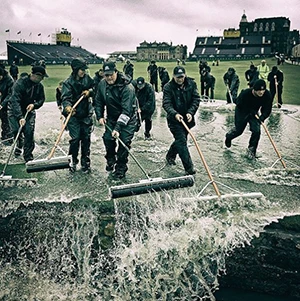
Weather can certainly be a game changer in golf. Today was no exception as blustery conditions created challenges for the greenkeepers as well as the players. Several hours of rain produced 25 mm of rain (or close to 1 inch or rain). While the volume was large the puddling was massive even on a sand based golf course.
Players were given notice that the course was unplayable and play was delayed for several hours. Anytime you get players out of their routine it can create havoc. Some players waited hours beyond their supposed tee times for Thursday. Later tee times saw a greater wind with gusts up to 47 kmh (40 mph)! While the wind helped to dry the course out it also created challenges for golf balls in the air. The wind also had to be factored into putting on parts of the course.
So how do you get hundreds of puddles of water off of the golf course to be ready for play? The answer is easy. Many of the St. Andrews greenkeepers and volunteers manned their squeegees and pushed the water to channels and the rough. Gordon Moir indicated that half of the rain fell in about 30 minutes causing the surface puddling.
LEADERS OF GREENKEEPING
Gordon Moir is the director of greenkeeping for St. Andrews Links. He has worked for the Links Trust for almost 24 years and has been in his current role since October of 2000. No rookie for The Open, Gordon is working his 5th Open and has overseen three of those. If that wasn’t enough experience then add two Women’s Opens, The Amateur, a Curtis Cup and 14 European Tour events!
 |
Over the years, I have had the good fortune to know Gordon and he is always so helpful in sharing information. I am thankful for his daily insight into what takes place behind the scenes during The Open.
In addition to Gordon Moir there is another important Gordon managing the Old Course at St. Andrews -- 47 year old Gordon McKie. Mr. McKie started his career at Tain Golf Club, which is a Tom Morris designed links course 5 miles from Royal Dornoch, as an apprentice. After rising through the ranks at Tain he was appointed Deputy Course Manager on the Eden Course at St. Andrews where Mr. Moir was the Course Manager. At the time Mr. Moir was made director of greenkeeping Mr. Moir became the course manager on the Eden. Mr. McKie moved over to the same position at the New Course (built in 1895) and eventually to Course Manager at the Old Course in April of 2007. This is the second Open Championship for Gordon McKie but he has also overseen two Women's British Opens, a Curtis Cup and the Alfred Dunhill Links Championship every year since 2007.
THE OPEN
Day 1 -- Thursday
THE HISTORY
Two simple words describe the oldest and most international championship in professional golf. There are many “Opens” in a variety of countries but none are as old or as celebrated as The Open. This event has always lived by the guiding principle of crowning the Champion Golfer of the Year!
The first event began in 1860. At that time there were 8 professionals playing for the title of Champion. The original prize was a belt. It was made of Morrocan leather embellished with a silver buckle and emblems. At the end of each of the initial competitions the belt was left to be worn by the next champion. It was decided that the “Challenge Belt” would be retired when someone had been crowned champion for three consecutive years. It only took 10 years for that to occur. Tom Morris junior not only retired the belt but won a fourth consecutive championship and became the first person to win the Claret Jug as all future champions would come to know the prize for excellence in golf.
This week’s event is the 144th Open. It has been played at only 14 courses over that time. Those courses include:
- St. Andrews
- Musselburgh Links, The Old Golf Course
- Royal Birkdale
- Royal St. George’s
- Prince’s
- Muirfield
- Royal Liverpool
- Carnoustie
- Royal Portrush
- Prestwick
- Royal Troon
- Royal Cinque Ports
- Royal Lytham & St. Annes
- Turnberry
THE COURSE
The venue for this year’s Open is the venerable Old Course at St. Andrews. This wonderful test of golf has been around for more than 500 years. Since 1873 there have been 28 Opens held at St. Andrews. Over those years the golf course has withstood the test of time with minor adjustments to keep pace with technology of the various eras. Today the course plays to Par 72 and a length of 7297 yards. St. Andrews is a links style course and very little earth was moved, over the years, to provide such a wonderful golf course. Players will find undulating fairways and many of the greens are similarly a challenge with their many slopes. Several of the holes share greens and St. Andrews is special with these double green complexes.
LEADUP TO THE 2015 OPEN
There has been a fair amount of press leading up to this year’s event. Certainly some of that has been the return to St. Andrews but it is hard not to follow Jordan Spieth in his quest for another major in this calendar year. The test of a true champion is not only the number or wins and majors but also their ability to plan a broad variety of golf courses. Augusta, Chambers Bay and St. Andrews are all quite different and create their own challenges.
While July is mid-summer, the weather in the USA is a bit different than we see on this side of the pond. Cool mornings with temperatures near 50 degrees Fahrenheit and daytime highs of 64 are the norm. Rain and wind are not only normal weather events but a major factor in how the golf course will play.
THE MEDIA
On Thursday the golf course looked healthy and the commentators praised the greenkeeping staff for all of their efforts to provide an excellent playing surface for the championship. It was apparent that frequent rains have benefitted the fescue throughout the golf course. Highly likely that the winds will blow a few days of the championship. Days like that will make sub-par rounds very difficult.
Several of the media mentioned that the greens were rolling 10 feet on the Stimpmeter. Hopefully that will bring reality back to the many golfers around the world that demand unsound speeds for so many courses. Great golf can be contested at reasonable speeds!
Latest from Golf Course Industry
- Tartan Talks 116: Doug Smith
- Audubon International adds 127 golf courses to Monarchs in the Rough
- USGA’s GAP preps for fourth year
- Protect your vehicles from rodent damage
- VIDEO: Fun with fairways
- From the publisher’s pen: Humble giving
- Syngenta adds two to western U.S. team
- The Aquatrols Company introduces soil surfactant for Canada