 |
Many people don't appreciate how closely linked the turf market is with developments being made with agriculture.
In fact, it is from the ag market that many innovative turf products are born, says Jan Buberl, director of BASF's specialty products department.
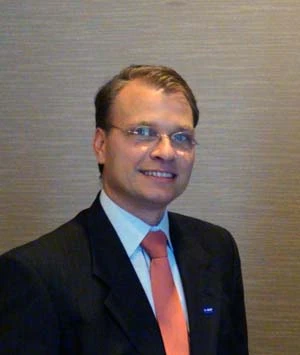
For example, Buberl announced at the 2012 Agricultural Solutions Media Summit, which took place in Chicago June 4-6, Lexicon, a new fungicide scheduled to hit the turf market in 2014, owes its origins to a similar ag product called Xemium. The company’s R&D BASF's Jan Buberl and GCI's Mike Zawackipipeline also includes herbicides that suppress seed heads on zoysiagrass, and products that use absorbent polymer technologies to improve water use efficiency in plants.
GCI sat down with Buberl to get his thoughts on the golf market, the impact of the recovering economy on the turf market and how products under development eventual reach golf course superintendents and other turf professionals.
What are the main challenges you see in the turf market facing in the next 3-5 years?
Hopefully the economy with recover, that’s number one. For me, what will be the golfer of the future? We have to tackle this topic. You and I we don’t have the time – we don’t want to spend hours and hours to play 18 holes of golf. How can you make this game quicker, how can you make it appealing to a broader population of people? The other key thing is the discussion around sustainability. You see the discussion of water and water restrictions in places like Florida and the panhandle in Texas, it’s huge. If we don’t handle this, sustainability and the public pressure around this is big. I’m on the board of RISE, so I hear a lot of things and discussion especially about new legislation in the Northeast. If we don’t manage this in a proactive way, we have challenges to really make sure we down the road have tools in our hand to manage the golf courses and the lawn care. If you don’t tackle sustainability proactively and change the perception in the broader population …. People have no clue what we do. It’s something we have to tackle and the industry has to tackle. It’s a very long journey, but we have to start somewhere. We’re convinced this is the journey we have to take and how to get the industry better perceived.
Earlier today we learned about a partnership BASF has with Monsanto to develop new crop systems. Do you look for similar partnerships in the turf markets?
We work in the T&O world with some third parties, especially around equipment solutions. What we say is we want to bring product solutions to the customers. BASF doesn’t have the full expertise in equipment, so we work with third parties on this piece. But mostly we have interaction with BASF units that aren’t the ag units. We work very closely with the polymer division. When we talk about water efficiency – we work with our other division that produces a super-absorber. Joe [Schuh’s] team has a very close relationship with universities. We have a network in terms of third-party collaborations. I tell you that I personally think we have to broaden our open innovation approach, because we miss some opportunities, but it’s a process. It’s a process to learn, and if you would have listened to the discussion we had a couple of years ago with Monsanto, they were key competitors – no way that you work with them. And today, we say it’s a great collaboration. You have to find a way to work with people in a trustful environment.
Can you give me an example of a product solution?
We have one in the cooker, but it’s too early to tell.
What’s your biggest concern right now?
Where is the golf market going? If you look at statistics, it’s going down in terms of the number of golf courses. We have a huge population of superintendents who are waiting to go from assistant to main superintendent. Where are these people going? The other concern is also the discussion we had about how can we make golf more attractive to a broader population of people – but also more attractive in the perception of people. How can we make sure golf and sustainability is in the forefront of people’s minds, and makes sense? In my neighborhood, I enjoy the conversation with my neighbors every time. Because you have to change the perception day in, day out by really starting to talk openly about it.
The specialty markets see a lot of technology come from the ag divisions. Do any innovations from specialty ever make their way to ag side?
There’s no way this happens on the active ingredient side. If you’re developing an active ingredient, it costs about 200 million Euro. I can make the best business case, I can treat all the lawns in the U.S., I will never get there. The thing is, yes, there is some exchange, but it’s primarily around formulation technology, application technology. There are some things we can try, especially on golf courses because it’s high input, we can then try on row crops. And water management is one.