 |
A number of reasons make fairy ring difficult to prevent. No. 1, multiple basidiomycete fungi can be involved. No. 2, the depth of fairy ring activity varies according to where the lignin-rich organic matter food sources are located (often the thatch or mat layer). No. 3, weather is an important factor, and long, hot summers are associated with greater incidence of fairy ring on golf greens. For these reasons and more, superintendents need to be well versed on how to control fairy ring curatively.
Symptoms
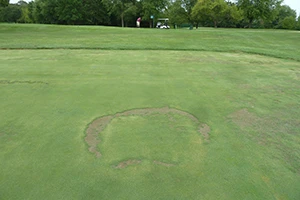
Fairy ring occurs in rings, arcs or patches that can vary greatly in size. The size ranges from several inches to several feet in diameter. Three types of fairy ring are used to describe symptoms and associated turf damage:
- Type 1 = brown rings of dead turf
- Type 2 = green rings of stimulated turf growth
- Type 3 = presence of mushrooms or puff balls
Conditions
At times, fairy ring will break through a preventive fungicide program. Frequently, this occurs during the months of July and August when high air temperatures reach 90-100° F or greater. Curative measures need to be taken quickly because fairy ring often interferes with the ability of soils to absorb moisture and in the heat of summer it doesn’t take much moisture stress to push cool- or warm-season greens over the edge.
Significance
For golf course superintendents, fairy ring represents a ‘double whammy’ on golf greens. Belowground, fairy ring can create a prolific amount of mycelium which leads to hydrophobic soils and/or localized dry spot and then additional hand-watering is required by staff. Aboveground, rings or arcs (can be raised or sunken) and then golfers complain about ball roll. The bottom line is that curative fungicide treatments can help avoid plant damage by fairy ring under heat- or water-stress and this will ensure a smooth putting surface.
Fairy Ring Curative Cultural Practices (top 5)
- Maintain an organic matter reduction program – Core aerification, regular verticutting and sand topdressing
- Avoid stressing turf – Do not mow greens too low; Do not dry out greens too much
- Provide adequate nitrogen – Insufficient nitrogen produces chlorotic turf and this increases fairy ring symptom severity. Excessive nitrogen leads to greater organic matter or more lignin for fairy ring to colonize.
- Use needle tining or spiking – Breaks up mycelial layers associated with hydrophobic soils and improves gas exchange
- Apply wetting agents – Reduces symptoms by alleviating hydrophobic soil conditions
Fairy Ring Curative Fungicide Application Methods
- Find the fairy ring mycelium – Identify the depth of the fairy ring to target active fungi and optimize fungicide applicationsUpper thatch – Application in 2-4 gallons of water volume is adequate
- Thatch or upper mat – Water-in after application using 1/8 to 1/4 inch of irrigation
- Lower mat or soil – Water-in after application using greater than 1/4 inch of irrigation
- Optimal timing of watering-in of fungicides – Immediately or within 10 hours of application
- In summer, select a safe fungicide – ProStar® has been shown to be one of the most effective curative treatments for fairy ring. There are no negative PGR effects from this fungicide and it can be used during summer stress conditions.
- Use the curative label rate – Often curative applications need the high label rate to be effective.Wetting agents and ProStar – The use of wetting agents with fungicides like ProStar have been shown to reduce soil hydrophobicity and increase the effectiveness of curative applications.
References
http://www.backedbybayer.com/system/white_paper/asset_file/39/Solutions_FairyRing.pdf
http://www.backedbybayer.com/system/product_guide/asset_file/74/Product_Prostar.pdf
Derek Settle, Ph.D., Bayer Green Solutions Team
Latest from Golf Course Industry
- Time for discovery
- From the publisher’s pen: ‘Incredibly intentional’
- VIDEO: 'It's their livelihood'
- Reel Turf Techs: TJ Vollmar
- Bernhard and Company names G.C. Duke as North American Distributor of the Year
- Course at Sewanee picks KemperSports for management
- WiTricity expands wireless charging technology
- Shining star