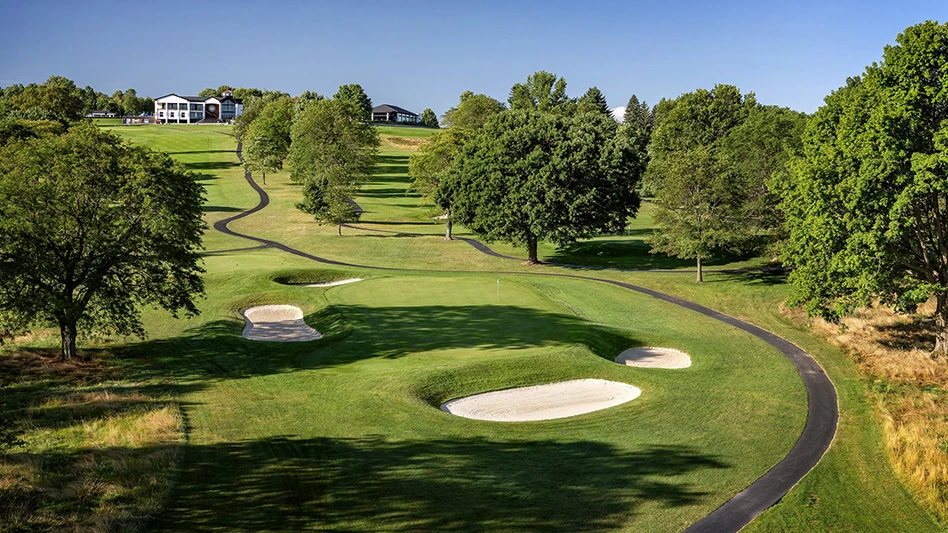
Chris Tritabaugh, superintendent at Hazeltine National Golf Club in Chaska, Minn., is in the enviable position of not currently battling patch diseases at the future site of the 2016 Ryder Cup, but he’s gone a few rounds with the diseases in the past. Entering his seventh season as a superintendent, he fought “significant” take-all patch while at Northland Country Club in Duluth.
“At both Northland and Hazeltine, we are managing bentgrass,” Tritabaugh said. “The presence of take-all patch can be devastating to new bentgrass stands.”
A disease of creeping bentgrass that is often seen on greens, tees and fairways, take-all patch is caused by a root-infecting, soilborne fungus, Gaeumannomyces graminis f.sp. avenae.
According to Tritabaugh, it wasn’t hard to spot, but they leaned on a lab’s expertise to diagnose.
“We would start to notice it as soon as stressful weather showed up,” he said. “The plant’s root system was compromised and thus the affected plants suffered. It was fairly obvious what we had, but we had it diagnosed at the University of Wisconsin lab.”
Tritabaugh’s team treats the greens at Hazeltine in spring and fall with Headway, but he wasn’t as fortunate at his prior course.
“At Northland, we tried to control it culturally, but ended up treating with fungicide last fall after a particularly bad outbreak,” he said. As long as the timing is right, Tritabaugh said, fungicide treatments can be relatively effective.
In addition to treating with fungicide, to prevent further outbreaks Tritabaugh uses acid-based fertilizers and nutrients. Manganese deficiency plays a part in the severity of take-all patch, he said, so he applies manganese on a regular schedule.
With success to his credit, Tritabaugh offered some advice to fellow superintendents who may be facing patch diseases for the first time.
“Start by finding out what you have, then use a combo of fungicide and nutritional treatments to keep the disease at bay,” he said.
“Take-all is a tough one ... you have no idea it’s out there,” he said. “By the time you see the symptoms, it’s too late. At that point, you just have to manage those plants through their weakness.”
Latest from Golf Course Industry
- Tartan Talks 116: Doug Smith
- Audubon International adds 127 golf courses to Monarchs in the Rough
- USGA’s GAP preps for fourth year
- Protect your vehicles from rodent damage
- VIDEO: Fun with fairways
- From the publisher’s pen: Humble giving
- Syngenta adds two to western U.S. team
- The Aquatrols Company introduces soil surfactant for Canada