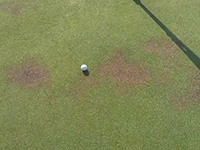
The weather is warming across the country and, with that, golf course superintendents are beginning their battles with patch diseases. John C. Inguagiato, Ph.D., assistant professor, turfgrass pathology in the Department of Plant Science and Landscape Architecture at the University of Connecticut, offered some insight into what can be a difficult fight.
What patch diseases are you seeing as the weather warms?
In the Northeast, symptoms of take-all patch and Waitea patch (syn. Brown ring patch) commonly become apparent at this time of year. Later on, usually around July and August, turf decline due to summer patch and brown patch becomes more prevalent.
Are certain diseases more prevalent in one region or another, or on specific turfgrasses?
Take-all patch is generally limited to bentgrass greens, tees and fairways, particularly new construction or fumigated areas. Summer patch affects annual and Kentucky bluegrasses. It tends to be most severe on closely mowed areas, such as greens and fairways, due to reduced rooting potential at low mowing heights. However, Kentucky bluegrass roughs and intermediate cuts are also susceptible. In the Northeast, Waitea patch seems to be limited to annual bluegrass putting greens, although has occasionally been observed on fairways as well.
Have you seen the severity or frequency increase or diminish over recent years?
The incidence of these diseases each year are largely dependent on prevailing environmental conditions. For example, last year in New England, take-all patch seemed to be less problematic. The abnormally warm spring caused soil temperatures to rapidly exceed favorable levels for infection. This year, a similar reduction of take-all severity may be possible in our area since April and early-May were so dry.
What weather conditions tend to bring on the various patch diseases?
Take-all and summer patch symptoms typically become apparent during dry periods in late-spring and mid-summer, respectively. However, environmental conditions for initiation (i.e., infection) of these root diseases are often quite different than those which eventually bring on the symptoms. For take-all patch, infection occurs when soils are wet and cool; once soil temperatures exceed approximately 65 F growth of the pathogen slows. Summer patch generally begins to infect roots when soils are wet and temperatures consistently reach 65 F. In contrast to take-all, the summer patch pathogen may continue to infect roots throughout the summer.
In the lab, have you seen certain products work better than others?
We are not actively evaluating products for patch disease control. However, strobilurin and DMI fungicides often provide the most effective control patch diseases.
Are there new methods or products on the horizon for treating and preventing the various patch diseases?
Patch diseases like take-all and summer patch often re-occur in the same locations each year. Some superintendents, with limited patch disease problems, have found success using GPS to mark patches, and spot treat according to GPS coordinates the following year.
Any advice you can provide superintendents on how to prevent the various patch diseases?
Correct poor drainage areas and remove excessive thatch since these conditions increase soil water that is necessary for root infections. Soil pH greater than 6.8 increases the severity of take-all and summer patch. Ammonium based fertilizers can provide a rapid, short-term decrease of soil pH at the root, which can help reduce these diseases. If possible, avoid using topdressing sand or irrigation water with a high pH. Where a history of patch diseases exists, apply fungicides preventively once afternoon soil temperatures consistently reach 40 degrees for take-all patch or 65 degrees for summer patch.
Once they show up on the course, any advice you can provide to treat the various diseases?
Since roots of take-all and summer patch affected areas are compromised, it is often necessary to fertilize and hand water more frequently to sustain plant growth and encourage recovery.
On summer patch, specifically, perception is that once it appears, it's too late to treat curatively. Is this true or is there hope?
Curative fungicide applications for summer patch will not likely eliminate the symptoms, but since the pathogen may continue to infect new roots throughout the summer, they are certainly important to help arrest further turf decline and spread of the disease. An application of an ammonium based fertilizer, immediately watered in to minimize burn, can also help encourage recovery.
Latest from Golf Course Industry
- Tartan Talks 116: Doug Smith
- Audubon International adds 127 golf courses to Monarchs in the Rough
- USGA’s GAP preps for fourth year
- Protect your vehicles from rodent damage
- VIDEO: Fun with fairways
- From the publisher’s pen: Humble giving
- Syngenta adds two to western U.S. team
- The Aquatrols Company introduces soil surfactant for Canada