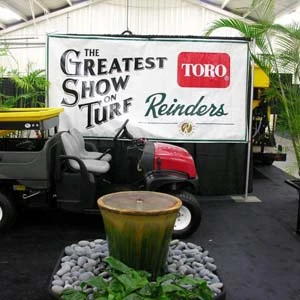
“I must be out of my mind,” I grumbled to myself as I crawled along I-94 in a late winter blizzard. My destination was the 2011 Reinders Turf and Irrigation Conference, scheduled for March 9 & 10 in a western Milwaukee suburb.
This was the 40th year of the Reinders conference, which has been held every other year since 1973. At least a little of my motivation to travel in lousy weather was to maintain my record of perfect attendance over all those years. Their first conference was held the same year as my first year as a golf course superintendent – we have a shared history!
In the scheme of their history, the Reinders conference is a relatively recent development. The company is family-owned and the current management is the fifth generation. I had the pleasure to meet Roland Reinders years ago – he was the third generation of the family to operate the business – and I did business throughout my career with his sons Bob and Dick. For a while the company was known as Reinders Bros, which would be a misnomer today. The management team consists of brothers and sisters and cousins!
The company was started in 1866, selling groceries and general merchandise. Located in Elm Grove, just outside of Milwaukee, it has changed its business focus over the years, a key to its continued prosperity. John Reinders, the first generation, quickly broadened his lines to include service and supplies needed by area farmers. A feed mill allowed them to grind and formulate dairy, beef, pork and poultry rations in the 1880s and beyond. Coal, coke and fuel oil were required by a growing Milwaukee, and Reinders became a major supplier to homeowners and businesses as well.
As years went by, the ability of the family to sense and embrace product lines demanded by a changing society grew their business. They became a major blender of grass seed in the Midwest under their name and logo, and also moved into the wild birdseed business. They even rode the snowmobile craze for a period of time as a distributor.
Lots of companies carry family names, often into maturity when no family members even work there. In our business John Deere and Jacobsen come to mind. You have undoubtedly heard the old rule of thumb of family businesses – the first generation starts the company, the second generation grows it and the third generation either sells it or manages to lose it somehow.
The Reinders family has carefully avoided that. I have heard of their monthly meetings where issues are openly discussed, concerns vented and problems solved. I have also learned of their participation in a Marquette University program for family businesses. It gives family members tools and methods to successfully navigate problems and challenges they will inevitably face – from day-to-day operations to how to transition from one generation to the next. It is a program that leads participants through the pitfalls of delegation, teaches how to avoid failures and instructs on ways to keep alive the business ethics and success of preceding generations. Clearly, they have listened and learned from the Marquette faculty and complemented their own instincts and experiences with that information.
I left for the Army in 1969 and when I came home two years later Reinders was the new Toro distributor for Wisconsin. In the 40 years since, their product lines have expanded greatly to include equipment and supplies for golf, sports turf, landscapes, and all kinds of outdoor living. These days they have six stores in Wisconsin (including offices and warehousing at the same exact site originally established by John Reinders in 1866), three in Illinois, a couple in Minnesota and one in Olathe, Kansas. They also serve as Upper Michigan’s Toro distributor.
It must be a good place to work, too. Undoubtedly the reason I seem to know so many staff people has less to do with decades of doing business with them and more with the fact the 24 former golf course superintendents are on their payroll. Their approximately 150 employees offer over 1000 years of experience with the company.
So, what is it that makes their biennial turf conference so popular? They draw about 1500 people over two days and attendance is consistent despite a snowstorm this year (it wasn’t the first time!) or growing grass and open golf courses other years. I have thought about it a lot over the years because I have been involved in planning meetings for turf and golf organizations I belong to.
Obviously, the main reason people go is to learn something, and the Reinders conference provides lots of opportunities to do this, both for a superintendent and for his entire permanent staff. They literally have something for everyone. The lecturers are always top notch. This year’s impressive roster included Dr. Joe Vargas, always a favorite at any educational venue. He has never missed a Reinders conference, going back to the first in 1973. And every once in a while, Elvis manages to travel with him! Frank Rossi, Roch Gaussoin, Fred Yelverton and John Stier joined him. The program included experts in irrigation and instruction and clinics covering just about any landscape subject you could think of.
Reinders has stayed with the same site since the beginning; everybody knows where it’s at and how to get there. It is also accessible from all quarters of the state as well as Chicago. They trailer in a lot of machinery for those who love kicking tires and who want to see the latest in what is available. It is interesting that there is a waiting list of exhibitors who want to be a part of the Reinders conference when space becomes available – a nice problem to have.
Reinders has kept their conference affordable; it was $49 each day per person this year. They have learned the really important lesson of conference food service, too – generous portions of hot, well-cooked food and a comfortable place to eat. The six buffet lines move quickly, and from arrival to departure, you will never be thirsty! And from your arrival until lunchtime, the Reinders donut maker is going full speed, deep frying breakfast and break snacks for their guests! Door prizes, networking, raffle prizes and freebies all go to helping make a day at their conference a lot of fun, too.
This was my second Reinders conference as an exhibitor, wearing my Wisconsin Turfgrass Association ambassador’s hat. Reinders provided my tabletop, along with one for the WGCSA, gratis; it was truly appreciated. I counted up the turf organizations they supported this past year and came up with 27; they obviously believe in sharing their prosperity.
It doesn’t happen often, but every once in a while someone will grouse a little about what tough competition the Reinders conference is for conferences hosted by professional organizations. It only takes a bit of contemplation to realize that an independent conference, especially like this one, is a complement to our own shows. To argue or complain otherwise is to argue against education. In our state, each group has found its niche. The WGCSA for nearly 50 years has hosted the Wisconsin Golf Turf Symposium, the only true golf symposium in the country. The Wisconsin Turfgrass Association offers its annual Turf Expo to feature our turfgrass faculty and staff, with a couple of guest lectures as well. The focus is on the research underway in our state. Then, on alternate years, we get a broader look at things at the Reinders conference. This approach is especially valuable in years when so many are not able to attend the GIS.
So, if you are ever in our neck of the woods at conference time, call Craig or Mary or Joel or Ann or Laurie. I am sure they would love to have you attend their show. And who knows – maybe Elvis will be in the house again!
Monroe Miller is a regular columnist and contributor to GCI.
Latest from Golf Course Industry
- Texas club enters final stages of renovations
- Troon selected to manage Turtleback Mountain Golf & Resort
- Penn State captures 2026 Collegiate Turf Bowl title
- SiteOne expands LESCO golf portfolio
- John Deere introduces pair of new mechanical rakes
- Wonderful Women 56: Grace Allen
- Toro unveils all-electric greens roller
- VIDEO: Introducing our February issue