Anthracnose is a dirty word around Hyannisport Club superintendent Tom Colombo. He’s had his trials and tribulations with the turf disease over the years, particularly the most damaging “crown rot” version.
“CRA is the most damaging disease on Poa putting green turf that I have experienced in my 26 years as a golf course superintendent in the Northeast,” he says. “The disease is very difficult to control once you have it. It is random in the way that it affects greens one year and not the next. In my experiences, it would never touch the bent, only the Poa. Your best greens the previous year could be your worst the next year. In the past we would utilize special mowers for the CRA greens, sterilize the reels after mowing each green and seed and topdress regularly to maintain playability on thinning greens.”
A few years back, A and G series bentgrass strains were new to the market and touted as more competitive to Poa annua when interseeded. So, with aggressive spike overseeding, topdressing and rolling, the strain worked “very well” and became the basis of Colombo’s anti-anthracnose program.
“Not too long ago, turfgrass pathologists were prescribing heavy DMI applications, higher mowing heights, no PGRs and increased nitrogen levels. Results were costly with very little success,” he says.
In hindsight, he says, the steady flow of DMIs exacerbated the problem over an already weakened turf. “All cultural practices, such as rolling, verticutting and topdressing, were frowned upon.” Coincidentally, today’s recommendations on how to deal with the disease are almost the opposite.
Colombo faced a “good amount of CRA” when he arrived at Hyannisport five years ago. “We got it under control in the first year but we continue to scout for any signs (orange blade tips, irregular pattern). He says that CRA is more active in the spring and in the fall and that disease activity will taper off in the warmer summer months.
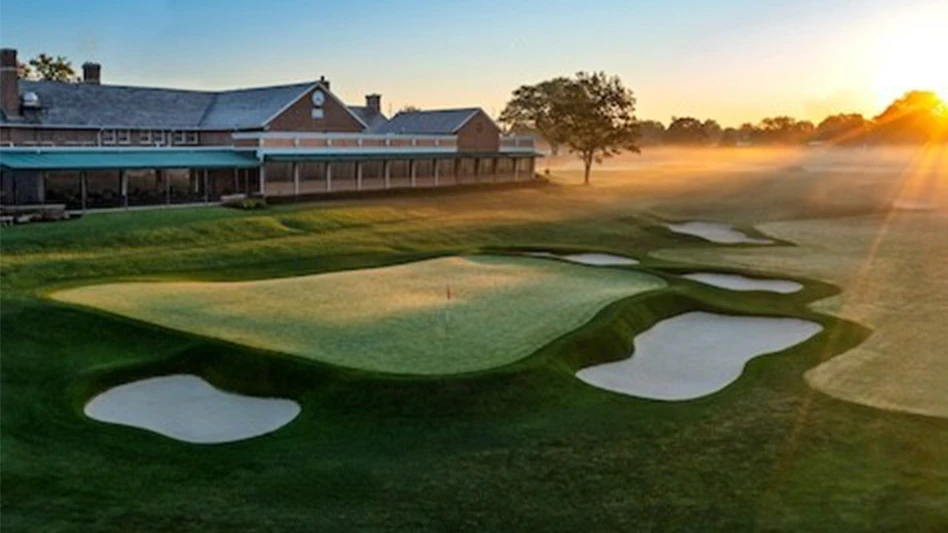
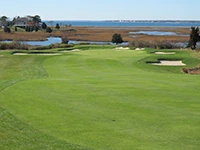
The Hyannisport Club in Cape Cod, Mass., the members of which have been “supportive and appreciative” of Colombo’s efforts, is over 100 years old and supports a predominant mix of annual and perennial Poa bio types with bent in the lower percentage. The Poa annua thrives in the seaside environment on Cape Cod, and Colombo continuously interseeds with A-1/A-4 bents to maintain a viable seedbed and increase the population.
“We like the Blec walk-behind seeder with a light topdressing, because there is a subtle and no real disruption to the putting surface.” Foliar nutrients and biostimulants applied on a regular basis keep the plant growing, and a Signature tank mixed with a rotation of Insignia, Daconil and Interface “helps carry us through the bulk of the growing season.” Preventative applications of Tourney in the early spring and fall helps set the control stage before peak disease activity begins.