.jpg) |
EDITOR'S NOTE: The following article, authored by Doug Houseworth, Ph.D., Turf & Ornamental Technical Manager at Arysta LifeScience North America, is a follow up to a REAL SCIENCE article that ran in the May 2012 issue of Golf Course Industry. CLICK HERE to read that article.
One year ago, the golf course industry learned of a new solution to effectively control Poa annua: Xonerate, a post-emergent herbicide from Arysta LifeScience.
Xonerate helps superintendents control Poa annua, one of the most common and widely distributed winter annual grassy weeds in the world. Specifically, Poa annua is one of the most difficult weeds to control on turfgrass, making Xonerate a welcomed addition to the turf-care arsenals of many superintendents.
The Poa Problem
Poa annua survives as a weed due to its high genetic variability, short life cycle, tolerance of compacted soil, and rapid germination – each Poa annua plant produces between 1,000 and 2,250 seeds in a season that easily can spread from equipment, human or animal contact. Poa annua is especially challenging in creeping bentgrass, which provides conditions that are ideal for its growth, including high moisture, high nitrogen, traffic levels and routine fungicide use.1 Also, Poa annua is very susceptible to diseases, such as anthracnose, and doesn’t tolerate heat well, which means it dies quickly in warm weather, leaving unsightly bare patches during high play times. The effect on golf courses is bumpier-than-normal surfaces, impaired playability and unattractive greens and fairways during the height of the play season.
Xonerate offers a solution to golf course superintendents. Xonerate contains 70 percent amicarbazone in a convenient water-dispersible granule formulation, packaged in 1 oz foil packets, which is absorbed by leaves and roots of Poa annua for quick, residual, post-emergent activity. Xonerate is selective, so it kills the weeds but not the turfgrass. Additionally, numerous university and co-operator field trials have been conducted to examine the performance of Xonerate in diverse geographic areas, under a wide range of climatic and turfgrass conditions. These trials found Xonerate to be 90% effective in controlling Poa annua – more than any product currently on the market1.
An Xonerate Overview
Xonerate offers selective removal of Poa annua in all commonly used cool- and warm-season turfgrasses including creeping bentgrass and Bermuda grass. The mode of action in Xonerate eliminates Poa annua with little to no disruption to the growth of bentgrass. Xonerate is absorbed by leaves and roots of Poa annua, where it inhibits photosynthesis by interfering with normal electron transport. Subsequent cell membrane and chlorophyll loss occurs. Poa annua initially becomes chlorotic (loss of green color), followed by necrosis (browning of plant tissue). Turfgrass remains mostly the same, with some possible discoloration at first, lasting about two weeks, as it fills back in the bare spots left by the Poa annua. Poa annua control occurs over a three- to four-week time period.2
Xonerate may be tank-mixed (water is the recommended liquid carrier). It can be applied up to four times at a 1 oz/A rate for bentgrass. (KBG and KBG/ryegrass mixtures up to 2 oz/A rate at two applications.). It should be used on turf that has smaller percentages of Poa annua (less than 10% Poa annua population), while transitioning to desirable turfgrass. To quote Dr. Fred Yelverton, professor of weed science at North Carolina State University: “Be careful what you ask for; Xonerate will take out Poa annua; make sure you can live with that.” Creeping bentgrass can be re-seeded as soon as seven days after the last application in roughs, fairways and tees.
Elimination of Poa annua also should include a management program that incorporates frequent topdressing, proper nutrient balance in the soil, proper soil pH and good water control (not overwatering) tailored toward encouraging optimum bentgrass growth and quality.3
Looking Ahead at Xonerate's Second Year
Via ongoing research and data gathering, Arysta LifeScience continues to review results for Xonerate heading into its second year on the market. Many superintendents and other lawn care operators have seen successes in controlling Poa annua using the product, and they have plans to continue using Xonerate for a second consecutive year. Additionally, there have been others who are looking to make good results even better heading into the upcoming season.
Arysta LifeScience offers the following recommendations for Xonerate in year 2:
- Application at 7-14 day intervals – Initially, this was recommended at just 7 days in 2012 but has an expanded window for 2013 to give users more flexibility. Superintendents should repeat the application at 7- to 14-day intervals for a maximum of four applications (applications should cease once Poa annua control is at an acceptable level, no Poa annua remains, or after a maximum of four applications).
- Poa annua at less than 10% -- Specifically, Xonerate can be applied up to four times at a 1 ounce per acre rate for bentgrass. It should be used on turf that has smaller percentages of Poa annua (less than 10 percent Poa annua population) while transitioning to desirable turfgrass. Rates and applications will vary by turf type, and superintendents should refer to the product label.
- No surfactant – Ongoing research shows a nonionic surfactant is not a requirement with Xonerate. For those superintendents who have utilized them in the past, good results also have been obtained with usage of a surfactant in creeping bentgrass fairways when a light irrigation (approx. 0.1-0.2 inches of water) has been applied immediately after application.
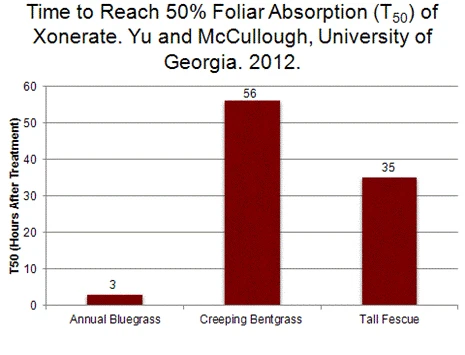
- Water 3-4 hours following the Xonerate application – University research shows Poa annua takes up the most Xonerate in 3-4 hours; whereas, it takes 56 hours for bentgrass to take up the same amount. Thus, by watering in after 3-4 hours, Poa annua takes up a lethal amount, and much of the Xonerate is washed off the bentgrass blades.
- If needed, irrigate before the Xonerate application – Additional research has shown irrigation before applying Xonerate will be beneficial if the turf is at a low moisture level. Again, superintendents should follow local recommendations regarding the amount of moisture recommended for their turf and climate.
- Do not apply Xonerate to juvenile turf – The Xonerate label states not to apply the product within six months of new seeding. Additional research has shown that sometimes, due to cultural practices, newly seeded bentgrass is not hardened off and established after six months. Superintendents should use their best judgment with their weather conditions and keep a keen eye on the maturity of their bentgrass to determine whether or not to use Xonerate.
- Confirm the turf has a well-developed root system – This is a new recommendation for the second year of Xonerate. A well-developed root system is a good indication the bentgrass is mature enough to take an Xonerate application without a decrease in turf quality.
- Maintain soil moisture throughout Xonerate applications – Arysta LifeScience recommends consistent amounts of moisture for actively growing bentgrass prior to and throughout the application period.
- Assess your turf’s overall stress – Turf stresses should be addressed prior to applying Xonerate. Treatment is likened to a marathon runner – a long-distance runner would not go from no training to a full marathon in a single day. Xonerate treatment should be approached similarly; have all insect, weed, and disease control programs, as well as any other turf management programs, in place before an Xonerate application.
Summary
Again in 2013, golf course superintendents have a choice to manage Poa annua or eliminate it with Xonerate Herbicide. Poa annua management requires intense practices that are costly in terms of labor, water usage and fungicide/insecticide applications. At a cost of “X” per acre, the total cost of Xonerate is “X” in herbicide plus any additional monies in seed and fertilizer minus the reduced input needed to maintain Poa annua throughout the playing season. The first year cost will be the largest initial increase in budget expenses, and annual maintenance applications of Xonerate will be required to maintain a clean stand of bentgrass in subsequent years.
Golf course superintendents also need to be aware that Xonerate is recommended only for spring applications to creeping bentgrass fairways. Fall applications or applications in the summer months can adversely injure creeping bentgrass. Key reminders for successful use of Xonerate on creeping bentgrass fairways include:
1.Use 1.0 oz/A of Xonerate 70 WDG or 1.0 fl. oz/A of Xonerate 70 WDG.
2.Use four applications on 7-14 day intervals.
3.Use on fairways with an annual bluegrass infestation of less than 10 percent.
4.Apply Xonerate at air temperatures of 55 to 80 degrees F.
5.Do not apply amicarbazone to creeping bentgrass when the daytime air temperature is expected to exceed 80 degrees F, or immediately before or after periods of higher air temperatures.
6.Do not add a surfactant.
7.Lightly (0.1-0.2 in.) water-in Xonerate 3-4 hours after application.
8.Do not apply to drought-stressed creeping bentgrass; irrigate 1-2 days before application if needed.
9.Alter spray application patterns for repeat applications.
10.Do not improperly overlap spray patterns.
11.Do not apply to juvenile creeping bentgrass.
To learn more about Xonerate Herbicide and Arysta LifeScience, please visit www.eliminatepoa.com or contact your Arysta LifeScience territory sales manager.
About the author
Doug Houseworth, Ph.D., is Turf & Ornamental Technical Manager at Arysta LifeScience North America
# # #
1 Grounds Maintenance, Controlling Poa annua in bent grass greens by Bert McCarty, Clemson University, Dec. 22, 2011.
2 Rates and applications will vary by turf type and geography.
3 USGA Green Section Record, The Continuing Saga of Poa annua May/June 1987.
Latest from Golf Course Industry
- Tartan Talks 116: Doug Smith
- Audubon International adds 127 golf courses to Monarchs in the Rough
- USGA’s GAP preps for fourth year
- Protect your vehicles from rodent damage
- VIDEO: Fun with fairways
- From the publisher’s pen: Humble giving
- Syngenta adds two to western U.S. team
- The Aquatrols Company introduces soil surfactant for Canada